 The Civil War Day By Day An Almanac, 1861-1865 The most exhaustively detailed and fascinating book on the American Civil War of its kind. Not only does it provide a day-by-day look at the major events of the war, but lists so many of the small skirmishes and actions as well. Accurate and enjoyable |
American Civil War Summary
|
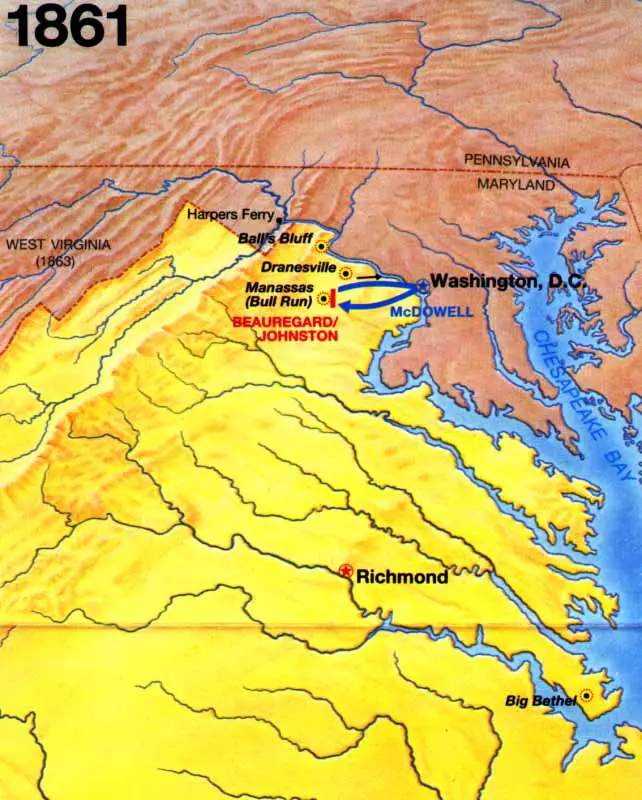
Where the Armies Fought More than 10,000 military actions of one kind or another took place during the Civil War. Only a small percentage were big battles like Gettysburg or Vicksburg; most were relatively small affairs, many of them forgotten today. The following breakdown by State shows where most of these events took place. Eastern TheaterLike a bolt of lightning out of a darkening sky, war burst upon the American landscape in the spring of 1861, climaxing decades of bitter wrangling and pitting two vast sections of a young and vigorous nation against each other. Northerners called it the War of the Rebellion, Southerners the War Between the States. We know it simply as the Civil War. In the East, beginning in the spring of 1861, the cry from Union headquarters was "On to Richmond!" For the next four years a succession of Northern commanders struggled desperately to do just that -- get to Richmond. One well-designed effort in 1862 used the mammoth naval might of the Union to reach the vicinity of the Confederate capital by water routes. The other attempts stubbornly slogged across a narrow central Virginia corridor and sought to disperse tenacious Southern defenders who seemed always to be athwart the path. Confederate successes offered occasional opportunities to take the war north into Maryland and Pennsylvania and to threaten Washington. Both sides came to see the enemy army as the proper goal, and both recognized the obligation of the enemy army to defend its respective capital city against military threats. The consequence was four years of war fought to the death mostly in a relatively small strip of Virginia countryside between Washington and Richmond. When the guns were finally silenced in the spring and early summer of 1865 and the authority of the Federal Government was once again restored, the Union had been permanently scarred. As Mark Twain put it, the war had "uprooted institutions that were centuries old ... transformed the social life of half the country, and wrought so profoundly upon the entire national character that the influence cannot be measured short of two or three generations." Click to enlarge The high spirits with which North and South naively go to war after the attack on Fort Sumter first meet the test of battle on a large scale in mid-July as Union troops under Brig. General Irvin McDowell clash with Confederate soldiers under Gen. Joseph E. Johnston and Brig. Gen. P.G.T. Beauregard on the plains of Manassas, Virginia. A sweeping Confederate victory in what Southerners call the First Battle of Manassas (the North calls it Bulls Run) inspires the Federal Government to renewed effort and makes the South over-confident. For the rest of the year the contending armies remain static between Manassas and Washington, giving Union Major General George B. McClellan plenty of time to organize and train his new Army of the Potomac. A small Federal force overwhelmed and crushed at Ball's Bluff, Virginia, in October includes a friend and ally of President Abraham Lincoln, so the political repercussions of that battle outstrip its military significance. In December, Confederate cavalry leader J.E.B. Stuart fights a small affair at Dranesville, Virginia. All of the 1861 actions combined do not equal in scope a single day of the famous battles fought later in the war.
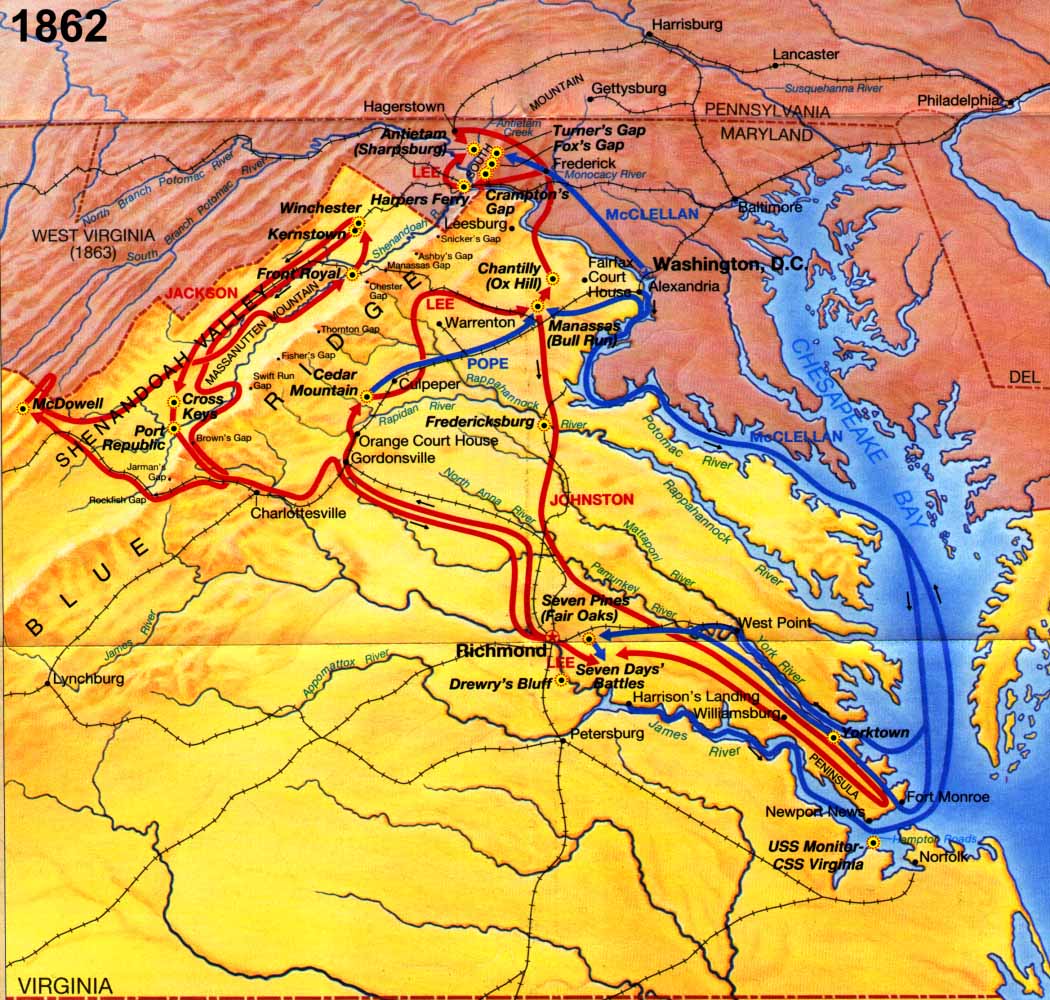
1862 Eastern TheaterJoe Johnston's Confederates abandon their long-held lines around Manassas in early March and withdraw toward Richmond. McClellan's Army of the Potomac moves by water to Fort Monroe and Newport News at the tip of the Virginia peninsula and prepares to march on Richmond some 70 miles to the northwest. Confederate delaying tactics and heavy rains slow McClellan's advance and it is nearly two months before he comes within sight of the city's steeples. When a Southern offensive at Seven Pines on May 31-June 1 fails to dislodge the Federals and Johnston is wounded, Robert E. Lee assumes command of the Army of Northern Virginia and drives McClellan's troops away from the Southern capital in the Seven Days' Battles. Victories during August by Maj. Gen. Thomas J. "Stonewall" Jackson at Cedar Mountain and by Lee's army at the Second Battle of Manassas push the Federals back to the outskirts of Washington. Within nine weeks, Lee has transferred the war from his own capital to the edge of his enemy's. A Confederate offensive across the Potomac is halted and turned back after battles at South Mountain and Antietam (Sharpsburg), Maryland, in mid-September. The final action of the year ends in Federal disaster when McClellan's successor, Major General Ambrose E. Burnside, throws his army against Lee's near Fredericksburg, Virginia, in a series of frontal assaults that are easily and bloodily repulsed. March 9 USS Monitor vs CSS Virginia in Hampton Roads, Virginia First naval battle between ironclad vessels.
Apr 5-May 4 McClellan's Army of the Potomac begins Peninsula Campaign toward Richmond.
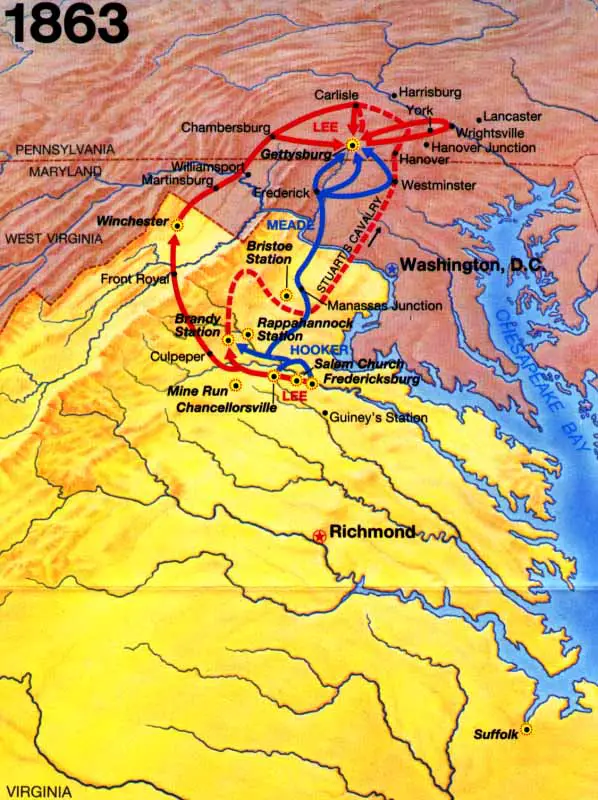
1863 Eastern TheaterThe 1863 campaigns open along the Rappahannock in the final days of April as Burnside's replacement, Major General Joseph Hooker, leads the Army of the Potomac upstream to slip around Lee's left flank. Lee responds aggressively and during the first week of May wins what has been called his greatest victory. That victory is costly, because, Stonewall Jackson is mortally wounded, but it gives the Confederate the opportunity to march northward into Pennsylvania. The Army of the Potomac follows, and, now under Major General George G. Meade's direction, gives Lee a stinging defeat at Gettysburg on July 1-3. After Lee's retreat into Virginia, both armies spend the next three months recuperating while the military frontier alternates between the river lines of the Rappahannock and Rapidan west of Fredericksburg. Both armies are also reduced in strength as troops are ordered west to bolster operations around Chattanooga. Lee's attempt to turn Meade's flank in October crests in defeat at Bristoe Station. A similar move by Meade south of the Rapidan culminates in stalemate at Mine Run at the end of November.
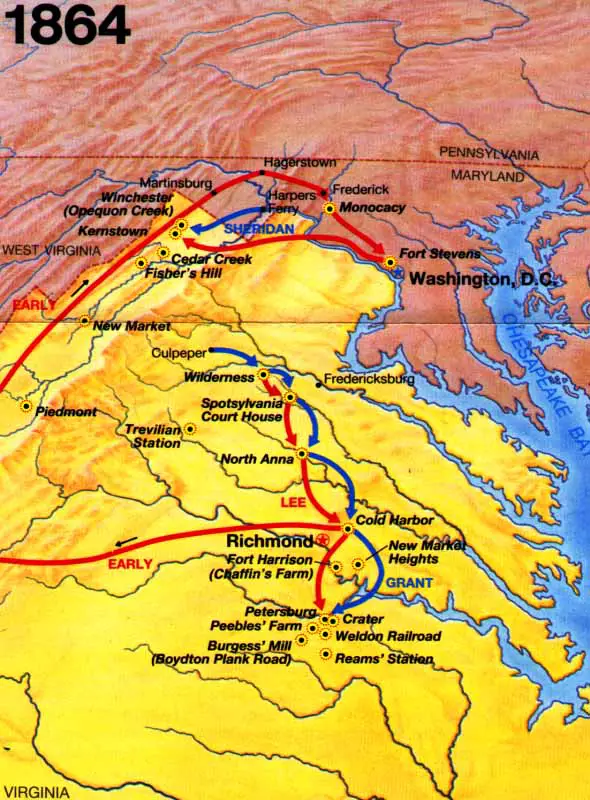
1864 Eastern TheaterThe last full year of campaigning in the east begins with Federal forces east and west making a unified effort to wear down the South's will to continue fighting. Lincoln has given Ulysses S. Grant the received rank of Lieutenant General and placed him in command of all Union armies. His mission: destroy Joe Johnston's Army of Tennessee and Lee's Army of Northern Virginia. Leaving Major General William T. Sherman to deal with Johnston, Grant concentrates on Lee. Their first encounter, the Battle of the Wilderness, opens on May 5 and for the next 40 days the armies remain locked in a deadly embrace. The course of the fighting leads through Spotsylvania Court House, across the North Anna River to Cold Harbor, and finally to Petersburg. There the opponents settle down to a siege, punctuated by Grant's relentless efforts to outflank the Confederates and seize vital transportation arteries. His attempt to capture Petersburg outright fails at the Battle of the Crater. Meanwhile, Lt. Gen. Jubal Early's Confederate troops expel Union forces from the Shenandoah Valley and march to the outskirts of Washington, before being turned back at Fort Stevens. Outnumbered but defiant, they return to the Valley where, in a series of hard-fought engagements, Major General Philip Sheridan erases Early's army from the war.
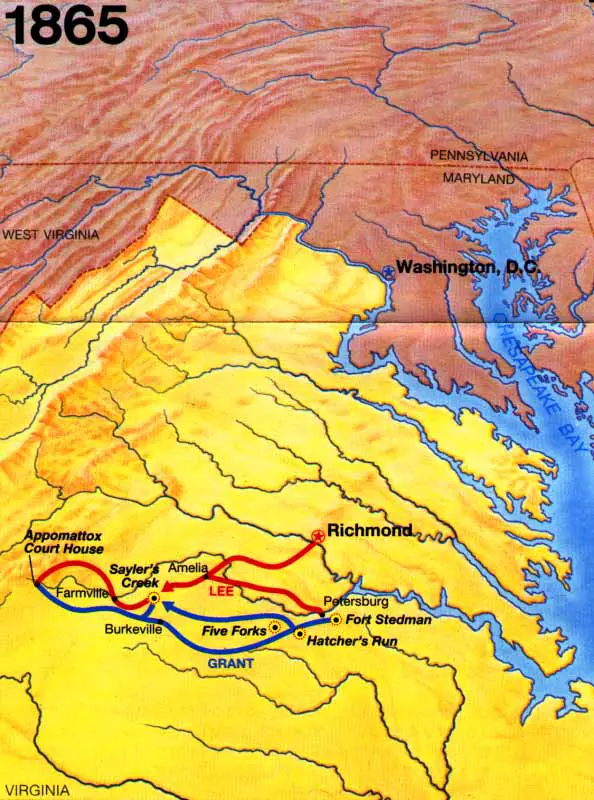
1865 Eastern TheaterThe year opens with both armies largely inactive and still entrenched around Petersburg. With each passing week, the hopelessness of Lee's cause becomes more apparent. Early in February, Grant sends his cavalry and infantry south and west of Petersburg in an attempt to sever the only remaining supply lines into the city and to force Lee to extend his already strained defensive positions. Confederate attempts to halt the movement are checkmated at Hatcher's Run. As March begins, Lee realizes that he cannot hold the Petersburg-Richmond lines much longer. On the 25th he makes a desperate attempt to extricate his army by attacking Federal Fort Stedman east of Petersburg. The attempt fails and Lee tells President Davis: "I fear now it will be impossible to prevent a junction between Grant and Sherman...." Shortly thereafter, the Federals achieve the inevitable and break the thin Confederate defenses at Five Forks, southwest of Petersburg. Lee evacuates the city and Richmond falls. his forlorn retreat lasts one week until Grant cuts off the remnant of the Army of Northern Virginia at Appomattox Court House. Lee's surrender on April 9 signals the early end of the Confederacy.
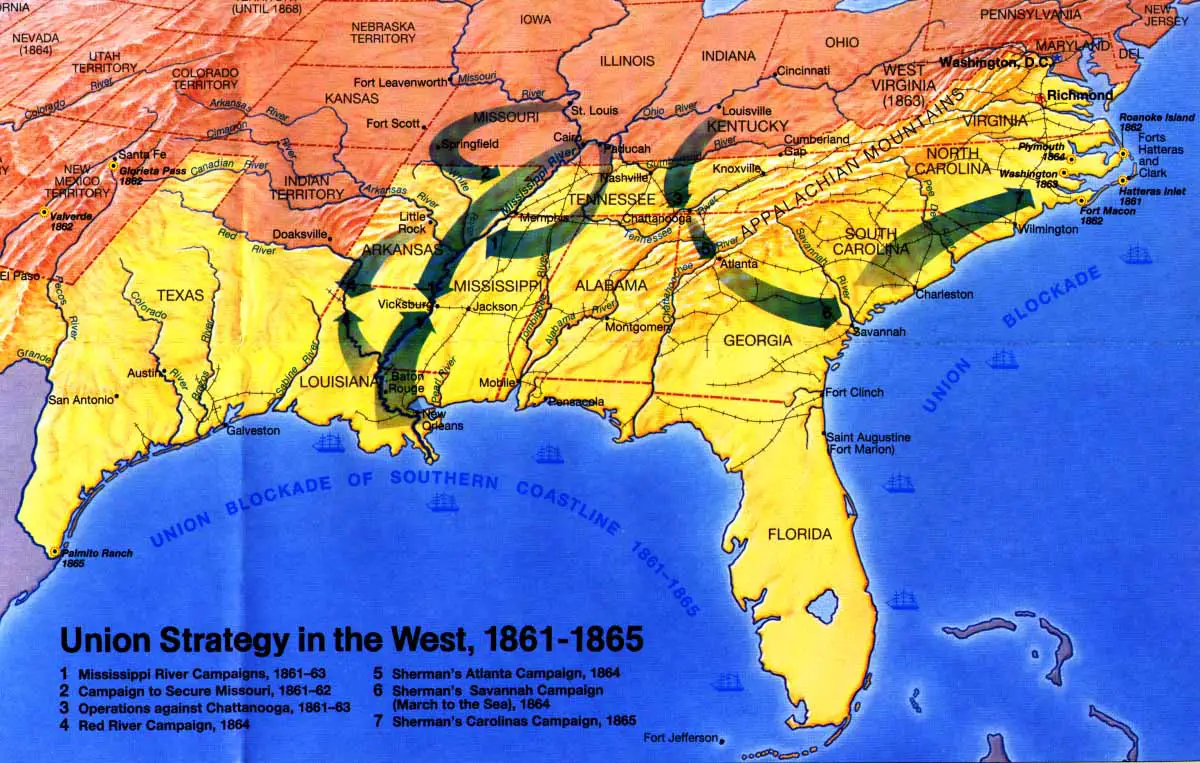
Click to enlarge When the Civil War began, the Confederacy possessed fewer military resources and pursued principally a defensive posture while the Union took a more aggressive role. Northern strategy was directed at keeping the Border States of Kentucky and Missouri (along with Delaware and Maryland in the East) within the Union; starving the South by blockading her coastline from Virginia to Texas; regaining control of the Mississippi; and dividing and subdividing the Confederacy. The Border States were secured by the spring of 1862 and a string of Union victories--Forts Henry and Donelson, Pea Ridge, Shiloh, Island No. 10, and New Orleans--caused many to believe that the Confederacy was finished. The North's blockade of Southern ports to deny the Confederates access to much-needed foreign war material and manufactured goods and to keep them from exporting cotton was slow to take effect. But each year the blockade continued to tighten and more and more Confederate ports fell to Union forces. Union amphibious operations to regain control of the Mississippi River began in 1862 and, although initially thwarted, eventually culminated in Grant's successful Vicksburg Campaign of 1863 and the subsequent fall of Port Hudson. This not only closed down the South's most important commercial waterway; it also severed the Confederacy on a north/south axis. By 1864, with the development of a unified command system, Northern strategy focused on cutting the Confederacy along an east/west axis in order to destroy its food supply and its war-making industrial capacity in the deep South. Sherman's Atlanta Campaign and his subsequent March to the Sea achieved the desired results by the end of the year. By early 1865, with Sherman's troops pushing northward into the Carolinas, it was clear that the days of the Confederacy were numbered.
Click to enlarge
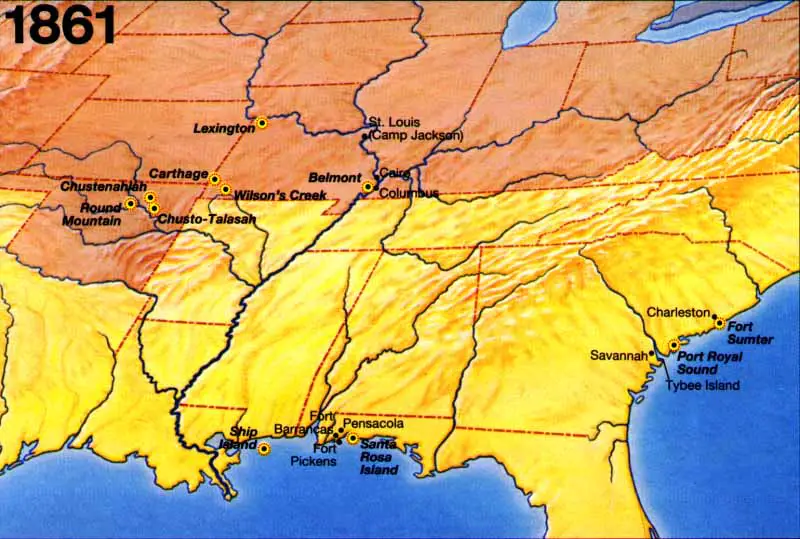
1861 Western TheaterConfederate strategy in the early months is mainly defensive in the face of Federal efforts to retain control of the slave-holding Border States of Delaware, Maryland, Kentucky, and Missouri; to tighten a blockade of the Southern coastline; and to regain control of the Mississippi River from Cairo, Illinois, to the Gulf of Mexico. In Missouri, in a lightning-like campaign, Brig. General Nathaniel Lyon crowds the Missouri State Guard into the southwestern part of the State before being killed and his army defeated at Wilson's Creek in August. The Missouri State Guard moves on the besiege and capture Lexington, but retires into southwest Missouri when threatened by Federal columns converging from the east and west. A union army is defeated at Belmont, Mo., early in November--the first test of battle for a rising young brigadier general named Ulysses S. Grant. Along the Southern coasts, Federals cling to several forts and employ their power afloat to seize and establish additional fortified enclaves at Hatteras Inlet, North Carolina, Port Royal Sound, South Carolina, and Ship Island, Mississippi. These enclaves not only provide bases for blockading squadrons but serve as spring boards for future amphibious operations. Click to enlarge 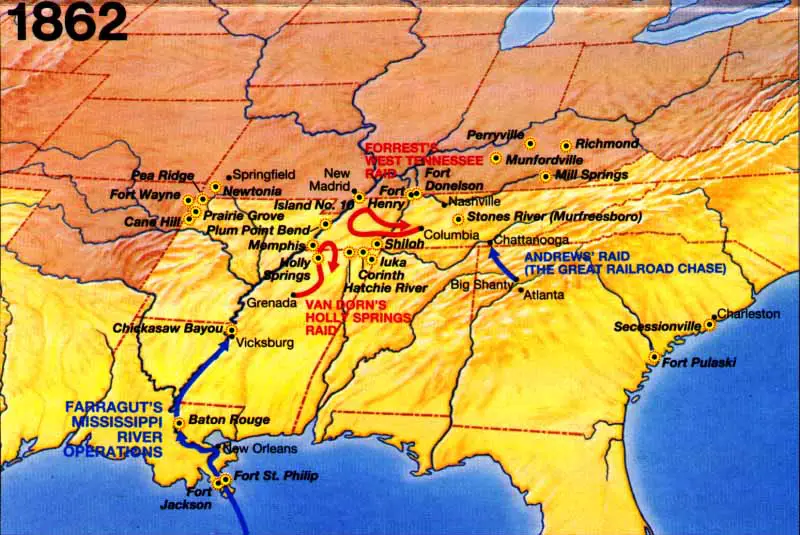 1862 Western TheaterFrom January through June, Union forces thrust deep into the South, forcing Confederates to abandon southern Kentucky, much of Middle and West Tennessee, and southwest Missouri following defeats at Mill Springs, Kentucky, Forts Henry and Donelson, Tennessee, and Pea Ridge, Arkansas. Early in April, Gen. Albert Sidney Johnston's army assails Federal troops under Grant at Pittsburg Landing, Tennessee, But Johnston is killed and his army beaten in the two-day battle of Shiloh. In Mississippi in June, Union amphibious forces converge on but fail to capture the Confederate stronghold of Vicksburg. July brings a dramatic change in the tide of war as Confederate armies invade Union territory from the trans-Mississippi to the Atlantic seaboard. By early October, however, the offensives are halted, and during the last two months of the year Federal forces are again pressing ahead. In Middle Tennessee on December 31 Maj. Gen. William S. Rosecrans' Union army confronts Gen. Braxton Bragg's Confederate army at Stones River in a battle that lasts into the new year. In north Mississippi, Grant's attempts to take Vicksburg are thwarted by slashing Confederate cavalry raids on his supply lines. The blockade tightens as Union forces capture Roanoke Island and Fort Macon on the North Carolina sounds and bombard Fort Pulaski, Georgia, into surrender. Click to enlarge 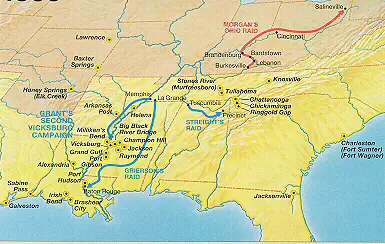 1863 Western TheaterGrant's efforts to capture Vicksburg are finally rewarded on July 4 when, after one of the great campaigns of military history and a 47-day siege, the Confederacy's mighty bastion succumbs to Union arms. Five days later Port Hudson surrenders and Lincoln proclaims "The father of Waters again goes unvexed to the sea." The South is cut in half along the Mississippi. Meanwhile, Rosecrans' brilliant Tullahoma Campaign forces Bragg to abandon most of Tennessee and concentrate around Chattanooga. In September Rosecrans occupies Chattanooga and pursues Bragg into Georgia,where, at Chickamauga Creek, the Confederates turn on the Northerners and drive them back. To relieve the beleaguered Federal troops, the Union Government rushes reinforcement to Chattanooga, names Grant to command in the west, and replaces Rosecrans with Maj. Gen. george H. Thomas. In several battles around Chattanooga between October and November, Grant's armies defeat Bragg's troops, forcing them to retreat to Dalton, Georgia, where Bragg is succeeded in command be Gen, Joseph E. Johnson. The two-week siege of Union-occupied Knoxville by Lt. Gen. James Longstreet's Confederate troops ends December 3 with the approach of a relief column led by General Sherman. Charleston, under attack much of the year, enters the third winter of the war battered but unconquered. January 1-2 Battle of Stones River, Tennessee, continued.
April - September- Operations against Defenses of Charleston, South Carolina
May 21-July 9 Siege and surrender of Port Hudson, Louisiana June 23-July 4 Tullahoma Campaign, Tennessee
July 10-16 Siege of Jackson, Mississippi July 17 Battle of Honey Springs (Elk Creek), Indian Territory
November-December Knoxville Campaign, Tennessee
Click to enlarge 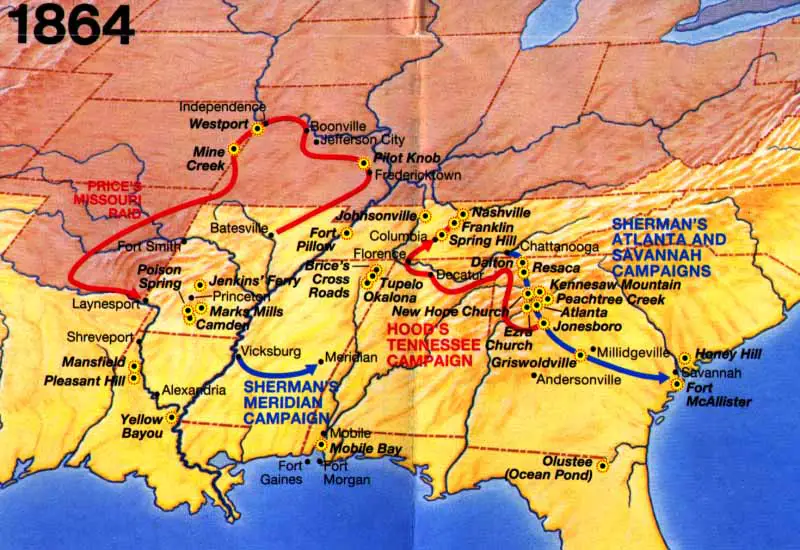 1864 Western TheaterUlysses S. Grant, promoted to lieutenant general and transferred East to command all Union armies, calls for a war of attrition against the Confederacy's two principal armies: Robert E. Lee's Army of Northern Virginia and Joseph E. Johnston's Army of Tennessee. Early in May, with Atlanta as his objective, Sherman, Grant's successor in the West, attacks Johnston at Rocky Face Ridge west of Dalton. For the next eight weeks the two armies grapple their way south into central Georgia. On July 17, With Sherman's armies approaching Atlanta, Confederate President Jefferson Davis fires Johnston and replaces him with Gen. John B. Hood. Hood Abandons Johnston's defensive strategy and boldly sends his troops to attack Sherman in a series of costly battles that only serve to underscore the futility of such tactics. On September 1, after a long siege by Sherman's soldiers, Atlanta is evacuated and Hood withdraws, regroups, and advances into Tennessee. Within three months his Army of Tennessee is virtually destroyed in battles at Spring Hill, Franklin, and Nashville. Meanwhile, in mid-November, Sherman burns Atlanta and begins his famous "March to the Sea." Elsewhere, the blockade continues to tighten as Union amphibious forces seize the forts guarding the entrance to Mobile Bay and Admiral Farragut's ocean-going squadron crushes a Confederate fleet. February 3-March 4 Meridian Expedition, Mississippi
June 10 Battle of Brice's Cross Roads, Mississippi
Click to enlarge 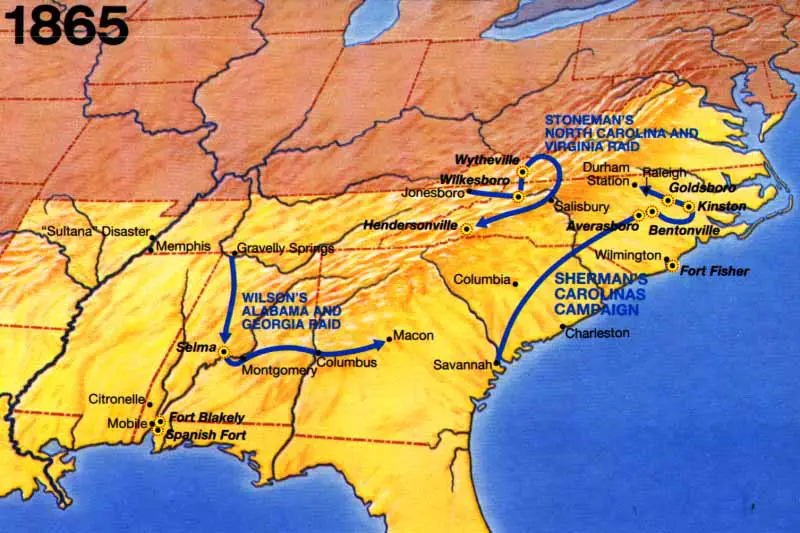 1865 Western TheaterThe year begins with Union forces capturing Fort Fisher guarding the approaches to the Cape Fear River and Wilmington, North Carolina. Wilmington is occupied February 22, the same day that Joseph E. Johnston is restored to the command of what is left of the Army of Tennessee and given the impossible task of stopping Sherman's armies then sweeping northward through South Carolina. Sherman's troops occupy Columbia on February 17 and compel the evacuation of Charleston that evening. Entering North Carolina, Sherman defeats Johnston at Averasboro and at Bentonville. At Goldsboro, Sherman is joined by Maj. Gen. John M. Schofield's force, fresh from victory at Kinston. The outnumbered Johnston surrenders his troops to Sherman on April 26, at durham Station. Meanwhile in Alabama, Mobile falls to Federal forces while Maj. Gen. James H. Wilson's Union cavalry corps sweeps through Selma and Montgomery and on to Columbus and Macon, Georgia. Near Irwinville, Georgia, on May 10, his troopers capture Confederate President Jefferson Davis, who had fled Richmond when that city was evacuated on April 2. From Jonesboro, Tennessee, Maj. Gen. George Stoneman and his 4,000 cavalrymen raid eastward across the Appalachians into southwest Virginia and North Carolina's Piedmont region. By June 23, the last Confederate army is surrendered and the long war is finally over.
April 2 Battle of Selma, Alabama April 9 General Robert E. Lee Surrenders to General Ulysses S. GrantMay 4 Surrender of Lt. Gen. Richard Taylor's Confederate forces at Citronelle, Alabama May 12-13 Battle of Palmito Ranch, Texas Last Civil War land engagement. May 26 Surrender of Lt. Gen. E. Kirby Smith's Confederate forces at New Orleans, Louisiana June 23 Surrender of Brig. Gen. Stand Watie's Confederate Indian forces at Doaksville, Indian Territory. |
 Civil War Soldier 102 Piece Playset
|
Civil War Home Page Kids Zone Causes of the War Kids Zone Underground Railroad Young Reader Selections Civil War Timeline Women in the War Civil War Documents State Battle Maps Picture Album Civil War Maps |
 Civil War Musket Wood & Steel Frontier Rifle Designed After The Original Rifle, This Civil War Musket replica has been designed after the original rifle of its era. Measures approximately 37 inches long. Each is constructed with a solid one-piece wood stock, painted steel barrel and die-cast parts. |
Resource:
National Park Service
U.S. Department of the Interior
|
Battle of Shiloh Civil War Map First Manassas Civil War Pictures Civil War Cooking Gettysburg Civil War Ships |