|
|
|
|
Kindle Available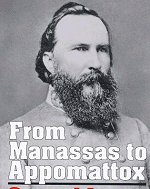 From Manassas to Appomattox: General James Longstreet According to some, he was partially to blame for the Confederate defeat at Gettysburg; according to others, if Lee had followed Longstreet's advice, they would have won that battle. He has been called stubborn and vain; and he has been lauded as one of the greatest tacticians of the Civil War  Extraordinary Circumstances The Seven Days Battles One of the most decisive military campaigns in Western history, the Seven Days were fought in the area southeast of the Confederate capitol of Richmond from June 25 to July 1, 1862  This Terrible Sound The Battle of Chickamauga Study of the great bloody battle of Chickamauga that was the last great offensive, although costsly, victory by the Confederates. This is a detailed account of the movements of regiments, brigades, divisions. |
Supplement to the Gettysburg Battlewalk: Lee and LongstreetAmericanCivilWar.com's Joe Ryan reviews the issue of Longstreet's relationship with General Lee.Part One Part Two View all the Joe Ryan Original Battlewalks |
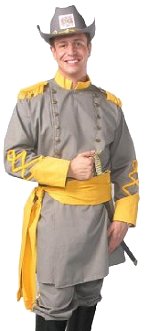 Adult Confederate Officer Uniform |
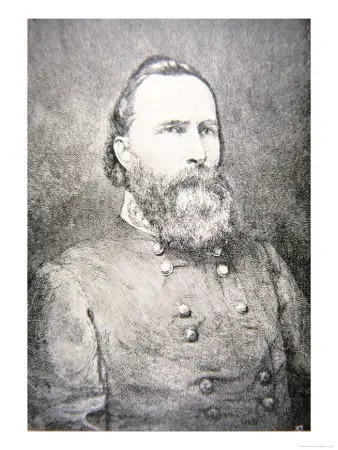 Portrait of General James Longstreet 18 in. x 24 in. Buy at AllPosters.com Framed Mounted |
 |
 "We Shall Meet Again": The First Battle of Manassas (Bull Run), July 18-21, 1861 The First Battle of Manassas claimed the lives of approximately 878 soldiers and wounded another 2,489. With a battlefield stretching nearly five miles, 15,000 Union and 14,000 Confederate soldiers clashed for four fateful days, many of them young and terrified and receiving their first taste of a long and bitter war |
 Cavalry Saber This fine replica is 39 inches overall and features a highly polished 33 inch carbon steel blade. Its leather wrapped handle fits the hand perfectly and sports decorative brass accents and a shiny brass pommel. |
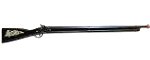 Civil War Musket Wood & Steel Frontier Rifle Designed After The Original Rifle, This Civil War Musket replica has been designed after the original rifle of its era. Measures approximately 37 inches long. Each is constructed with a solid one-piece wood stock, painted steel barrel and die-cast parts. |
 Shades of Blue and Gray: An Introductory Military History of the Civil War The Civil War with an emphasis on contemporary advances in military technology and their effects on behavior in the field. Ulysses Grant was speaking nearly literally when he wrote, "the iron gauntlet must be used more than the silken glove to destroy the Confederacy" |
Kindle Available Staff Officers in Gray: A Biographical Register of the Staff Officers in the Army of Northern Virginia Profiles some 2,300 staff officers in Robert E. Lee's famous Army of Northern Virginia. A typical entry includes the officer's full name, the date and place of his birth and death, details of his education and occupation, and a synopsis of his military record. Two appendixes provide a list of more than 3,000 staff officers who served in other armies of the Confederacy and complete rosters of known staff officers of each general |
Kindle Available The Class of 1846: From West Point to Appomattox: Stonewall Jackson, George McClellan, and Their Brothers No single group of men at West Point has been so indelibly written into history as the class of 1846. The names are legendary: Thomas "Stonewall" Jackson, George B. McClellan, Ambrose Powell Hill, Darius Nash Couch, George Edward Pickett, Cadmus Marcellus Wilcox, and George Stoneman |
Kindle Available Nathan Bedford Forrest's Escort And Staff The CSA escort company and staff officers of Nathan Bedford Forrest were held in awe by men on both sides of the conflict during the war and long after, and they continue to be held in esteem as figures as legendary as Forrest himself. Not merely guards or couriers, these men were an elite force who rode harder and fought more fiercely than any others |
Kindle Available Robert E. Lee This book not only offers concise detail but also gives terrific insight into the state of the Union and Confederacy during Lee's life. Lee was truly a one of kind gentleman and American, and had Virginia not been in the south or neutral, he ultimately would have led the Union forces. |
Kindle Available The Maps of First Bull Run: An Atlas of the First Bull Run (Manassas) Campaign, including the Battle of Ball's Bluff, June-October 1861 The Maps of First Bull Run breaks down the entire operation (and related actions) into numerous map sets or "action-sections" enriched with more than fifty full-color original full-page maps. These cartographic originals bore down to the regimental and battery level and include the march to and from the battlefield and virtually every significant event in between. |
Kindle Available One Continuous Fight: The Retreat from Gettysburg and the Pursuit of Lee's Army of Northern Virginia The first detailed military history of Lee's retreat and the Union effort to catch and destroy the wounded Army of Northern Virginia Complimented with 18 original maps, dozens of photos, and a complete driving tour with GPS coordinates of the entire retreat |
Kindle Available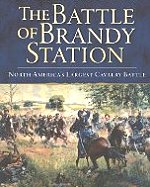 The Battle of Brandy Station North America's Largest Cavalry Battle Just before dawn on June 9, 1863, Union soldiers materialized from a thick fog near the banks of Virginia's Rappahannock River to ambush sleeping Confederates. The ensuing struggle, which lasted throughout the day, was to be known as the Battle of Brandy Station the largest cavalry battle ever fought on North American soil. |
 Civil War Historic 1000-piece Puzzle The famous faces and fearsome facts of the Civil War are captured in this 1,000-piece cardboard puzzle for Civil War buffs and serious puzzle fans. |
 Civil War Cannon Collectible Models and childrens playsets Miniature Collectible Civil War Cannon12 pound Civil War field cannon replica weapon collectible is a detailed 1/12th scale military caisson replica weapon collectible as used throughout the Civil War Childrens Cannon Set. Includes 6 gray cannon with black wheels that measure 4.5 inches long |
 Professor Noggin's Civil War Trivia Game
|
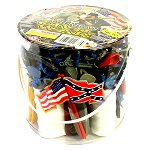 Civil War Soldier 102 Piece Playset
|
||||||
 Battleground 7: Bull Run July 21, 1861 The earliest large-scale engagement of the Civil War, the First Battle of Bull Run found J.E. Johnston's outnumbered Rebels fighting a desperate delaying action versus the powerful Union army of Irvin McDowell. It was in this battle that General Thomas J. Jackson earned his famous nickname "Stonewall" |
 Civil War Battles Campaign Atlanta You decide the outcome of a duel between two determined generals in the American Civil War. It's 1864 and the Union forces are ready to make a final drive into the Deep South. General William T. Sherman advances to destroy the Confederate Army of Tennessee & capture the city of Atlanta. Confederate General Joseph E. Johnston planned on using Georgia's difficult terrain to inflict heavy losses |
 Campaign Chickamauga Civil War Battles A defining moment in the Civil War -- one that could have spelled victory for the South if things had been slightly different. At Chickamauga Creek near Chattanooga, TN there was a battle that earned it a new nickname: "River Of Blood." Chattanooga was a vital rail station at the time and had fallen to Union General Rosecrans |
 History Channel Civil War Secret Missions There are about a half-dozen different small arms types, but the Henry is the best for rapid repeating fire and least reloading. The shotgun they give you is useless: you must aim spot-on to affect an enemy, so why not just use the rifle? Grenades are useful at times. |


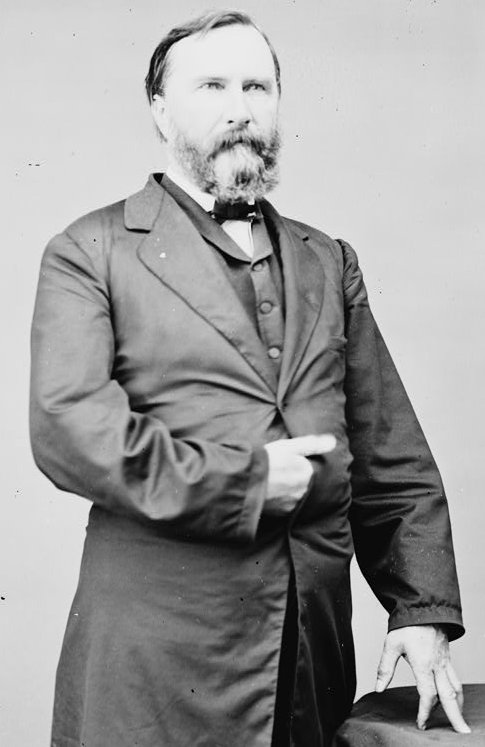
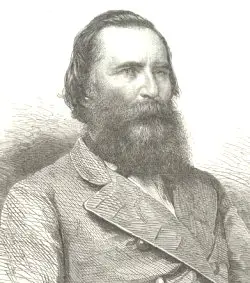 James Longstreet was born on January 8, 1821 in Edgefield District, South Carolina, the son of planter James and Mary Ann (Dent) Longstreet. Raised by his uncle in Alabama and Georgia, the young James entered West Point and graduated fifty-fourth in a class of sixty-two in 1842. He was assigned to various military posts in Missouri and Louisiana until the outbreak of the War with Mexico in 1848. Serving under General Zachary Taylor, Longstreet saw combat at Palo Alto, Resaca, and Monterrey. He participated in several other battles including the decisive Battle of Chapultepec where he was wounded. His gallantry and service won him several promotions, but by 1852, he was still only a captain. Longstreet was not discouraged but continued with his duties and assignments in Texas, New Mexico, and finally in Washington where he was promoted to major. The coming of the Civil War tested his loyalty which he felt belonged to his native state. Thus, Major Longstreet resigned from the US Army on June 1, 1861, and offered his services to the new Confederacy.