John Brown (1800-1859)
|
|
|
|
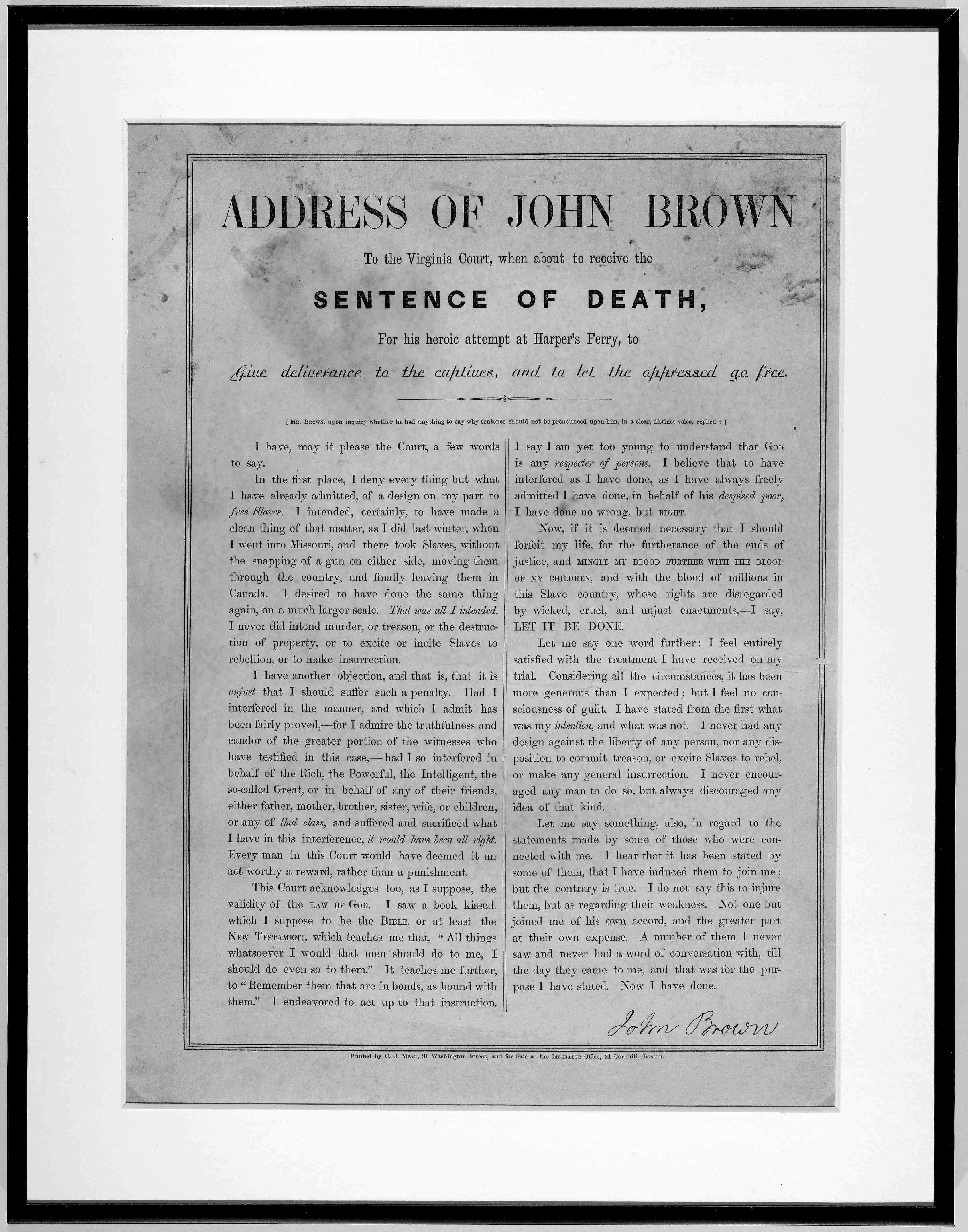
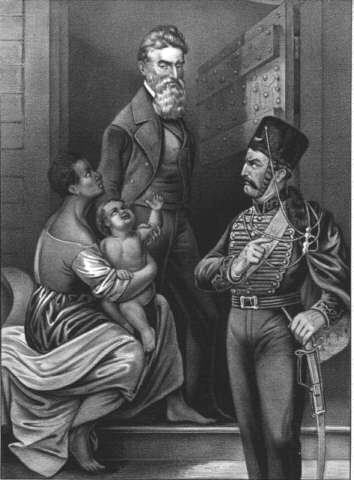
John Brown (1800-1859) was an abolitionist who took direct action to free slaves by force. Following his raid on the arsenal at Harpers Ferry, in mid-October 1859, he was convicted of treason, conspiracy, and murder. One of the most controversial abolitionists, Brown was regarded by some as a martyr and by others as a common assassin. Brown's dignified bearing in prison and at his trial moved many spectators. Ralph Waldo Emerson said that Brown's death would "make the gallows as glorious as the cross." This image shows a heroic Brown being adored by a slave mother and child as he walks to his execution on December 2, 1859. Late on the night of October 16, 1859, John Brown and twenty-one armed followers stole into the town of Harper's Ferry, Virginia (now West Virginia) as most of its residents slept. The men--among them three free blacks, one freed slave, and one fugitive slave--hoped to spark a rebellion of freed slaves and to lead an "army of emancipation" to overturn the institution of slavery by force. To these ends the insurgents took some sixty prominent locals including Col. Lewis Washington (great-grand nephew of George Washington) as hostages and seized the town's United States arsenal and The upper hand which nighttime surprise had afforded the raiders quickly eroded, and by the evening of October 17, the conspirators who were still alive were holed-up in an engine house. In order to be able to distinguish between insurgents and hostages, marines under Colonel Robert E. Lee waited for daylight on October 18 to storm the building. (The arrest of John Brown by Union General Robert E. Lee) Brown and most of his men were veteran foes of slavery. In 1849, he and his family had settled at a black community at North Elba in New York state. Brown had become increasingly militant during the 1850s in his quest to eradicate slavery. In 1855, he had migrated to the Kansas Territory to become the leader of a band of anti-slavery guerrillas. He lead a nighttime raid in retaliation for the sack of Lawrence, Kansas by pro-slavery forces and helped to liberate slaves and to safely transport them to Canada. In 1858, Brown drafted a constitiution for a provisional United States government of which he was elected president with which he intended to establish an effective means of freeing the slaves of Maryland and Virginia. Most of his raiders held comissions in the government's army. Apparently, only the black conspirators held no comissions. Even the ill-concieved plan for the raid had been germinating in Brown's thoughts for some time; he had moved to nearby Kennedy Farm in preparation in July. Brown claimed he, "knew the proud and hard hearts of the slave-holders, and that they would never consent to give up their slaves, till they felt a big stick about their heads," and that a slave-holding community was, by its nature, in a state of war and, thus drastic actions were necessary and justified. His supporters felt they had a moral imperative to take action: Millions of fellow-beings require it of us; their cries for help go out to the universe daily and hourly. Whose duty is it to help them? Is it yours? Is it mine? It is every man's, but how few there are to help. But there are a few who dare to answer this call and dare to answer it in a manner that will make this land of liberty and equality shake to the centre. In his account of the raid for Century Magazine, Alexander Boteler pointed out that, "…the usages of ordinary warfare had been more than once disregarded, during the day, by the belligerents on both sides." Harper's Ferry mayor Fountain Beckham was clearly unarmed and his hands were in his pockets when he was shot by the insurgents; raider Dangerfield Newby's ears were cut off as trophies; and Jeramiah Anderson was tortured and beaten as he lay dying. Some considered the Harper's Ferry raid to have been the first skirmish of the Civil War: then and there the first shot was fired and the first blood was shed-the blood of an unoffending The raid enflamed the emotions of parties on both sides of the conflict while Northern and Southern press fanned the flames that had been smoldering hotter and hotter with the publication of Uncle Tom's Cabin, the Dred Scott decision, and the Kansas-Nebraska Act. Fear and anger had now totally eclipsed any other motivations which had been factors in the battle over slavery. Fellow abolitionist Frederick Douglass recognized in Brown an unparallelled devotion, "I could live for the slave, but he could die for him." Brown had lost two sons in the raid. Another son had already sacrificed his life for the anti-slavery cause in the Osawatomie raid. Now, if it is deemed necessary that I should forfeit my life, for the furtherance of the ends of justice, and MINGLE MY BLOOD FURTHER WITH THE BLOOD OF MY CHILDREN, and with the blood of millions in this Slave country, whose rights are disregarded by wicked, cruel, and unjust enactments,--I say LET IT BE DONE. For his actions, Brown was quickly tried and convicted of murder, slave insurrection, and treason against the state and sentenced to death by hanging. The simplicity and sincerity of Brown's address after his sentencing astounded listeners on both sides of the issue. While awaiting his fate in the Harper's Ferry jail, he received a sympathetic letter from Massachusetts writer and abolitionist Lydia Maria Child. "I think of you night and day," she wrote, "bleeding in prison, surrounded by hostile faces, sustained only by trust in God and your own heart. I long to nurse you--to speak to you sisterly words of sympathy and consolation." Brown declined her offer, asking instead that she contribute to the financial support of his surviving family which included two daughters-in-law whose husbands had been killed in the raid. "Would you not," he wrote, "as soon contribute fifty cents now, and a like sum yearly, for the relief of those very poor and deeply afflicted persons, to enable them to supply themselves and their children with bread and very plain clothing, and to enable the children to receive a common English education?" Child's support of Brown occasioned a bitter exchange of letters which reveals the depth of animosity between abolitionists and Southern slaveholders in the wake of Brown's raid. "I and thousands of others," Child wrote Virginia Governor Henry A. Wise, "feel a natural impulse of sympathy for the brave and suffering man. Perhaps God, who sees the inmost of our souls, perceives some such sentiment in your heart also." "I could not permit an insult even to woman in her walk of charity among us," Governor Wise responded, "though it to be to one who whetted knives of butchery for our mothers, sisters, daughters and babes. We have no sympathy with your sentiments of sympathy with Brown." His actions made John Brown a martyr to abolitionists. Of the five conspirators who escaped from the engine house and were never caught, four served in the Union Army during the Civil War (only Brown's son Owen did not.) The Harper's Ferry raid remains one of the more controversial events of the country's history. Frederick Douglass sums up his assessment of his friend's actions: Did John Brown fail? He certainly did fail to get out of Harper's Ferry before being beaten down by United States soldiers; he did fail to save his own life, and to lead a liberating army into the mountains of Virginia. But he did not go to Harper's Ferry to save his life. The true question is, Did John Brown draw his sword against slavery and thereby lose his life in vain? and to this I answer ten thousand times, No! No man fails, or can fail who so grandly gives himself and all he has to a righteous cause.
|
Kindle Available Patriotic Treason John Brown and the Soul of America The life of the first citizen committed to absolute racial equality. His friendships in defiance of the culture around him, He turned his twenty children into a dedicated militia. He collaborated with black leaders such as Frederick Douglass, Martin Delany, and Harriet Tubman to overthrow slavery.  Secret Six: The True Tale of the Men Who Conspired with John Brown The story of how Brown was covertly aided by a circle of prosperous and privileged Northeasterners who supplied him with money and weapons, and, before the raid, even hid him in their homes while authorities sought Brown on a murder charge. These men called themselves the Secret Six. |
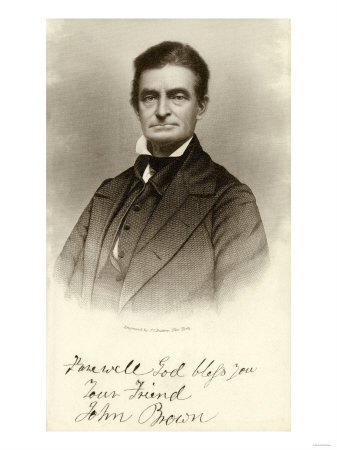 John Brown Autograph Reading: Farewell God Bless You, Your Friend, John Brown Buy at AllPosters.com Framed Mounted |
John Brown and Harper's Ferry |
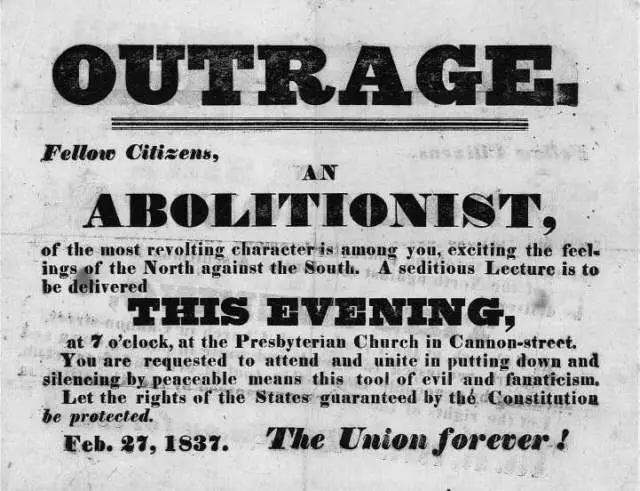 |
This handbill urging opponents of abolitionists to obstruct an anti-slavery meeting demonstrates the depth of pro-slavery feeling. Although the handbill advocates peaceful means, violence sometimes erupted between the two factions. An emotion-laden handbill was a factor in the well-known Boston riot of October 21, 1835. In that incident, a mob broke into the hall where the Boston Female Anti-Slavery Society was meeting, and threatened William Lloyd Garrison's life. |
 A Stranger And a Sojourner: Peter Caulder, Free Black Frontiersman in Antebellum Arkansas An illiterate free black man, defied all generalizations about race as he served with distinction as a marksman in the U.S. Army during the War of 1812, repeatedly crossed the color line, and became an Arkansas yeoman farmer, thriving and respected by white neighbors until he fell victim of new discriminatory legislation on the eve of the Civil War |
Union Generals Confederate Commanders Civil War Exhibits Timeline of the War State Battle Maps President Abraham Lincoln Civil War Summary Civil War Picture Album Kids Zone Underground Railroad Civil War Submarines |
 Meteor of War The John Brown Story Students have already been taught that John Brown was at best a well-meaning madman. This book shows the various John Browns of history and myth, so that, whether you agree with the actions of Brown, you will at least understand them better and see him as a complex and human individual |
 American Experience The Massachusetts 54th Colored Infantry After Lincoln signed the Emancipation Proclamation, the governor of Massachusetts was authorized to raise the first northern black regiment, the Massachusetts 54th colored infantry. |
 Brother Against Brother The American Civil War Fort Sumter, to the Confederate surrender at Appomattox, Features battle reconstructions and depictions of army life, eyewitness accounts, period photographs and engravings, plus commentary and analyses. |
 Ride With The Devil The bloody feud among neighbors in the border state of Missouri. In this war zone the destinies of several young Southern bushwhackers as they experience the violence and the seasons |
 Shiloh: The War is Civil No More |
 Gettysburg / Gods and Generals The tide of the war changes during three fierce days of combat at Gettysburg [Disc 1] the gripping saga of the tactics command errors and sacrifices behind the bloodiest battle ever fought on U.S. soil. Gods and Generals [Disc 2] reveals the spirited allegiances and fierce combat of earlier Civil War struggles |
 Ulysses S. Grant - Warrior President Grant pushed for the annexation of Hispaniola, not to relocate blacks, but to give them the option to leave, thus impressing upon white southerners the importance of black people in their labor force and encouraging them to pay better wages and treat their employees better |
 THE GREAT COMMANDERS Ulysses S. Grant Lee was determined to confront Grant's numerically-superior Union Army in the dense Spotsylvania wilderness. For Lee it was imperative to fight here, his army was massively outnumbered, with 61,000 men to Grant's 101,000 |
 Manassas 1861 |
Sources:
U.S. Library of Congress


 its rifle works.