|
|
|
|
Kindle Available Naval Strategies of the Civil War: Confederate Innovations and Federal Opportunism Compare and contrast the strategies of the Southern Secretary of the Navy, Mallory, against his rival in the North, Welles. Mallory used technological innovation and the skill of individuals to bolster the South's seapower against the Union Navy's superior numbers  Blockaders, Refugees, and Contrabands: Civil War on Florida'S Gulf Coast, 1861-1865 Coastal Florida had a refugee crisis as the war progressed. Escaped slaves sought out the blockaders. Some joined the U.S. Navy. White men and their families sought to avoid conscription and eventually sought refuge with the blockaders |
Kindle Available Civil War Curiosities: Strange Stories, Oddities, Events, and Coincidences |
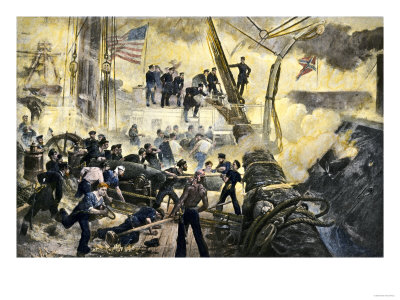
Admiral David G. Farragut in the Rigging during the Battle of Mobile Bay, 1864 24 in. x 18 in. Buy at AllPosters.com Framed Mounted |
 Confederate Ironclad 1861-65 Every aspect of Confederate ironclads is covered: design, construction, armor, armament, life on board, strategy, tactics, and actual combat actions. Kindle Available  Wolf of the Deep: Raphael Semmes and the Notorious Confederate Raider CSS Alabama In July 1862, the Confederate captain Raphael Semmes received orders to report to Liverpool, where he would take command of a secret new British-built steam warship. His mission: to prey on Union commercial vessels and undermine the North's ability to continue the war |
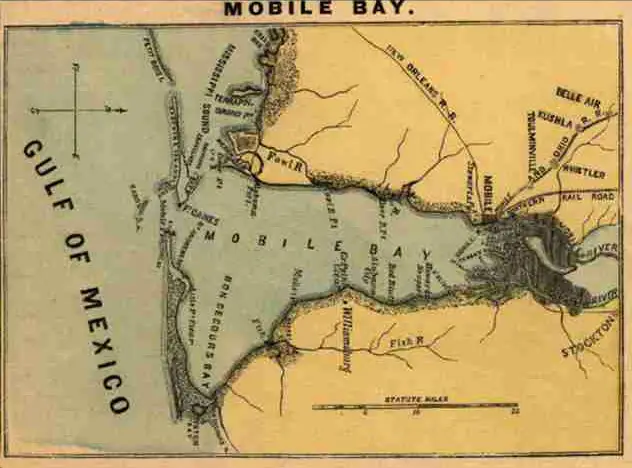
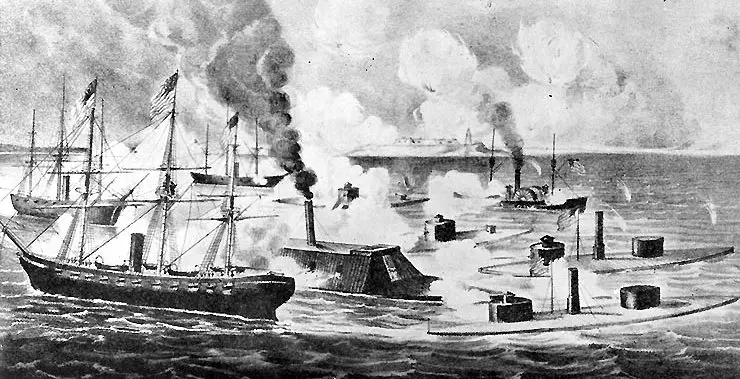
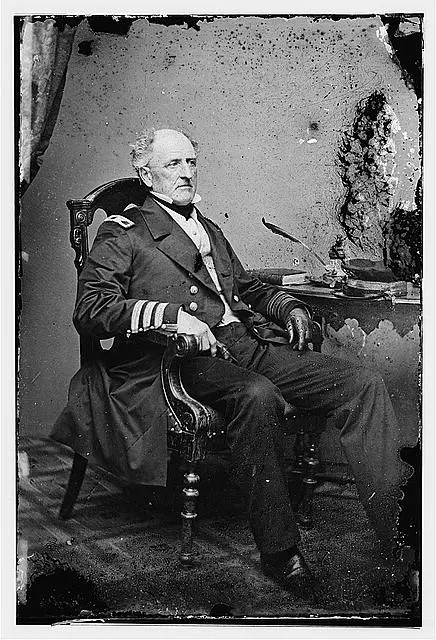
When Federal warships steamed into Mobile Bay on the morning of 5 August 1864, Confederate Admiral Franklin Buchanan stationed CSS Tennessee, his flagship, and her unarmored consorts, gunboats Morgan , Gaines and Selma , at the head of the channel. As the enemy moved up, exchanging fire with Fort Morgan, Buchanan's ships shot at them from ahead. The Union monitor Tecumseh, maneuvering to engage the Tennessee , struck a mine and sank, temporarily throwing the Federal column into confusion. Rear Admiral Farragut's flagship, USS Hartford , forged ahead and drove off the Confederate gunboats, but Tennessee remained in the battle zone, firing on the U.S. Navy ships as they passed and doing considerable damage to the last in line, USS Oneida. With the enemy was safely inside Mobile Bay, Buchanan understood that the Confederate forts at the bay's entrance would soon be untenable unless the Union ships could somehow be destroyed. In a desperate, solitary effort, Tennessee steamed toward Farragut's ships. As she slowly moved along, the sloops of war USS Monongahela and Lackawanna repeatedly rammed her, doing more damage to themselves than to their target. When Tennessee reached the Federal anchorage area, she was also rammed by the Hartford and subjected to a terrific cannonade. The U.S. monitors Chickasaw and Manhattan then engaged her at close range with their heavy guns, while other Union ships fired from a distance. Tennessee's smokestack and most other exposed fittings were hammered away, further reducing her never very great speed; her gunport shutter chains were cut, closing the ports so the Confederates could not shoot back; and her exposed steering chains were severed, leaving her unmanageable. The Manhattan blew a hole in Tennessee's armor with her massive fifteen-inch gun. The twin-turret monitor Chickasaw stationed herself off the beleagered ship's stern, firing her eleven-inch guns "like pocket pistols" and seriously weakening the after end of Tennessee's armored casemate. This view depicts, none too accurately, the CSS Tennessee in the center at the time she surrendered, surrounded by the Union warships. The latter include (at right) the twin-turret monitors Chickasaw and Winnebago at right. One of the single-turret monitors would be Manhattan . There was no second single-turret monitor present at this stage of the battle. The large ship in the left foreground is presumably USS Hartford . Fort Morgan is shown in the right distance |
Kindle Available Raising the Hunley: The Remarkable History and Recovery of the Lost Confederate Submarine For more than a century the fate of the Hunley remained one of the great unsolved mysteries of the Civil War. Then, on August 8, 2000, with thousands of spectators crowding Charleston Harbor, the Hunley was raised from the bottom of the sea and towed ashore. |
Naval Battle August 5, 1864 Alabama State Battle Map State Battle Maps American Civil War Exhibits Civil War Timeline Civil War Summary Civil War Music History Kids Zone Exhibits Confederate Commanders Union Generals Civil War Documents Women Civil War Soldiers Ships and Naval Battles |
 Civil War Musket Wood & Steel Frontier Rifle Designed After The Original Rifle
|
| Kindle Available Naval Strategies of the Civil War: Confederate Innovations and Federal Opportunism Compare and contrast the strategies of the Southern Secretary of the Navy, Mallory, against his rival in the North, Welles. Mallory used technological innovation and the skill of individuals to bolster the South's seapower against the Union Navy's superior numbers |
Confederate Ironclad 1861-65 Every aspect of Confederate ironclads is covered: design, construction, armor, armament, life on board, strategy, tactics, and actual combat actions. |
Kindle Available Reign of Iron: The Story of the First Battling Ironclads, the Monitor and the Merrimack The first ironclad ships to fight each other, the Monitor and the Virginia (Merrimack), were the unique products of American design genius |
 Battle on the Bay: The Civil War Struggle for Galveston Civil War history of Galveston is one of the last untold stories from America's bloodiest war, despite the fact that Galveston was a focal point of hostilities throughout the conflict. Galveston emerged as one of the Confederacy's only lifelines to the outside world. |
Kindle Available The H. L. Hunley The Secret Hope of the Confederacy On the evening of February 17, 1864, the Confederacy H. L. Hunley sank the USS Housatonic and became the first submarine in world history to sink an enemy ship. Not until World War I "half a century later” would a submarine again accomplish such a feat. But also perishing that moonlit night, vanishing beneath the cold Atlantic waters off Charleston, South Carolina, was the Hunley and her entire crew of eight |
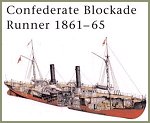 Confederate Blockade Runner 1861-65 The blockade runners of the Civil War usually began life as regular fast steam-powered merchant ships. They were adapted for the high-speed dashes through the Union blockade which closed off all the major Southern ports, and for much of the war they brought much-needed food, clothing and weaponry to the Confederacy |
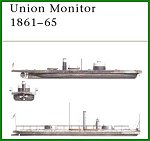 Union Monitor 1861-65 The first seagoing ironclad was the USS Monitor, and its profile has made it one of the most easily recognised warships of all time. Following her inconclusive battle with the Confederate ironclad Virginia on March 9, 1862, the production of Union monitors was accelerated. By the end of the year a powerful squadron of monitor vessels protected the blockading squadrons off the Southern coastline, and were able to challenge Confederate control of her ports and estuaries |
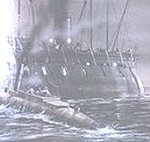 Confederate Submarines and Torpedo Vessels 1861-65 Interesting information and many excellent illustrations. It addresses the CSA David class torpedo boats and the Hunley (and its predecessors), as well as Union examples such as the Alligator and the Spuyten Duyvil |
Women in the War
Confederate President Jefferson Davis
General Stonewall Jackson
Civil War Picture Album
Civil War Submarines
Sources:
U.S. National Park Service
U.S. Library of Congress.
|
Books Civil War Womens Subjects Young Readers Military History DVDs Confederate Store Civil War Games Music CDs Reenactors |