Source:
Travelbrains Second Manassas Expedition Guide

Prelude to Second Manassas

The First Battle of Manassas lasted more than eight grueling hours and culminated with the wounded Union army fleeing for its life. It was a sobering event that proved the civil war would be anything but short and bloodless. Thirteen months later, the Union and Confederate armies once again clashed at Manassas. However, both armies were a far cry from the novice soldiers that squared off the previous summer. The troops were now seasoned veterans, hardened to the gruesome realities of warfare. And with numbers twice the size of the previous battle, it ensured a level of destruction that was unparalleled up to this point in the war.

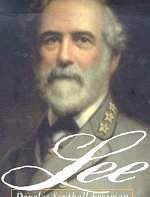
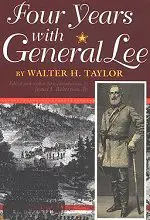
In the spring of 1862, General George McClellan and the Union army fought their way up the Virginia peninsula to the Confederate capital of Richmond. But a newly appointed Commander of the Confederate army-- General Robert E. Lee, stopped McClellan at the gates of Richmond. In a matter of weeks, Lee forced the Union troops away from Richmond. He then re-organized his army into two "wings". The famed General Thomas "Stonewall" Jackson captained the left wing, while Lee's "Old War Horse" , General James Longstreet assumed command of the right wing.

While Lee was busy reorganizing his army, President Lincoln was desperately seeking a commander who could match wits with the Confederates. He called upon 40-year-old General John Pope, a West Point graduate of the class of 1842. Pope was also connected by marriage to President Lincoln's wife, Mary Todd Lincoln.

In July, Lee learned that McClellan's army was retreating off of the Peninsula. They had been ordered to join forces with Pope, a combination that would produce a collosal army of 150,000 men. Located in the middle was Lee's army of 55,000 men. Lee knew he had destroy Pope before the two Federal armies could combine their forces. In mid August, Lee found the opportunity he was looking for. Pope's Army of Virginia that was positioned between the confluence of the Rapidan and Rappahannock rivers, an ideal location for Lee to isolate and destroy it. But on the morning of August 18th, a detachment of Union Cavalry captured a copy of Lee's attack orders. Pope immediately withdrew his army from the trap and established a strong position on the north bank of the Rappahannock. Time was running out for Lee. McClellan's army was fast approaching.

Lee's plan was to lure Pope away from his advantageous position on the Rappahannock River. To achieve this, he would cut the North's line of supply and communication.

In the pre-dawn hours of August 25th, Jackson's men started a 54-mile march around Pope. In less than 40 hours, Jackson's men descended on the Bristoe Railroad Station, cutting Pope's supply line, the Orange & Alexandria Railroad, and his telegraph communications with Washington. Next they ransacked the supply depot at Manassas Junction and burned what they couldn't take. It was a remarkable feat even by modern military standards.

Pope reacted quickly. He knew that Jackson was isolated. He ordered his army, nearly 60,000 strong, to concentrate at Manassas Junction. But by the time he arrived, Jackson was nowhere to be found. Upon receiving a report that Jackson was near Centerville, he ordered his army to once again take to the roads. Like a horse with blinders on, Pope fixated on finding and destroying Jackson. Somewhere out there in the Virginia countryside was the other half of Lee's army; 30,000 men of Longstreet's Wing.

As evening approached on August 28th, Pope was finally about to find Jackson. Unfortunately for Pope, it would be on Jackson's terms. With no lit fires to give their position away, Jackson's men patiently waited along a rise of ground known as Stoney Ridge north of the First Manassas battlefield. As a division of Federal soldiers marched east along the Warrenton Turnpike, they passed right in front of Jackson's waiting troops. Turning to his field commanders, Jackson issued the orders, "Bring out your men gentlemen". The Second Battle of Manassas was about to begin.

Second Manassas

On August 28, 29, and 30 1862 the Union and Confederate armies collided for a second time in little over a year on the fields of Manassas. The first meeting saw a green Union army fleeing for its life on the roads to Washington. Now 13 months later, a confident and arrogant Union General John Pope bragged that he would destroy the Confederate army in short order. Unfortunately for Pope, Southern General Robert E. Lee was now in command of the Army of Northern Virginia. Second Manassas would be one of Lee's most decisive victories.

August 28 1862 - A standup fight at Brawner Farm: About 6:00 PM on August 28th, Union General John Gibbon observed a group of horses emerge from the trees in the far distance. Gibbon was an experienced artillerist and knew by the action of the horses that Confederate artillery was present. Within moments a Confederate cannon opened fire, sending shells hissing over the heads of the Union division spread out on the turnpike.

Believing that the enemy battery belonged to JEB Stuart's horse artillery, Gibbon sent his only veteran regiment, the 2nd Wisconsin, to charge the guns and capture them. Even though they had seen action at Manassas the previous summer, the 2nd Wisconsin regiment was not prepared for what followed.

They were not simply chasing off an unsupported battery of light horse artillery, they were heading right into the veteran infantry of "Stonewall" Jackson. Gibbon's men left the turnpike, plowing there way the thicket of woods that bordered the road. Meanwhile, Jackson called his infantry forward. First to arrive was the famed "Stonewall" brigade. These were the same men that Jackson had personally led at the First Battle of Manassas the previous year. Back then the brigade numbered 2,500 men. Now, they had withered to just over 800 rifles but they were some of the best in the Confederate army. Both sides surged forward and unleashed volleys of musket fire. The fighting quickly escalated as both sides threw in additional troops. Within 40 minutes, the men from Gibbon's and portions of another brigade found themselves in a battle for their lives against a Confederate force that had swelled to nearly three times their size. It was a brutal contest of wills. Seventy yards separated the lines. Both sides stood their ground firing into each other's ranks. Neither side advanced, and neither side retired.

Darkness finally brought an end to the bitter contest. The musketry that Gibbon described as a "long and continuous roll" gave way to the anguished cries of the wounded. One in every three soldiers was shot. The "Stonewall" Brigade lost 40% of their men, while the 2nd Wisconsin lost almost 50%.

August 29, 1862 - A day of bloody diversions: After the fighting at Brawner Farm the night before, Pope mistakenly believed that Jackson was trying to escape. Pope envisioned a pincer movement against Jackson's fleeing troops. He would send units straight ahead to keep Jackson pinned down while the entire 5th corps, 10,000 men commanded by General Fitz-John Porter would swing around and strike Jackson's exposed right flank or end. There was only one problem. The flank attack would never happen. The battle orders Porter received were vague, but more importantly, Longstreet arrived with his 30,000 men and sat squarely between Porter and the right flank of Jackson.

The attack, as originally planned was no longer realistic and Porter halted his corps. Nevertheless, Porter's inaction did ensure that the piecemeal attacks made by the other Union troops on the 29th faced the full brunt of Jackson's men. Sadly, the men who marched forward on those attacks, had no idea of the diversionary role they were playing. They struck with every ounce of energy they could muster, thinking that their prime objective was to destroy Jackson. German born, Major General Franz Sigel led the way. At first light on the morning of August 29th, his men advanced on a broad front. Their purpose was to locate and probe the Confederate line. He achieved his goal. Well before 10:00 AM, Sigel's men were heavily engaged with Jackson's troops positioned behind an unfinished railroad bed. By 12:30 Sigel had settled into a stalemate in front of the unfinished railroad and a deceptive lull settled over the battlefield. Then suddenly in the afternoon in quick succession, two Union brigades hurled themselves in unsupported attacks on Jackson's Line. Each attack met with initial success but was swiftly beaten back by Confederate counterattacks.

At around 5 pm Pope ordered the fiery one-armed general, Phil Kearney to assault the left end of Jackson's line, held by AP Hill's famed "Light Division". After 9 hours of near continuous fighting, Hill's men were nearing the limits of human endurance. Hill's men were slowly pushed back and on the verge of collapse when Jackson threw his last reserves into the fray. A large brigade under the command of Confederate General Jubal A. Early slammed into Kearny's men like a hammer blow and sent the Federals all the way back to their starting line. Back at his headquarters, Union General John Pope continued to delude himself. Despite the failure to crack Jackson's line and the obvious arrival of Longstreet's corps on the battlefield, Pope believed that the next day a grand pursuit of Lee would bring a great victory. He was soon to learn otherwise.

August 30, 1862 - The very vortex of hell: Pope's grand pursuit never happened. In fact, it was Pope's army that became the pursued that day. The first Union troops to discover the truth belonged to general James Ricketts. His men advanced at around noon and were immediately repulsed by Jackson's troops. Pope could delude himself no longer. Lee was not retreating and he knew it. But that realization did not stop what happened next. Pope sent orders for the 10,000 men of Fitz John Porter's V corps to hit Jacksonhard.

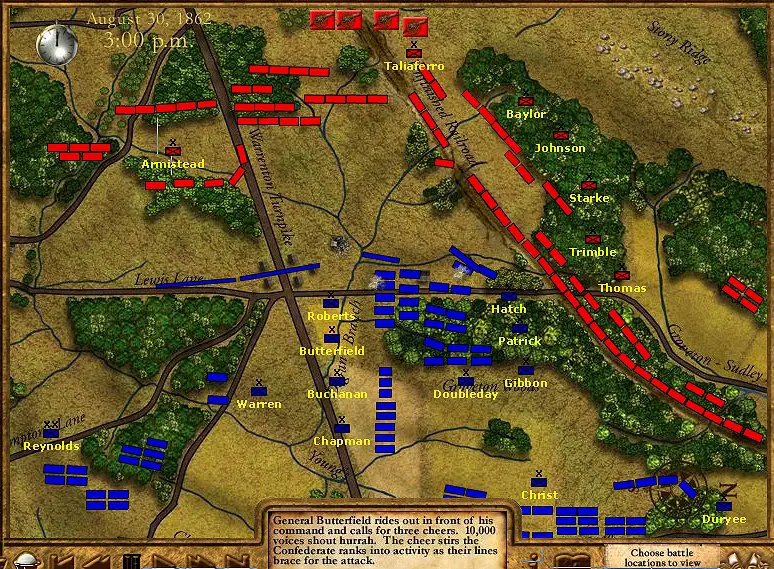
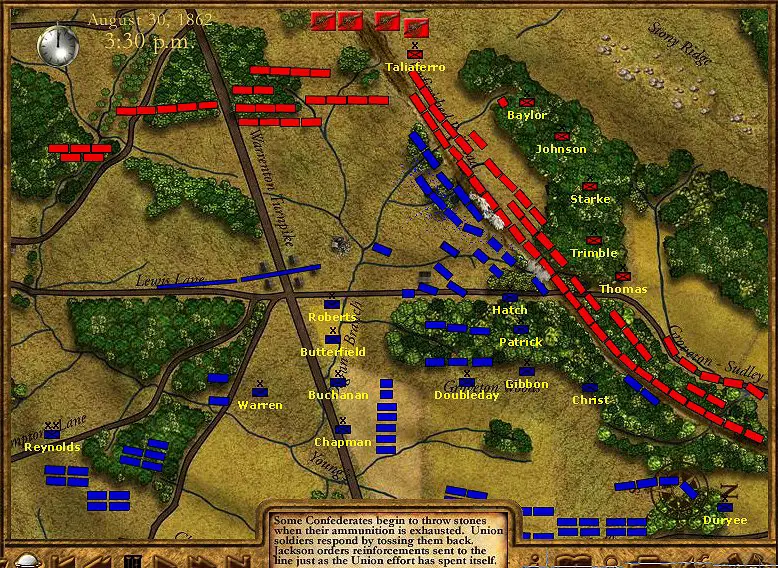
Ironically, this is exactly what Lee hoped for. Porter's attack set the stage for one of the largest and most successful flank attacks of the war. At 3:00 PM. like a giant avalanche, Porter's men stormed out from the protection of the woods into the open fields in front of Jackson's line.


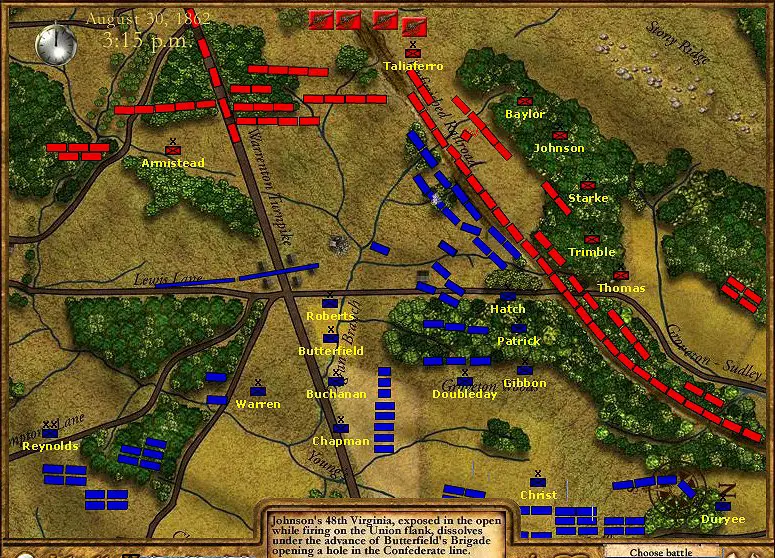
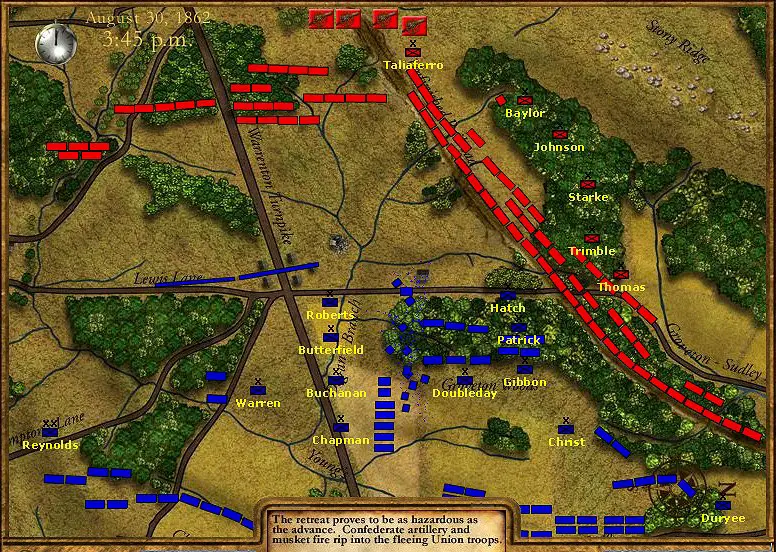
Porter's Attack Screen Shots

See Porter's Attack and the Confederate Defense in a Narrated sequence
showing troop movements and highlights of the
Advance and Retreat


Beautifully animated battle maps bring the fighting to life. A 35 minute multi-media movie explains the entire campaign and battle. Animated movies describe the opposing armies and provide a wealth of biographical information. View Civil War weapons in an interactive museum. Take the trivia quiz and test your knowledge of the Civil War and the Second Battle of Manassas.

Like other guides in this series, this set of audio and video CD's, along with the accompanying text, is an indespensible asset for those seriously trying to understand the battle that resulted in America's bloodiest day. Despite reading extensively about the battle, the automated and time-scaled troup movement maps helped me clearly grasp the scope and scale of the conflict better than ever before. Well worth the money for those contemplating more than a casual visit to this site, one of the best preserved of all civil war battlefields. Amazon Review


Porters Attack

The Confederate artillery wasted no time. Jackson's batteries along with eighteen cannons under the command of Stephen D. Lee (no relationship to Robert E. Lee) were in a perfect position to rake the Union advance. Despite the devastating artillery fire, Porter's men along with Hatch's division closed ranks and pushed forward. The Union ranks degenerated into confused clusters of men. A fierce battle raged along the Unfinished Railroad, behind which Jackson's men had take cover. At some spots along the line Confederates ran out of ammunition and began to hurl stones at the assaulting Union troops. The Union attack stalled and Porter refused to risk sending reinforcements into the artillery death trap. Porter's assault was shattered an hour after it had started. Nearly 3,000 men now lay dead, wounded, or missing on the field.

One of the men who witnessed Porter's attack crumble was Union Third Corps Commander General Irvin McDowell. In July of the previous year, McDowell had commanded the Union troops that were routed on these same fields at the First Battle of Manassas. Now, from his vantage point, it appeared that the center of the Union line was in total disarray and in danger of collapsing. McDowell promptly ordered General John Reynold's to move his men to the north side of the Warrenton Turnpike and shore up the weakness. It was one of the worst decisions of his military career. With Reynolds' departure, it left a mere 2,500 Union troops south of the turnpike.

For the Confederates, the moment to strike was at hand. Longstreet's 30,000 fresh troops surged forward in one of the largest flank attacks of the Civil War. The Confederate juggernaut was about to steam role everything in its path. Leading the way was John Hood's Texas Brigade and only Union resistance in their path was a small brigade of New York Zouave's commanded by Colonel Gouverneur K. Warren. In a matter of ten minutes the 5th New York lost approximately half its men. For a single infantry regiment, it was the largest loss of life in any single battle of the entire Civil War. Longstreet was guiding his men straight for Henry Hill, the key to cutting off the Union retreat back across the Bull Run. With only a handful of troops in their path, it appeared as if nothing could stop the Confederate onslaught. Pope was rapidly reaching the same conclusion. His next series of orders would reveal how desperate the situation had become.

On Chinn Ridge Pope sacrificed one brigade after another in an attempt to buy time while his army established a last ditch defense on Henry Hill. The Union troops defending Chinn Ridge were grudgingly pushed back by successive waves of Confederate infantry. Following a brief but valiant attempt by Koltes' brigade to recapture a Union battery, Longstreet's men finally conquered Chinn Ridge around 6:00 PM. It had been 90 minutes of the most intense and sustained fighting of the battle.

Lee's army was now poised to take Henry Hill and destroy Pope's army. But the struggle for Chinn Ridge had been costly. As darkness approached, Longstreet's troops were becoming disorganized and tired. He had three more divisions remaining for the final assault on Henry Hill. Two of these were fresh divisions but were still some ways off the front line. That left David R. Jones's Division. The Union line braced itself, leveled their rifles atop the road bank and let loose a deafening volley. The Georgia troops of Colonel George T. Anderson's line staggered. Anderson urged his men forward. "Knock hell out of those blue shirts," he yelled. His men were now within 50 yards of the road, but The Yankees would not give an inch. Union artillery belched canister into the Confederates lines with dreadful effect. Still the Rebels pushed forward.

The weight of the Confederate attack was beginning to show. Pushing through the Federal line, Georgians from Benning's Brigade forced a toehold on the Manassas-Sudley road. Union reinforcements rushed forward to seal the breach. The Confederate attack began to wane. Darkness had nearly enveloped the battlefield when Confederate troops finally maneuvered around the southern end of the Union line. Inexplicably, however, the Confederates did not exploit their advantage. JEB Stuart, the Confederate cavalry commander, urged General Armistead to advance his brigade and attack the exposed Union line. Armistead declined. In the smoke and darkness, he feared his men would not be able to tell friend from foe.

With that the Confederate sweep to Henry Hill ground to a halt. By 11:00 PM, most of the Union army had retreated across Bull Run, bloodied but intact. As the Union troops filed across the wooden bridge on their way towards the Washington defenses, they left behind nearly 10,000 of their men dead, wounded or captured on the fields of Manassas. Lee had lost just over 8,000 men. His telegram to Confederate President Davis read as follows: "This army achieved today on the plains of Manassas a signal victory over the combined forces of Generals McClellan and Pope."


More on Second Manassas
American Civil War Exhibits
Women in the War
Civil War Summary
State Battle Maps
Civil War Picture Album

Civil War History Documentary DVD Movie Titles

American Civil War visitors top DVD picks

Civil War Combat:
America's Bloodiest Battles

With beautifully shot footage of reenactors, Civil War Combat illustrates aspects of four particular Civil War battles that are rightfully considered legendary. Filmed on location, the reenactors depict the violent mayhem of the hornet's nest at Shiloh, the valiant charge on the sunken road at Antietam, the carnage in the wheat field at Gettysburg, and the brutal fighting at Cold Harbor. Produced by the History Channel, the episodes all benefit from insightful appearances by historians as well as rangers from the National Park Service.

The Civil War -
A Film by Ken Burns
The most successful public television miniseries in American history, the 11-hour Civil War didn't just captivate a nation, reteaching to us our history in narrative terms; it actually also invented a new film language taken from its creator. The Civil War evokes atmosphere and resurrects an event that many knew only from stale history books


Civil War Journal -
The Conflict Begins

The battles have been documented, the generals lionized. We have seen the turning points and the sacrifices. Now let Civil War Journal take you deeper, into the personal stories. Join host Danny Glover as he takes you through diaries, photographs, and factual re-enactments. Finally, a Civil War program that makes you feel the private and intimate side of the great conflict.


Civil War Minutes
Volumn 1
In Civil War Minutes - Union Volume 1, you will learn about the lives of soldiers through their handwritten letters to home. Also find out what life was like from the perspective of the average foot soldier through never-before-seen photographs, artifacts and rare paintings and engravings. Find out what is the General Beauregard Pipe; what is the Report of Samuel Weaver and how it was related to Gettysburg; what is a musket and much more!


Source:
TravelBrains