Frederick Douglass Timeline
| 1818 |
Born Frederick Augustus Washington Bailey, a slave, in Tuckahoe, Talbot County, Maryland. Mother is a slave, Harriet Bailey, and father is a white man, rumored to be his master, Aaron Anthony. He had three older siblings, Perry, Sarah, and Eliza. |
| 1819-23 |
Raised by grandmother Betsey Bailey at Holme Hill Farm, where he was born; sees his mother only a few times. |
| 1820 |
Sister Kitty is born. |
| 1822 |
Sister Arianna is born. |
| 1824 |
Moves to plantation on Wye River, where he lives with his siblings Perry, Sarah, and Eliza. |
| 1825 |
Sees his mother for the last time. |
| 1826 |
His mother dies.
|
|
Sent to Baltimore to live with Hugh Auld and his wife Sophia. His master, Aaron Anthony, dies late in the year; Frederick becomes the property of Thomas Auld, Anthony's son-in-law. Thomas Auld sends him back to Hugh Auld. |
| 1827 |
Asks Sophia Auld to teach him to read. She does so until Hugh Auld stops them, believing that education makes slaves rebellious. |
| 1829-30 |
Works in shipyard as general assistant; practices reading and writing in secret. |
| 1831 |
Reads newspaper article on John Quincy Adams's antislavery petitions in Congress; learns of the abolitionist movement. |
|
Buys copy of a compilation of speeches, Caleb Bingham's The Columbian Orator , with which he hones his reading and speaking skills. |
| 1832 |
Sister Sarah is sold to a planter in Mississippi. |
| 1833 |
Sent to St. Michaels, Maryland, where he works for Thomas Auld. Tries to teach other slaves to read until Auld discovers it and stops him. |
| 1834 |
Auld rents him out to farmer Edward Covey, known as a "slave breaker." He is beaten several times and finally fights back. Covey never tries to beat him again. |
| 1835 |
Hired out to work for William Freeland, a Talbot County, Maryland, farmer. Secretly organizes Sunday school and teaches other slaves to read. |
| 1836 |
Makes an escape plan but is discovered, jailed, and then released. He returns to work for Hugh and Sophia Auld in Baltimore and is hired out to work as a caulker in a Baltimore shipyard. The knowledge he gains there helps him escape slavery two years later. |
1837 |
Joins the East Baltimore Mental Improvement Society, a debating club of free black men. Through the society, he meets a free African-American housekeeper, Anna Murray. |
| 1838 |
September 3
Borrowing papers from a free black sailor, he escapes from slavery to New York and changes his last name to Johnson.
September 15
Marries Anna Murray. The ceremony is performed by minister James W. C. Pennington, who is also an escaped Maryland slave. |
| |
The newlyweds move to New Bedford, Massachusetts, where Frederick works as an unskilled laborer. They stay with caterers Mary and Nathan Johnson. Nathan suggests that Frederick take on the last name Douglas, from a character in Sir Walter Scott's poem The Lady of the Lake. He does so, spelling it Douglass. |
| |
Tries to get job as a caulker, but white workers threaten to quit if he is hired. |
1839 |
June 24
Daughter Rosetta is born.
Douglass subscribes to William Lloyd Garrison's abolitionist weekly The Liberator. Hears Garrison speaking in April.
Becomes a licensed preacher for the African Methodist Episcopal Zion Church. |
1840 |
October 9
Son Lewis Henry is born. |
1841 |
Speaks at an antislavery meeting in New Bedford, Massachusetts. Abolitionist William C. Coffin talks him into speaking about his life as a slave at a Massachusetts Anti-Slavery Society convention. William Lloyd Garrison follows his remarks with a speech of his own, encouraging Douglass. The Society is impressed and he is hired as a speaker. Douglass becomes closely allied with Garrison and his abolitionist views. |
1842 |
March 3
Son Frederick is born.
Meets black abolitionist Charles Lenox Remond. |
1843 |
At an antislavery meeting in Pendleton, Indiana, he is beaten by a mob. His right hand is broken in the scuffle and he never fully recovers the use of his hand. |
1844 |
October 21
Son Charles Remond is born. |
1845 |
Publishes Narrative of the Life of Frederick Douglass . In it, he reveals details that could lead to his arrest as a fugitive slave.
He meets Susan B. Anthony while on a speaking tour. Later he becomes a champion of women's rights.
Begins tour of Great Britain and Ireland, lecturing on slavery with abolitionist William Lloyd Garrison. English friends raise money to "purchase" his freedom; Douglass is manumitted after Hugh Auld receives $711.66 in payment. |
| 1847 |
Returns from overseas tour; moves to Rochester, New York.
With money raised by English and Irish friends, buys printing press and begins publishing the abolitionist weekly North Star. He continues publishing it until 1851. |
| 1848 |
Participant in first women's rights convention, Seneca Falls, New York.
Meets and becomes acquaintance of abolitionist John Brown.
Begins sheltering escaped slaves fleeing north on the "underground railroad."
Daughter Rosetta is asked to leave school in Rochester because she is African-American; Douglass begins struggle to end segregation in Rochester public schools. |
| 1849 |
March 22
Daughter Annie is born.
Hires a tutor to teach his wife, Anna, to read, but the effort is unsuccessful. |
| 1851 |
Merges North Star with Gerrit Smith's Liberty Party Paper to form Frederick Douglass' Paper (printed until 1860). Agrees with Smith that the Constitution is an antislavery document, reversing his earlier statements that it was pro slavery, an opinion he had shared with William Lloyd Garrison. This change of opinion, as well as some political differences, create a rift between Douglass and Garrison. Douglass begins to assert his independence in the antislavery movement. |
| 1852 |
Harriet Beecher Stowe publishes Uncle Tom's Cabin , an antislavery novel. It sells three hundred thousand copies its first year in print and helps galvanize opinions on both sides of the slavery issue. |
| 1855 |
Publication of his second autobiography, My Bondage and My Freedom . |
| 1856 |
Becomes friends with Ottilia Assing, a German journalist living in New Jersey. She eventually translates My Bondage and My Freedom into German. |
| 1857 |
In the Dred Scott case, the U.S. Supreme Court rules that African Americans are not U.S. citizens and that Congress has no authority to restrict slavery in U.S. territories. |
| 1859 |
John Brown and other abolitionist followers raid the federal arsenal at Harpers Ferry, then in Virginia. He plans to start a slave insurrection and provide refuge for fleeing slaves. Federal troops capture him, and he is eventually tried and hanged. Authorities find a letter from Douglass to Brown. Douglass flees to Canada and then to a planned lecture tour of England to escape arrest on charges of being an accomplice in Brown's raid. |
| 1859-63 |
Begins publishing Douglass' Monthly , first as a supplement to Frederick Douglass' Paper. It becomes an independent publication the following year and is distributed until 1863. |
| 1860 |
March
Daughter Annie dies in Rochester.
April
Returns to the United States and is not charged in the John Brown raid.
November
Abraham Lincoln is elected president.
December
South Carolina secedes from the Union. |
| 1861 |
The Civil War begins. |
1862 |
Congress abolishes slavery in Washington, D.C. |
1863 |
Jan. 1
Lincoln's Emancipation Proclamation takes effect, abolishing slavery in the states that are "in rebellion."
February
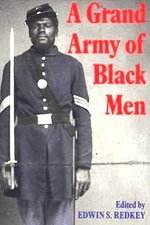
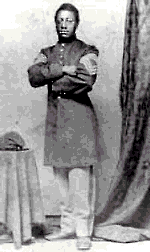
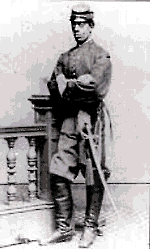
Douglass becomes a recruiter for the 54 th Massachusetts Infantry, the first regiment of African-American soldiers; his sons Lewis and Charles join the regiment. Eventually his son Frederick Douglass Jr. becomes an army recruiter also. About 180,000 African Americans serve in the Civil War on the Union side.
August 10
Meets with President Lincoln to discuss the unequal pay and poor treatment black soldiers receive. |
1864 |
August 19
Meets with Lincoln again. In case the war is not a total Union victory, Lincoln asks Douglass to prepare an effort to assist slaves escaping to the North. |
1865 |
April 14
Lincoln is assassinated.
December 18
The Thirteenth Amendment to the Constitution, outlawing slavery, is ratified. |
1865-95 |
Douglass lectures on Reconstruction and women's rights. |
1870 |
Edits and then owns the New National Era , a weekly newspaper for African Americans. He loses ten thousand dollars when the paper folds in 1874.
Fifteenth Amendment to the Constitution adopted. This amendment states that the rights of citizens to vote cannot be denied "on account of race, color, or previous condition of servitude." |
1871 |
President Ulysses S. Grant appoints Douglass to the commission investigating the possibility of annexing the Dominican Republic to the U.S. |
1872 |
The Equal Rights Party nominates Douglass for vice-president of the United States on a ticket headed by Victoria C. Woodhull.
Douglass moves his family to Washington, D.C., after a mysterious fire destroys his home in Rochester. He attributes the fire to arson. |
1874 |
March
Becomes president of the troubled Freedmen's Savings and Trust Company. Works with the chairman of the Senate Finance Committee to save the bank, which ultimately fails. |
1875 |
Congress passes a Civil Rights Act prohibiting discrimination in public places. |
| 1877 |
Douglass is appointed U.S. marshal of the District of Columbia by President Hayes. |
| 1878 |
Purchases Cedar Hill, in Anacostia, Washington, D.C. The twenty-room house sits on nine acres of land. He later expands the estate by buying fifteen acres of adjoining land. |
| 1881 |
Publishes his third and final autobiography, The Life and Times of Frederick Douglass. Address for John Brown |
|
President Garfield appoints one of his own friends to the post U.S. Marshall and makes Douglass recorder of deeds for the District of Columbia, then a high-paying job. |
| 1882 |
August 4
Douglass's wife of forty-four years, Anna Murray Douglass, dies after suffering a stroke. Douglass goes into a depression. |
| 1883 |
The U.S. Supreme Court rules the Civil Rights Act of 1875 unconstitutional. |
| 1884 |
January 24
Douglass marries Helen Pitts, a white woman who had been his secretary when he was recorder of deeds. The interracial marriage causes controversy among the Douglasses' friends, family, and the public. |
| 1886-87 |
Tours Europe and Africa with wife. |
| 1889 |
July 1
Appointed U.S. minister resident and consul general, Republic of Haiti, and chargé d'affaires, Santo Domingo. Arrives in Haiti in October. |
| 1890 |
The U.S. government instructs Douglass to ask permission for the U.S. Navy to use the Haitian port town of Môle St. Nicholas as a refueling station. |
| 1891 |
In April Haiti rejects the Navy's proposal as too intrusive. The U.S. press reports that Douglass is too sympathetic to Haitian interests. Douglass resigns as minister to Haiti in July. |
| 1892-93 |
Douglass is commissioner in charge of the Haitian exhibit at the World's Columbian Exposition in Chicago. |
| 1895 |
February 20
Speaks at a meeting of the National Council of Women in Washington, D.C. Dies suddenly that evening of heart failure while describing the meeting to his wife.
|
|
|
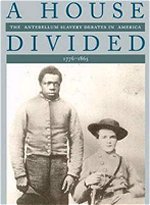
A House Divided: The Antebellum Slavery Debates in America, 1776-1865
An excellent overview of the antebellum slavery debate and its key issues and participants.
The most important abolitionist and proslavery documents written in the United States between the American Revolution and the Civil War
Night Boat To Freedom
Night Boat to Freedom is a wonderful story about the Underground Railroad, as told from the point of view of two "ordinary" people who made it possible. Beyond that, it is a story about dignity and courage, and a devotion to the ideal of freedom.
Kindle Available
The Missouri Compromise and Its Aftermath: Slavery and the Meaning of America
Go behind the scenes of the crucial Missouri Compromise, the most important sectional crisis before the Civil War, the high-level deal-making, diplomacy, and deception that defused the crisis
Kindle Available
Many Thousands Gone: The First Two Centuries of Slavery in North America
The evolution of black society from the first arrivals in the early seventeenth century through the Revolution
Kindle Available
Nothing but Freedom
Emancipation and Its Legacy
Insights into the relatively neglected debates over fencing laws and hunting and fishing rights in the postemancipation South, and into the solidarity of the low-country black community

History's Mysteries
Human Bondage
The story of Africans forcibly enslaved and shipped to America is a well-known tale; yet, it is just one tragic episode in the saga of world slavery. For nearly 6,000 years of recorded history, conquerors have imprisoned their enemies and forced them to act as laborers
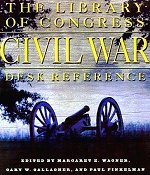
The Library of Congress
Civil War Desk Reference
The conflict that from 1861 to 1865 took 620,000 lives, laid waste to large sections of the South, and decided the future course of the nation. Drawn from the Library's unparalleled Civil War collections including previously unpublished letters and diaries, maps and photographs |