Kindle Available Tennessee in the Civil War Selected Contemporary Accounts of Military and Other Events, Month by Month |
Memphis
|
|
|
|
|
Kindle Available Wolf of the Deep: Raphael Semmes and the Notorious Confederate Raider CSS Alabama In July 1862, the Confederate captain Raphael Semmes received orders to report to Liverpool, where he would take command of a secret new British-built steam warship. His mission: to prey on Union commercial vessels and undermine the North's ability to continue the war |
Kindle Available Standard Catalog of Civil War Firearms |
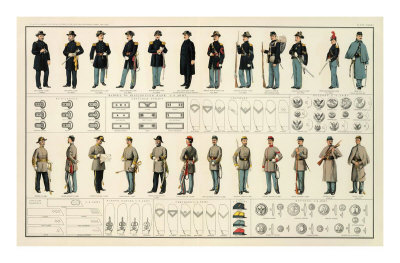
Civil War: Uniforms, US and Confederate Armies 48 in. x 31.5 in. $169.99 Buy at AllPosters.com Framed |
Kindle Available Reign of Iron: The Story of the First Battling Ironclads, the Monitor and the Merrimack The first ironclad ships to fight each other, the Monitor and the Virginia (Merrimack), were the unique products of American design genius |
 Ironclads and Big Guns of the Confederacy : The Journal and Letters of John M. Brooke Information about the Confederate Navy's effort to supply its fledgling forces, the wartime diaries and letters of John M. Brooke tell the neglected story of the Confederate naval ordnance office, its innovations, and its strategic vision. |
"The Total Annihilation of the Rebel Fleet by the Federal Fleet under Commodore Davis." "On the Morning of June 6th 1862, off Memphis, Ten." Lithograph by Middleton, Strobridge & Co. In the foreground, the print depicts the Confederate ships (from left to right): General M. Jeff Thompson (shown sinking); Little Rebel (shown burning); General Sterling Price ; General Beauregard (shown being rammed by the Ellet Ram Monarch ); General Bragg (shown aground) and Colonel Lovell (shown sinking). In the background are the Federal warships (from left to right): Queen of the West ; Cairo ; Carondelet ; Louisville ; Saint Louis ; a tug; and Benton . The city of Memphis is in the right distance, with a wharf boat by the shore. 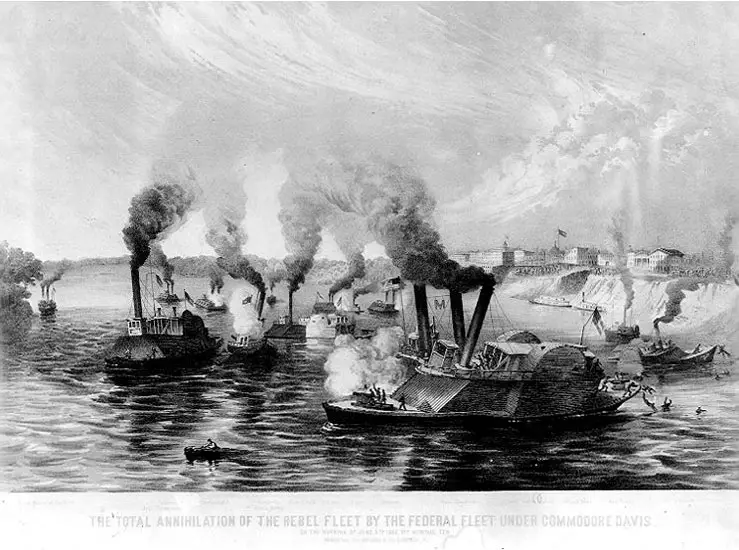 More Confederate and Union Navy Ships and Battles |
Kindle Available Men of Fire: Grant, Forrest, and the Campaign That Decided the Civil War In the winter of 1862, on the border between Kentucky and Tennessee, two extraordinary military leaders faced each other in an epic clash that would transform them both and change the course of American history forever |
Tennessee State Battle Map State Battle Maps American Civil War Exhibits Documents of the Civil War Civil War Timeline Women in the War Ships and Naval Battles Confederate Supplies |
 Sid Meier's Civil War Collection Take command of either Confederate or Union troops and command them to attack from the trees, rally around the general, or do any number of other realistic military actions. The AI reacts to your commands as if it was a real Civil War general, and offers infinite replayability. The random-scenario generator provides endless variations on the battles |
Kindle Available The H. L. Hunley The Secret Hope of the Confederacy On the evening of February 17, 1864, the Confederacy H. L. Hunley sank the USS Housatonic and became the first submarine in world history to sink an enemy ship. Not until World War I "half a century later” would a submarine again accomplish such a feat. But also perishing that moonlit night, vanishing beneath the cold Atlantic waters off Charleston, South Carolina, was the Hunley and her entire crew of eight |
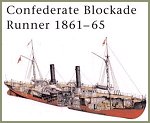 Confederate Blockade Runner 1861-65 The blockade runners of the Civil War usually began life as regular fast steam-powered merchant ships. They were adapted for the high-speed dashes through the Union blockade which closed off all the major Southern ports, and for much of the war they brought much-needed food, clothing and weaponry to the Confederacy |
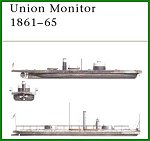 Union Monitor 1861-65 The first seagoing ironclad was the USS Monitor, and its profile has made it one of the most easily recognised warships of all time. Following her inconclusive battle with the Confederate ironclad Virginia on March 9, 1862, the production of Union monitors was accelerated. By the end of the year a powerful squadron of monitor vessels protected the blockading squadrons off the Southern coastline, and were able to challenge Confederate control of her ports and estuaries |
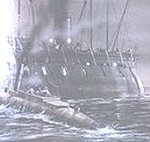 Confederate Submarines and Torpedo Vessels 1861-65 Interesting information and many excellent illustrations. It addresses the CSA David class torpedo boats and the Hunley (and its predecessors), as well as Union examples such as the Alligator and the Spuyten Duyvil |
Kindle Available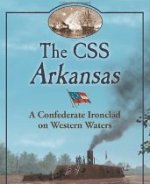 The CSS Arkansas: A Confederate Ironclad on Western Waters While the Monitor and Merrimack are the most famous of the Civil War ironclads, the Confederacy had another ship in its flotilla that carried high hopes and a metal hull. The makeshift CSS Arkansas, completed by Lt. Isaac Newton Brown and manned by a mixed crew of volunteers, gave the South a surge of confidence when it launched in 1862. |
 The Hunt for the Albemarle Anatomy of a Gunboat War The Confederate ironclad Albemarle was the key to the river wars in North Carolina. Flusser's search for this ship would determine the success or failure of the Union navy in securing the North Carolina coast and rivers. |
 Northern Naval Superiority and the Economics of the American Civil War Author David Surdam has finally done what others should have done years ago: he has connected the dots between the detailed studies of blockade running, weapons production, materials production, rail transport, and naval strategy to produce a definitive analysis of the blockade's effectiveness. |
 The Confederate Navy in Europe Full account of the European activities of the Confederate navy during the American Civil War, including information on the Southerners who procured naval vessels in Great Britain and France, the construction of the ships, and the legal and political impact on the European governments that assisted in the Confederate cause. |
|
Books Civil War Womens Subjects Young Readers Military History DVDs Confederate Store Civil War Games Music CDs Reenactors |
