|
|
|
|
The Racial Causes Behind The American Civil War General Lee and his Drummer Boy  The Gettysburg Address in Translation: What It Really Means How long is four score and seven years? Just what are unalienable rights? This translation makes important historical documents meaningful. Each book translates the work of a primary source into a language you can understand  A Ballad of the Civil War A wonderful chapter book for children that should help them to appreciate the fact that some people could not defend a person's right to own other people and to understand that sad era that ended in the "brothers' war." 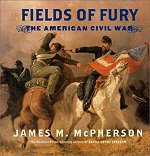 Fields of Fury The American Civil War Written for young readers a stirring account of the greatest conflict to happen on our nation's soil, the Civil War, bringing to life the tragic struggle that divided not only a nation, but also friends and family. 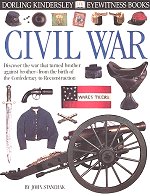 Eye Witness Civil War Eyewitness Civil War includes everything from the issues that divided the country, to the battles that shaped the conflict, to the birth of the reunited states. Rich, full-color photographs |
Lee and his Drummer Boy
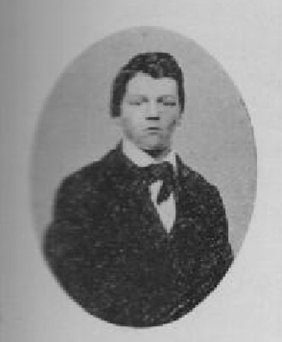
There is a story told about General Lee: After the battle of Second Manassas, General Lee was seated on Traveller at the Groveton crossroads, watching his soldiers digging graves for the burial Now, the drummer boy, his shock of sandy hair caked with greasy dirt, his shallow face black with smudges of powder, his homespun clothes in tatters, came up to Traveller’s stirrup and, laying a hand on the big stallion’s moist shoulder, said to General Lee, in a quavering voice: “Please sir, why must the men fight?”
For a moment, General Lee’s dark eyes fell full on the drummer boy’s face; then his gaze swept away over the dismal battlefield, and he raised a gauntleted hand and rubbed the back of his neck wearily, thinking of what to say. With the horrible field in front of him, he knew it would be a waste of words to recount the political history of the Union: the eighty years of rising tension between the sections—the political storms in the congress that produced the Missouri Compromise in 1820, and its repeal in 1850; the incessant harangues of the abolitionists, made in the Senate, the pulpit and the press; the violent, bitter struggle for control of the Kansas territory; the wanton murders John Brown committed seizing Harper’s Ferry in 1859; even Lincoln’s instigation of the war, using Fort Sumter like a stone thrown into a hornet’s nest, was too abstract, too ambiguous an answer. General Lee looked down at the drummer boy. He might say, he thought, that the men must fight for slavery—must fight to keep the institution secure, that Cotton is king, and with African negro slaves, the South owns the king—but that, too, was still too abstract an answer. And that Cotton was king certainly had nothing to do with Virginia. For Virginia it was simply a matter of refusing Lincoln’s call to suppress the secession. But how to tell the boy what caused the civil war? “How old are you, son?” General Lee asked, shifting his seat in the saddle and reaching down to put a hand on the boy’s shoulder. “Fifteen.” General Lee sighed, straightened, and looked away again; his thoughts embracing the blackness of his generalship: The war was being fought by boys. Almost one tenth of the soldiers in his army had enlisted at fifteen, half were seventeen or younger, most of the rest no older than twenty-one. All their future was like a dark corridor reeking of misery and death, its door at the end a pin-point. For an instant, a flash of lamentation swept through General Lee’s mind, his wasted calling, his hopeless future, already burdening him with dreams of souls streaming from the battlefields he had created. He breathed in suddenly with all his might the sweet smell of death that rose from the battlefield and it deepened his sadness. And he could think of nothing to say, except the truth, felt nothing but the urgent need to give the boy the answer, soothing the turmoil in his mind. “Where do you hail from, son?” he queried, looking down at the boy with a quiet smile of affection, as though he were a favorite friend. “From Loudoun County, sir,” the boy replied, his heart throbbing. “Do you have brothers?”
General Lee looked off again toward the battlefield, nodding his head slowly. The boy could see a crease show on Lee’s smooth brow. A moment passed and still looking at the field, bathed now in the glow of twilight, Lee said, “Suppose Pope had beaten us here and Richmond was now falling, and the war was ending. How would you feel, son?” The drummer boy looked up at General Lee earnestly, his hands gripping suddenly Traveller’s black mane. “Beaten you mean? Beaten? the boy said incredulously, his eyes like deep wells of light searching Lee’s face for confirmation. “Yes, that is what I mean,” Lee replied softly. A look of bewilderment came over the drummer boy’s face. He stared fixedly at Lee, his eyes widened, and the muscles of his face were quivering, as though he were struggling in confusion to comprehend. His flashing thoughts were of his mother and sisters at home, in Middleburg—he saw the column of bluecoat soldiers marching in the main street, squads breaking off down the lanes and one of them invading their home, the soldiers jeering at the women, jostling them aside, rummaging about breaking things, taking things. He felt suddenly more miserable than he could imagine possible. His powder-smirched face flamed red with blushing, as his pounding heart rushed blood through his veins. He felt a terrible impotency and, suddenly, he withdrew his hands from Traveller’s neck and balled them into fists in a rage. He felt an intense shame, self-contempt, loss of self-respect; realizing the whole world would be laughing if the battle had been lost. General Lee remained silent, watching the boy. He saw that the boy was gaining the light, that he was gaining control of himself, settling his emotions with a cold countenance, with an inner spring of steel welling up. The boy saw now that the war was a dire necessity, costly but worth the cost to hold out to the last, that every nation needs men willing to die for its survival, and Virginia and her allies must prove themselves no less a nation than the Union. The drummer boy’s eyes cleared and the muscles of his face became chiseled as in brown stone. He hitched up the straps of his drum cradle and, folding his arms across his chest, stepped back a pace. The wafting sound of a bugle faintly echoed Tattoo over the field. Both he and Lee turned their heads to the sound and listened. They could see the soldiers in the field had finished with their digging and the day was done.
:”We will fight them!” the boy suddenly exclaimed; “we will drive them from Virginia, General, I’m sure of it. We’ll teach them how hard it will go for them, making war on us!” The sound of horses galloping came to their ears and their eyes turned from their mutual look of warm understanding, and they saw the bobbing figures of a crowd of riders coming toward them on the pike. “You see my staff officers have found me,” Lee said, “and no doubt your sergeant is worried about you.” “Yes, sir!” the drummer boy said, raising his hand in salute. “The regiment needs me. And it’s time I gave up this drum and went into the ranks.” General Lee raised his rein-hand just an inch and Traveller pranced forward a step, his head coming up with his ears pricked. “Well, then, go son,” Lee said as he returned the boy’s salute. “Your regiment will need you in the ranks.” And he put Traveller to the trot and moved to meet the cavalcade. |
|||
Written by: Joe Ryan
|
12 Inch Action Figures 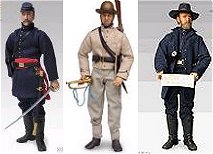 |
Kids Zone Exhibits Civil War Cooking Civil War Games Civil War Exhibits Ships and Naval Battles State Battle Maps Women in the War Civil War Picture Album Maps of the Civil War Civil War Timeline Young Reader Books |
|
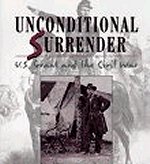 Unconditional Surrender U. S. Grant and the Civil War This is the best juvenile biography on Ulysses S. Grant by a wide margin. Marrin has done an excellent job in introducing Grant to a young audience. I highly recommend it. |
 Weapons and Strategies of the Civil War For grades 3-6 which packs 48 pages with color photos and 30 links providing quality Internet sites for more research. Chapter notes, a bibliography and an index round out information and assure not just accuracy, but constant updates to research information. |
A Ballad of the Civil War A wonderful chapter book for children that should help them to appreciate the fact that some people could not defend a person's right to own other people and to understand that sad era that ended in the "brothers' war." It has four chapters with a prologue and a closing author's note. The conversations that Tom has with the household slave "Uncle Roger" provide some unique insight into the dilemma that slaves faced in the antebellum South |
Fields of Fury The American Civil War Written for young readers a stirring account of the greatest conflict to happen on our nation's soil, the Civil War, bringing to life the tragic struggle that divided not only a nation, but also friends and family. well-organized, well-executed, kid-friendly history of the Civil War was a brilliant idea if there ever was one. It's difficult to imagine anyone doing a better job than McPherson at breaking down this complex, interrelated series of events. |
Kindle Available Civil War on Sunday Mary Pope Osborne's tremendously popular Magic Tree House series launches into a new realm, as Jack and Annie are challenged to save Camelot. Young readers will effortlessly learn the basics of Civil War history, while losing themselves in another gripping tale that has turned many a nonreader into a bookworm. (Ages 5 to 8) |
 Clara Barton: Spirit of the American Red Cross Ready To Read - Level Three Clara Barton was very shy and sensitive, and not always sure of herself. But her fighting spirit and desire to help others drove her to become one of the world's most famous humanitarians. Learn all about the life of the woman who formed the American Red Cross. |
Kindle Available The Civil War for Kids History explodes in this activity guide spanning the turmoil preceding secession, the first shots fired at Fort Sumter, the fierce battles on land and sea, and finally the Confederate surrender at Appomattox. Making butternut dye for a Rebel uniform, learning drills and signals with flags, decoding wigwag, baking hardtack, reenacting battles, and making a medicine kit bring this pivotal period in our nation's history to life. |
Eye Witness Civil War Eyewitness Civil War includes everything from the issues that divided the country, to the battles that shaped the conflict, to the birth of the reunited states. Rich, full-color photographs of rare documents, powerful weapons, and priceless artifacts plus stunning images of legendary commanders, unsung heroes, and memorable heroines |
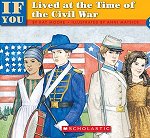 If You Lived at the Time of the Civil War All of the "If you Lived at the Time of..." books are great for kids, and also a nice, quick read for adults! What I like about them is their layout, which is easy for readers to follow. Each page begins with a question, "Would you have seen a battle in the South?" for example. Nicely drawn illustrations accompany each answer. |
 Day Of Tears Through flashbacks and flash-forwards, and shifting first-person points of view, readers will travel with Emma and others through time and place, and come to understand that every decision has its consequences, and final judgment is passed down not by man, but by his maker. |
Kindle Available The Civil War Introduces young readers to the harrowing true story of the American Civil War and its immediate aftermath. A surprisingly detailed battle-by-battle account of America's deadliest conflict ensues, culminating in the restoration of the Union followed by the tragic assassination of President Lincoln |
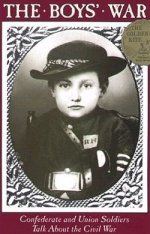 The Boys War With the many boys who fought in the civil war most of them lied about their age. A lot of them wrote letters or had a diary. Johnny Clem had run away from his home at 11. At age 12 he tried to enlist but they refused to let him join because he was clearly too young. The next day he came back to join as a drummer boy. |
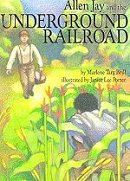 Allen Jay and the Underground Railroad Allen Jay and the Underground Railroad is the retelling of a man's recollections of his first experience helping an escaped slave. The book brings the underground railroad down to the level primary students can comprehend. This book makes for wonderful discussions regarding overcoming one's fears, going against the norm and doing what you believe to be morally correct. |
Kindle Available The Glory Cloak: A Novel of Louisa May Alcott and Clara Barton From childhood, Susan Gray and her cousin Louisa May Alcott have shared a safe, insular world of outdoor adventures and grand amateur theater -- a world that begins to evaporate with the outbreak of the Civil War. Frustrated with sewing uniforms and wrapping bandages, the two women journey to Washington, D.C.'s Union Hospital to volunteer as nurses. |
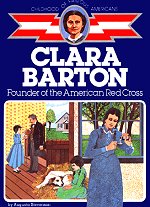 Clara Barton Founder of the American Red Cross Young Clara Barton is shy and lonely in her early days at boarding school. She is snubbed by the other girls because she doesn't know how to talk to them. But when she gets an opportunity to assist the local doctor, her shyness disappears, and Clara begins to discover her true calling as a nurse. |
Kindle Available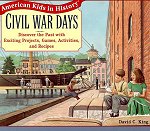 Civil War Days: Discover the Past with Exciting Projects, Games, Activities, and Recipes Dozens of projects and activities that will take you back to the days of the American Civil War Travel back to 1862 and spend a year with the Wheelers, an African American family in New York City, and the Parkhursts, a white family in Charleston, South Carolina, Eleven-year-old Emily Parkhurst and twelve-year-old Timothy Wheeler are eager to share the fun, adventure, and hard work of their daily lives. Along the way, they'll show you how to play the games they play and make the toys and crafts they make. |
Reference:
National Park Service
| Search AmericanCivilWar.com |
| Enter the keywords you are looking for and the site will be searched and all occurrences of your request will be displayed. You can also enter a date format, April 19,1862 or September 1864. |

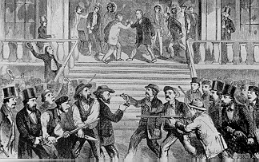
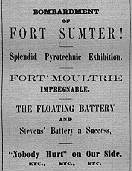 On April 12, 1861 the Confederate States of America attacked
 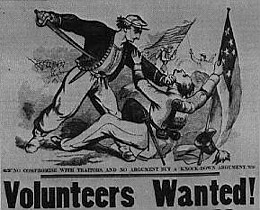 sent for service in the field. Many young men chose to enlist and volunteered for military service. In the South, men readily went to war to protect their homes and save the Southern way of life. Most did not believe that the government in Washington was looking out for the South's interests and they were better off as a new nation where the states would make up their own laws. Many were happy to be called rebels because they thought they were fighting against a tyrant like their forefathers did against the British during the American Revolution. Northern men volunteered to put down the rebellion of southern states and bind the nation back together. Most felt that the Southerners had rebelled without good cause and had to be taught a lesson. Some also felt that slavery was an evil and the war was a way abolish it. No one knew how terrible war really was and how hard life as a soldier could be. They did not have television or radio to communicate the terrible things that could happen. Politicians did not communicate either, which was one of the main reasons for the war and misunderstandings between North and South. The armies were raised and marched off to war. It was only after many battles and many lives were lost that the American people realized how horrible war really was. The soldiers communicated with their families and loved ones and told them of the hardships they endured and terrible scenes they had witnessed.
 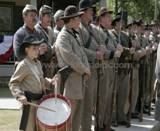 of their pals. A drummer boy from the 40th Virginia Regiment, Field’s Brigade, Hill’s division approached him, trembling and in tears. Two days before, the boy had been at the railroad cut and had witnessed his regiment’s bloody struggle with the bluecoats of Leasure’s brigade, Kearny’s division, Heintzelman’s corps. And the day before he had steadily beaten his drum, despite the terrifying whine and explosion of the shells, advancing with the pitiful few left of the regiment after Pope’s final attack had failed.

 “Yes,” the drummer boy answered; “my brother,
sixteen years old, was first of the family to enlist, and then I followed.”
“Yes,” the drummer boy answered; “my brother,
sixteen years old, was first of the family to enlist, and then I followed.”