Ulysses S. Grant
|
|
|
|
|
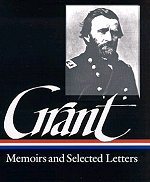 Ulysses S. Grant : Memoirs and Selected Letters Grant wrote his "Personal Memoirs" to secure his family's future. In doing so, the Civil War's greatest general won himself a unique place in American letters. His character, sense of purpose, and simple compassion are evident throughout this deeply moving account, as well as in the letters to his wife, Julia |
| DVD  Ulysses S. Grant Warrior President Grant pushed for the annexation of Hispaniola, not to relocate blacks, but to give them the option to leave, thus impressing upon white southerners the importance of black people in their labor force and encouraging them to pay better wages and treat their employees better  Unconditional Surrender: U. S. Grant and the Civil War This is the best juvenile biography on Ulysses S. Grant by a wide margin. Marrin has done an excellent job in introducing Grant to a young audience. |
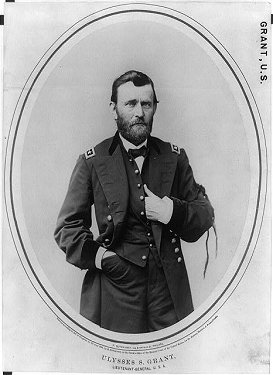
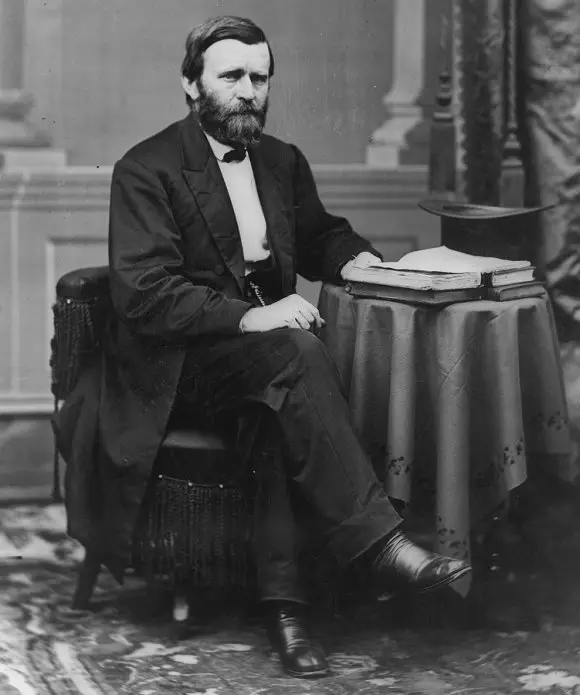
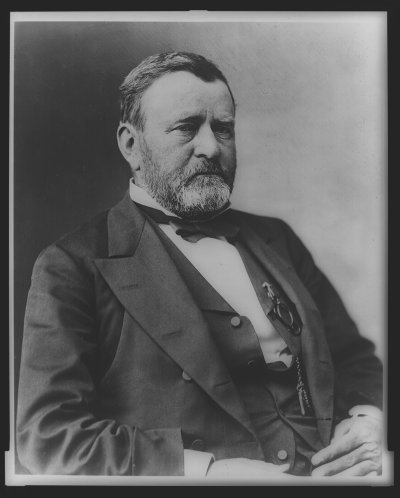
The man we know as Ulysses S. Grant was actually named Hiram Ulysses Grant. As a boy he was known as "Lyss". Thomas Hamer, the Congrssman who appointed Grant to West Point, forgot all about Hiram. Remembering that Grant's mother's maiden name was Simpson and thinking that was Lyss Grant's middle name, he filled out the application in the name of "Ulysses S. Grant". When Grant arrived at West Point and discovered that the Academy had him registered under the wrong name, he tried to get the error corrected. He was told that it didn't matter what he or his parents thought his name was, the official government application said his name was "Ulysses S." and that application could not be changed. If Hiram U. Grant wanted to attend West Point, he would have to change his name. Biography: Late in the administration of Andrew Johnson, Gen. Ulysses S. Grant quarreled with the President and aligned himself with the Radical Republicans. He was, as the symbol of Union victory during the Civil War, their logical candidate for President in 1868. When he was elected, the American people hoped for an end to turmoil. Grant provided neither vigor nor reform. Looking to Congress for direction, he seemed bewildered. One visitor to the White House noted "a puzzled pathos, as of a man with a problem before him of which he does not understand the terms." Born in 1822, Grant was the son of an Ohio tanner. He went to West Point rather against his will and graduated in the middle of his class. In the Mexican War he fought under Gen. Zachary Taylor. At the outbreak of the Civil War, Grant was working in his father's leather store He sought to win control of the Mississippi Valley. In February 1862 he took Fort Henry and attacked Fort Donelson. When the Confederate commander asked for terms, Grant replied, "No terms except an unconditional and immediate surrender can be accepted." The Confederates surrendered, and President Lincoln promoted Grant to major general of volunteers. At Shiloh in April, Grant fought one of the bloodiest battles in the West and came out less well. President Lincoln fended off demands for his removal by saying, "I can't spare this man--he fights." For his next major objective, Grant maneuvered and fought skillfully to win Vicksburg, the key city on the Mississippi, and thus cut the Confederacy in two. This was the culmination of one of the most brilliant military campaigns of the war. With the loss of Pemberton's army and this vital stronghold on the Mississippi, the Confederacy was effectively split in half. Grant's successes in the West boosted his reputation, leading ultimately to his appointment as General-in-Chief of the Union armies. Then he broke the Confederate hold on Chattanooga. Lincoln appointed him General-in-Chief in March 1864. Grant directed Sherman to drive through the South while he himself, with the Army of the Potomac, pinned down Gen. Robert E. Lee's Army of Northern Virginia. Finally, on April 9, 1865, at Appomattox Court House, Lee surrendered. Grant wrote out magnanimous terms of surrender that would prevent treason trials. As President, Grant presided over the Government much as he had run the Army. Indeed he brought part of his Army staff to the White House. Although a man of scrupulous honesty, Grant as President accepted handsome presents from admirers. Worse, he allowed himself to be seen with two speculators, Jay Gould and James Fisk. When Grant realized their scheme to corner the market in gold, he authorized the Secretary of the Treasury to sell enough gold to wreck their plans, but the speculation had already wrought havoc with business. During his campaign for re-election in 1872, Grant was attacked by Liberal Republican reformers. He called them "narrow-headed men," their eyes so close together that "they can look out of the same gimlet hole without winking." The General's friends in the Republican Party came to be known proudly as "the Old Guard." Grant allowed Radical Reconstruction to run its course in the South, bolstering it at times with military force. After retiring from the Presidency, Grant became a partner in a financial firm, which went bankrupt. About that time he learned that he had cancer of the throat. He started writing his recollections to pay off his debts and provide for his family, racing against death to produce a memoir that ultimately earned nearly $450,000. Soon after completing the last page, in 1885, he died. |
Comment by Author Joe Ryan Read Joe Ryan Original Works |
Grant is quite a character. He will be the last man standing in the end. It is clear that Lincoln and the military men around him thought of Grant as the last person they wanted to command troops in any important moment and sector. Only after Buell, and then Rosecrans, fail to deliver does Lincoln turn to Grant after Grant captures Vicksburg. At that point Lincoln puts Grant in command of the concentration against Chattanooga, where we have a series of battles, Missionary Ridge, Chickamunga, Lookout Mountain etc. Grant, unlike Buell and Rosecrans, is operating with all the forces in the West and I find that he left tactical command of the battles to others, like Hooker and Thomas. Grant's sole claim to fame, that I can see, is that he understood the principle the guy with the most men wins, and simply caused battles to happen, leaving the details to others, trusting that the pool of bodies he threw in was deeper than the pool opposing his.
From April 1862 to the end, the war turned on only three strategic points: Vicksburg, Chattanooga, and Richmond. He ended up responsible for the capture of the first two, at which point Richmond was a mopping up operation. So he came east to finish the job, leaving the Army of the Potomac to Meade to command. Lee repulsed him at every step but lacked the man power to drive him away. General Grant's Vicksburg Campaign |
|
General Grant reconnoitering the confederate position at Spotsylvania court house. Art Print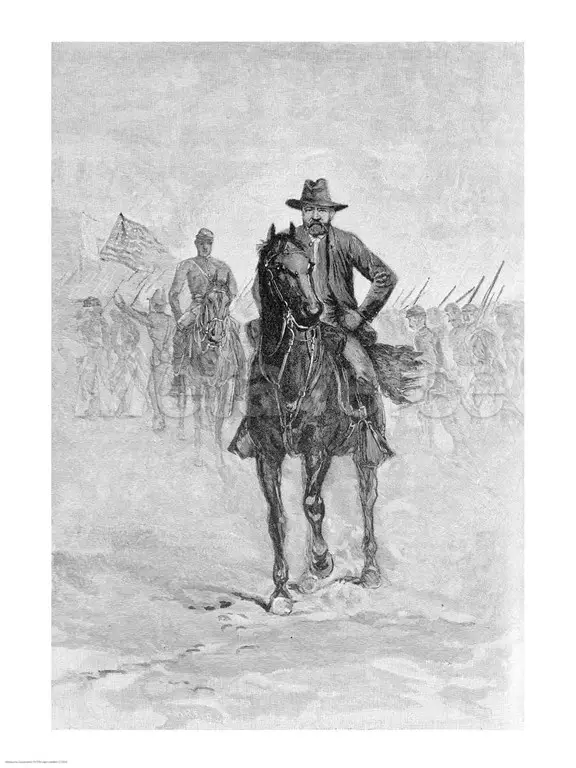 |
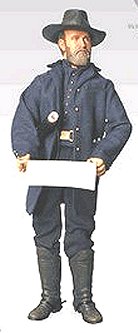 General US Grant 12 inch Action Figure |
Union Generals Confederate Commanders Civil War Exhibits Timeline of the War State Battle Maps President Abraham Lincoln Civil War Summary Civil War Picture Album Kids Zone Underground Railroad Civil War Submarines |
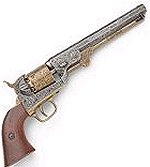 Civil War Model 1851 Naval Pistol Engraved Silver Tone / Gold Tone Finish and Wooden Grips - Replica of Revolver Used by Both USA / Union and CSA / Confederate Forces |
 |
 |
Civil War Union Generals Book Titles
|


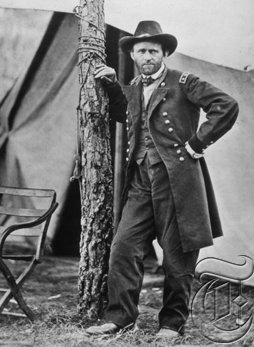
 in Galena, Illinois. He was appointed by the Governor to command an unruly volunteer regiment. Grant whipped it into shape and by September 1861 he had risen to the rank of brigadier general of volunteers.