Perryville: This Grand Havoc of Battle
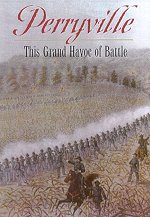
On October 8, 1862, Union and Confederate forces clashed near Perryville, Kentucky, in what would be the largest battle ever fought on Kentucky soil.

Perryville
Civil War in Kentucky

American Civil War
October 8, 1862


Mosby's Memoirs
Old soldiers tend to exaggerate their war stories; and they occasionally ramble. Mosby's Memoirs are fascinating. His view on the events leading up to Gettysburg. The colonel discusses the merits and failures of various generals and officers in the war..

Confederate Heartland Campaign Map

Confederate General Braxton Bragg's autumn 1862 invasion of Kentucky had reached the outskirts of Louisville and Cincinnati, but he was forced to retreat and regroup.

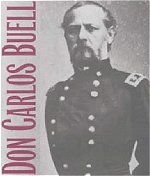
On October 7, the Federal army of Major General Don Carlos Buell, numbering nearly 55,000, converged on the small crossroads town of Perryville, Kentucky, in three columns.   Union forces first skirmished with Rebel cavalry on the Springfield Pike before the fighting became more general, on Peters Hill, as the grayclad infantry arrived.

The next day, at dawn, fighting began again around Peters Hill as a Union division advanced up the pike, halting just before the Confederate line. The fighting then stopped for a time. After noon, a Confederate division struck the Union left flank and forced it to fall back.

When more Confederate divisions joined the fray, the Union line made a stubborn stand, counter attacked, but finally fell back with some troops routed. Buell did not know of the happenings on the field, or he would have sent forward some reserves. Even so, the Union troops on the left flank, reinforced by two brigades, stabilized their line, and the Rebel attack sputtered to a halt.

Later, a Rebel brigade assaulted the Union division on the Springfield Pike but was repulsed and fell back into Perryville. The Yankees pursued, and skirmishing occurred in the streets in the evening before dark.

Union reinforcements were threatening the Rebel left flank by now. Bragg, short of men and supplies, withdrew during the night, and, after pausing at Harrodsburg, continued the Confederate retrograde by way of Cumberland Gap into East Tennessee.

The Confederate offensive was over, and the Union controlled Kentucky.

Result(s): Union strategic victory

Location: Boyle County

Campaign: Confederate Heartland Offensive (1862) Previous Battle in Campaign    Campaigns

Date(s): October 8, 1862

Principal Commanders: Major General Don Carlos Buell [US]; General Braxton Bragg [CS]

Forces Engaged: Army of the Ohio [US]; Army of the Mississippi [CS]

Estimated Casualties: 7,407 total (US 4,211; CS 3,196)


All for the Regiment: The Army of the Ohio, 1861-1862
The amateur soldiers who formed the Army of the Ohio organized themselves into individual regiments of remarkable strength. Commanders Anderson, William Sherman, and Don Buell all failed to integrate those regiments


A Hard Trip: A History of the 15th Mississippi Infantry, CSA
The thoughts of the men who formed the 15th Mississippi are front and center with good background about the communities the men came from and the reasons they joined the army.


72 Piece Civil War Army Men
Play Set 52mm Union and Confederate Figures, Bridge, Horses, Canon
  • 48 Union and Confederate Soldiers up to 2-1/8 inches tall
  • 4 Horses, 4 Sandbag Bunkers, 6 Fence Sections, 3 Cannon, 3 Limber Wagons (Ammo Carts)
  • Bridge, Small Barracks,
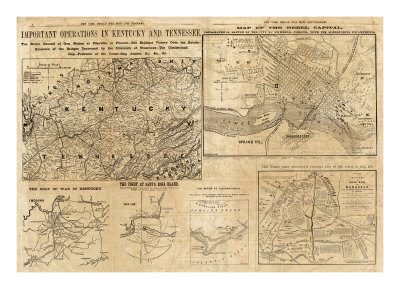
Kentucky Civil War Battle Map
State Battle Maps
Confederate President Jefferson Davis
Underground Railroad
Women Civil War Soldiers
Civil War Music
President Abraham Lincoln
General Ulysses S. Grant
Confederate Commanders
Union Generals
Documents of the Civil War
Civil War Store

The Civil War Reenactors' Encyclopedia
Besides his weapons, the soldier needed a leather belt with a cap box for the percussion caps that fired his weapon, a box for his cartridges, a sling/scabbard for his bayonet, a haversack and/or knapsack to carry his rations and his few personal items
American Civil War Book Titles

CHICAGO'S BATTERY BOYS
The Chicago Mercantile Battery in the Civil War's Western Theater

Organized in 1862 as part of John McClernand's 13th Corps, the battery participated in the arduous Vicksburg campaign. The artillerists performed well everywhere, Chickasaw Bluffs, Port Gibson, Champion Hill, Big Black River, and the siege of Vicksburg

War in Kentucky: From Shiloh to Perryville
Union gains in the Mississippi Valley and in Tennessee and Kentucky had brought the Confederacy to a point of crisis. This addition to the literature on the Civil War in the West tells how the Union then failed to press home its advantage while the Confederacy failed to force Kentucky into the Confederacy

The Last Confederate General: John C. Vaughn and His East Tennessee Cavalry
The first man to raise an infantry regiment in the state, and one of the very last Confederate generals to surrender.History has not been kind to Vaughn, who finally emerges from the shadows in this absorbing reassessment of his life and military career

Wade Hampton: Confederate Warrior to Southern Redeemer
General Wade Hampton was for a time the commander of all Lee's cavalry and at the end of the war was the highest-ranking Confederate cavalry officer

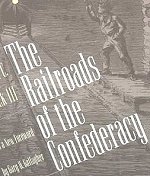
The Railroads of the Confederacy
The story of the first use of railroads on a major scale in a major war. A complex and fascinating tale, with the railroads of the American South playing the part of tragic hero in the Civil War: at first vigorous though immature; then overloaded, driven unmercifully, starved for iron; and eventually worn out

John Hunt Morgan and His Raiders
The "Thunderbolt of the Confederacy" John Hunt Morgan from Tompkinsville, Kentucky to Greeneville, Tennessee.

The Longest Raid of the Civil War: Little-Known & Untold Stories of Morgan's Raid into Kentucky, Indiana & Ohio
Kentucky, a slave state, did not secede. Many were pro Confederate however. Jefferson Davis was from Kentucky, Lincoln was also born there.

Mosby's Rangers
From 1863 to the end, Mosby's raiders were a constant headache for the North. More than 1,000 men served under Mosby, they usually acted in small detachments of several dozen, sacking supply depots, attacking railroads, and harassing federal troops. They seemed to move behind enemy lines almost at will.
Civil War History Documentary DVD Movie Titles

Brother Against Brother: The American Civil War
Fort Sumter, to the Confederate surrender at Appomattox, Features battle reconstructions and depictions of army life, eyewitness accounts, period photographs and engravings, plus commentary and analyses.

History's Mysteries: Family Feud:
The Hatfields And McCoys

Millions of dollars worth of timber and coal rich land were at stake, the courts were involved and once the national press got wind of what was happening, the backwoods folk found that their fight was being followed nationwide

Civil War: A Concise History
The best collection of Civil War visuals ever assembled in one 75-minute program. A breathtaking and first-hand account of the war. Great DVD Bonuses

Gettysburg / Gods and Generals
The tide of the war changes during three fierce days of combat at Gettysburg [Disc 1] the gripping saga of the tactics command errors and sacrifices behind the bloodiest battle ever fought on U.S. soil. Gods and Generals [Disc 2] reveals the spirited allegiances and fierce combat of earlier Civil War struggles

History Channel Presents The Civil War
From Harper's Ferry, Fort Sumter, and First Bull Run to Shiloh, Antietam, and Gettysburg. The most legendary Civil War battles in brilliant detail. A selection of the soldiers and legendary leaders.

The Civil War - A Film by Ken Burns
Here is the saga of celebrated generals and ordinary soldiers, a heroic and transcendent president and a country that had to divide itself in two in order to become one

American Experience: The Massachusetts 54th Colored Infantry
After Lincoln signed the Emancipation Proclamation, the governor of Massachusetts was authorized to raise the first northern black regiment,  the Massachusetts 54th colored infantry.

Blue Vs. Gray - Killing Fields
Relive the most vicious fighting of the Civil War, in which General Ulysses S. Grant forcibly reversed the tide of the conflict by paying with the blood of thousands. It was a desperate time for the Union

Sources:
U.S. National Park Service
U.S. Library of Congress.


Search
AmericanCivilWar.com
 
Enter the keywords you are looking for and the site will be searched and all occurrences of your request will be displayed. You can also enter a date format, April 19,1862 or September 1864.
Battle of Shiloh
Civil War Map
First Manassas
Civil War Pictures
Civil War Cooking
Gettysburg
Civil War Ships