Kindle Available Twenty-Seventh Louisiana Volunteer Infantry The first infantry regiment assigned to the defense of Vicksburg. The author, celebrates the undaunting courage of this regiment during the forty-seven-day siege by Union soldiers before the surrender of Vicksburg |
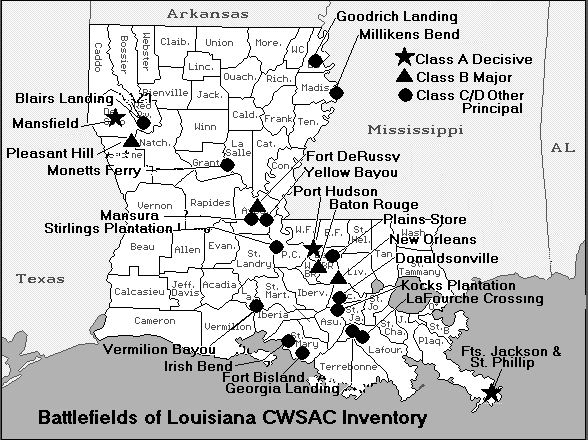
Louisiana Civil War Map of Battles
 |
 The Battle of Baton Rouge A detailed look at an often overshadowed part of the Civil War through his exhaustive genealogical and historical research. This book will be a great boon to anyone interested in the Battle of Baton Rouge and lower Mississipi operations |
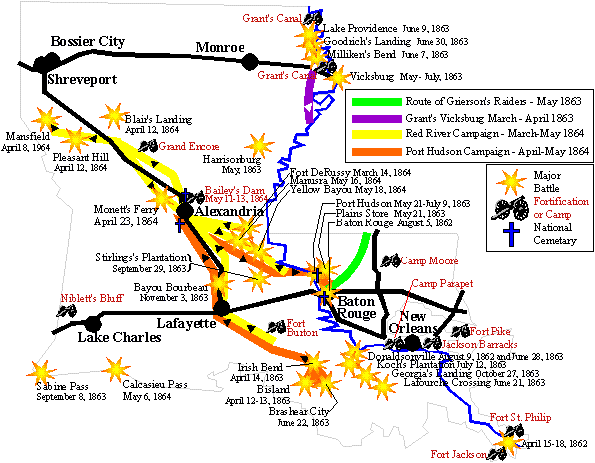 Source: http://www.crt.state.la.us/crt/tourism/civi lwar/cwmap.htm |
|
 Civil War Soldier 102 Piece Playset |
Civil War State Battle Maps American Civil War Exhibits American Civil War Timeline Civil War Summary Confederate President Jefferson Davis Civil War Submarines Women in the Civil War Civil War Period Maps Reenactors Row Supplies |
 1860 Enfield Civil War Musketoon This piece is a full-size non-firing reproduction of the rifle used in the Civil War. The body is made of European hardwood  Sid Meier's Civil War Collection |
 Irish Rebels, Confederate Tigers: A History Of The 6th Louisiana Volunteers A predominately Irish brigade from New Orleans. This regiment fought in Virginia during the entire Civil War, since New Orleans was captured so early in the war and the 6th Louisiana virtually became orphans in regards to State support. |
 The Night the War Was Lost With the fall of the critical city of New Orleans in spring 1862 the South lost the Civil War, although fighting would continue for three more years. On the Mississippi River, below New Orleans, in the predawn of April 24, 1862, David Farragut with fourteen gunboats ran past two forts to capture the South's principal seaport. |
 In Camp and Battle With the Washington Artillery of New Orleans Describes all major actions from the First Battle of Bull Run to the final surrender at Appomatox. A must read for all Civil War buffs. First published in 1885, Reissued in a limited edition that is an exact reproduction of the original, with a few additions |
Kindle Available When the Devil Came Down to Dixie: Ben Butler in New Orleans Butler headed the federal occupation of New Orleans, where he quickly imposed order on a rebellious city. He also made out like a bandit, diverting an enormous amount of money into his personal coffers. High society scorned him for his infamous "Woman Order," |
 Red River Campaign Politics and Cotton in the Civil War Fought on the Red River throughout Central and Northwestern Louisiana, this campaign is a study in how partisan politics, economic need and personal profit determined military policy and operations in Louisiana and Arkansas during the spring of 1864. |
 Civil War in the American West An accurate and detailed history of the Western Theater of the Civil War, which was largely forgotten by history. He was one of the first historians to fully understand the impact that California had on the war as he gives an accounting of the Federal raid on the Dan Showalter Ranch in San Bernadino on October 5, 1861. |
 Tirailleurs: A History of The 4th Louisiana and The Acadians of Company H Soldiers from West Baton Rouge Parish, Louisiana. This book follows them through the Civil War and uses diaries, letters, and memoirs to allow the soldiers to tell their own story. From a bloodbath at Shiloh's Hornet's, Nest, to the Battle of Nashville. |
 Louisianians in the Civil War The suffering endured by Louisianians during and after the war—hardships more severe than those suffered by the majority of residents in the Confederacy. The wealthiest southern state before the Civil War, Louisiana was the poorest by 1880 |
 Brokenburn: The Journal of Kate Stone, 1861-1868 (Library of Southern Civilization) |
Brokenburn: The Journal of Kate Stone, 1861-1868Brokenburn was a large plantation containing over 150 slaves in Madison Parish, Louisiana. From 1862 on, it was in the center of the Union Army's fierce assault to gain control of the Mississippi River and divide the Confederacy in half. Plantations were commandeered and slaves were encouraged to revolt. The civilian population was helpless before the demands of military control. Madison Parish had a population of approximately 9,000 of whom 7,000 were slaves. After 1861, the Parish was emptied of able-bodied white men, most of whom had been sent to far-off Virginia and Tennessee, leaving none to protect the civilians.In 1861, Kate was 20 years old, her immediate future being beaus, courtship, and a gay social life before she settled down to become a proper southern matron. She was unsure whether this route was ideal, as she remarked, "women grew significantly uglier in wedlock and ignored and abandoned their former female friends." This comfortable world was turned upside down, never to reappear again. With great enthusiasm and some trepidation, she watched her three older brothers go off to war. Her widowed mother made it clear that 14-year-old James was now in charge of the running of the plantation and the protection of the rest of the family. |
Civil War History Documentary DVD Movie Titles
|

Sources:
U.S. National Park Service
U.S. Library of Congress.
Baton Rouge Louisiana Weather and City History
|