Civil War Submarines

The Confederate States of America used submarines in combat. They built small, steam-powered submarines, called Davids, named for the Bible's legendary giant-slayer. On Oct. 5, 1863, one of these attacked the USS New Ironsides off the coast of Charleston, South Carolina, disabling but not sinking the ship with a 65-pound spar torpedo.

The Civil War also saw the first submarine to successfully sink its target, the  40-foot-long Hunley , which was operated by eight men turning a hand crank attached to her propeller shaft. The Hunley sank and was recovered three times during trial runs before it was successful. On Feb. 16, 1864, under the cover of darkness, the Hunley sank the USS Housatonic off Charleston. Accounts differ as to the reason, but the Hunley sank soon after sinking the Housatonic . It was discovered in May 1995 off the coast of Charleston and was recovered in August 2000.

In 1861, French inventor Brutus De Villeroi convinced the Union Navy that he could build a submersible warship. On May 1, 1862 the 47-foot-long, oar-propelled Alligator became the first submersible warship of the U.S. Navy. Her first mission was to destroy a bridge and clear obstructions on Virginia's Appomatox and James Rivers, respectively. Unfortunately, neither river was deep enough to allow the Alligator to submerge and she was returned to the Washington Navy Yard. Her next challenge soon came: destroy the new Confederate ironclad, the Virginia II . However, test runs in the Potomac River proved the Alligator was underpowered, unwieldy, and unsafe. The plan was abandoned .

In 1863, after the Alligator's oar system was replaced with a screw propellor, the submarine was sent to help capture Charleston, South Carolina. While being towed south for the battle, the Alligator had to be cut loose during a storm off Cape Hatteras, North Carolina. Her current whereabouts are unknown, but an effort (launched in 2003) by the Office of Naval Research and NOAA could one day reveal the Secrets of the Alligator.

Launched in 1862 during the Civil War, Alligator was an engineering marvel that helped usher in a new era in undersea travel. But until recently, little was known about the green, 47-foot-long Union vessel. The Alligator was lost off the North Carolina coast during a storm in 1863. It was never seen again.


I magine living in Philadelphia during the early days of the Civil War and reading the latest issue of the Philadelphia Evening Bulletin. A front page story reveals a strange and alarming tale: Harbor police have captured a partially-submerged, 33-foot long, cigar-shaped contraption moving slowly down the Delaware River.

This “infernal machine,” as the paper described it, was the creation of French inventor, Brutus De Villeroi. Whether a deliberate publicity stunt or not, DeVilleroi succeeded in convincing the Union Navy that he could produce a submersible warship from which a diver could place an explosive charge under an enemy ship. Six months later, in November 1861, he was under contract to build the Union's first submarine.

Hence begins the little-known story of United States Submarine Propeller U.S.S. Alligator -- a technological wonder akin to other great maritime advances of the Civil War era, including the well-known ironclad USS Monitor , and the recently-raised Confederate submarine, CSS Hunley .

Built in Philadelphia, the 47-foot long Alligator was primarily intended to counter the threat of the Confederate ironclad, the Virginia. Although the Navy specified that the submarine's construction take no more than 40 days at a cost of $14,000, the project suffered long delays. As project supervisor, DeVilleroi delayed completion by making changes during the process of advancing the initial design to an operational Naval vessel. As a result of serious liaison problems with the Navy, the contractor and himself, he effectively exited from the process and was later officially dismissed.
About a month after its launch on May 1,1862, the oar-propelled submarine was towed to Hampton Roads, Virginia. Her first missions: to destroy a strategically important bridge across the Appomattox River and to clear away obstructions in the James River.

When the Alligator arrived at the James River, with civilian Samuel Eakins in charge, a fierce battle was being waged in the area. Because neither the James nor the Appomattox was deep enough to permit the vessel to submerge, it was feared that even a partially visible submarine would be vulnerable to seizure by the Confederates. The Alligator was sent to the Washington Navy Yard, for further experimentation and testing.

In August 1862, Lt. Thomas O. Selfridge accepted command of the submarine, after being promised promotion to captain if he and the Alligator 's new crew destroyed the new Confederate ironclad, the Virginia II . During test runs in the Potomac, the Alligator proved to be underpowered and unwieldy. During one particular trial, the sub's air quickly grew foul, the crew panicked, and all tried to get out of the same hatch at the same time--prompting Selfridge to call the whole enterprise “a failure.” He and his crew were reassigned and the vessel was sent to dry dock for extensive conversion. The dream of using this “secret weapon” against the Virginia II was scrapped.

Over the next six months, the Alligator 's system of oars was replaced by a screw propeller. In early spring 1863, President Lincoln observed a demonstration of the “improved” vessel. Shortly thereafter, RADM Samuel Dupont ordered the Alligator , once again commanded by Eakins, to participate in the capture of Charleston.

Towed by the USS Sumpter , the unmanned Alligator left Washington for Port Royal on March 31, 1863. On April 2nd, a fierce storm forced the crew of the endangered Sumpter to cut the submarine adrift, somewhere off the Cape Hatteras coast. According to reports sent to Secretary of the Navy Welles, the Alligator was “lost” at sea.

Secrets of a Civil War Submarine
On the night of February 17, 1864, history was made when, for the first time ever, a submarine sank an enemy ship. The submarine was the C.S.S. H.L. Hunley, a hand-powered Confederate warship! However, when time came for the Hunley to return to port, it failed to return.


Brutus de Villeroi's booklet of general
Plans for the Alligator


The Alligator was the first submarine to:

Be ordered and built for the U.S.Navy.
Have a diver's lockout chamber
Be deployed to a combat zone.
Have onboard air compressors for air renewal/diver support.
Be commanded by a U.S. Naval officer (who would later achieve Flag rank).
Be designed with an air purifying system.
Have an underway test witnessed by a U.S. president.
Have electrically-detonated limpet mines.
Undergo an overhaul in a U.S. naval shipyard.


U.S.S. Casco
USS Monitor Onondaga

Books
Civil War
Womens Subjects
Young Readers
Gettysburg
Native Americans
Military History


Confederate Store
Civil War DVDs
Civil War VHS
Civil War Games
Civil War Music
Civil War Posters

Military Toys
Military Video Games
Military History DVDs
Military Magazines
US Military Gear

Battle of the Monitor
Civil War Naval Reference
USS General Sherman
United States Navy DVDs
Young Reader Selections
Civil War Recipes and Cookbooks
Civil War Summary
United States Army History Timeline
Civil War Exhibits

 
Web AmericanCivilWar.com
Volcano-Pictures.INFO

Civil War History Book Club Reading Titles

Book Title
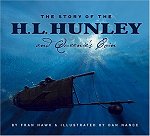
The CSS Hunley
Nine men in a rigged-out steam boiler cranked out of Breach Inlet near Mt.Pleasant, S.C. and changed naval history forever. It was not until 50 years later in 1914 that the next ship would be brought down by a submarine. This crisply written account is an excellent introduction to one of the most facinating subplots of the entire War for Southern Independence. Forced by necessity to outwit their industrial foe the South resorted to and developed many innovations to counter the vulnerability their rivers and coastline presented.
Reading Level Grade 3-4
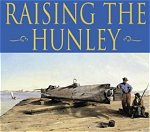
Readers will be immediately engaged with the first lines of this account of the raising of the Hunley on August 8, 2000, and are told that a mystery is about to be solved. Then, step-by-step they are taken back in time to a short discussion of the Civil War, the role of naval blockades, and the dream of James McClintock and Baxter Watson to create an underwater battleship to keep the Southern ports free of Northern ships. The idea did not come quickly to fruition and all of the many difficulties and disappointments are included. The chapters are short but packed with information and, while this is part of an early reading series, there is no sense that the information is simplified.
More Young Reader Selections
Easy Reader Book
Reign of Iron : The Story of the First Battling Ironclads, the Monitor and the Merrimack
The Monitor-Merrimack showdown may be one of the Civil War's most overhyped chestnuts: the two ships were by no means the first ironclads, and their long awaited confrontation proved an anticlimactic draw, their cannon fire clanging harmlessly off each other's hulls. Still, the author of this lively history manages to bring out the story's dramatic elements. Nelson, author of the Revolution at Sea series of age-of-sail adventure novels, knows how to narrate a naval crisis. He gives a harrowing account of the Merrimack's initial onslaught, in which it destroyed two wooden Union warships in a bloody and chaotic battle the day before the Monitor arrived, and of the Monitor's nightmarish final hours as it foundered in a storm at sea.

Glory in the Name : A Novel of the Confederate Navy
April 12, 1861. With one jerk of a lanyard, one shell arching into the sky, years of tension exploded into civil war. And for those men who did not know in which direction their loyalty called them, it was a time for decisions. Such a one was Lieutenant Samuel Bowater, an officer of the United States Navy, a native of Charleston, South Carolina.Hard pressed to abandon the oath he swore to the United States, but unable to fight against his home state, Bowater accepts a commission in the nascent Confederate navy, where captains who once strode the quarterdecks of the world's most powerful ships are now assuming command of paddle wheelers and towboats.

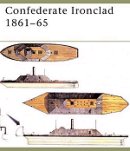
Confederate Ironclad 1861-65
The creation of a Confederate ironclad fleet was a miracle of ingenuity, improvisation and logistics. Surrounded by a superior enemy fleet, Confederate designers adapted existing vessels or created new ones from the keel up with the sole purpose of breaking the naval stranglehold on the nascent country. Her ironclads were build in remote cornfields, on small inland rivers or in naval yards within sight of the enemy. The result was an unorthodox but remarkable collection of vessels, which were able to contest the rivers and coastal waters of the South for five years. This title explains how these vessels worked, how they were constructed, how they were manned and how they fought.
Mississippi River Gunboats of the American Civil War
At the start of the American Civil War, neither side had warships on the Mississippi River and in the first few months both sides scrambled to gather a flotilla, converting existing riverboats for naval use. These ships were transformed into powerful naval weapons despite a lack of resources, trained manpower and suitable vessels. The creation of a river fleet was a miracle of ingenuity, improvisation and logistics, particularly for the South.