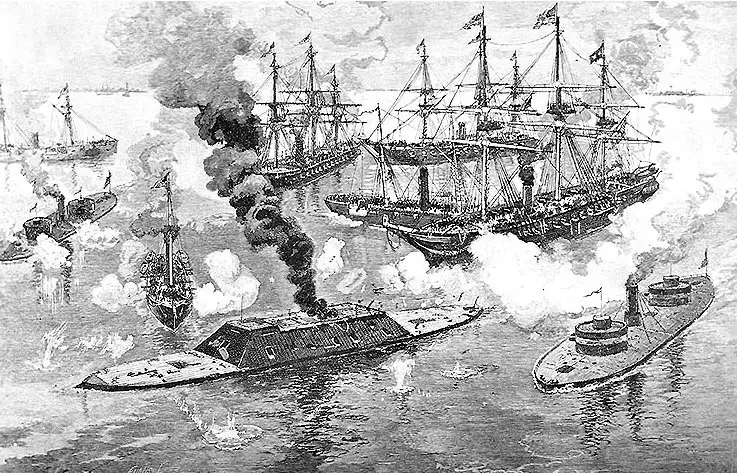
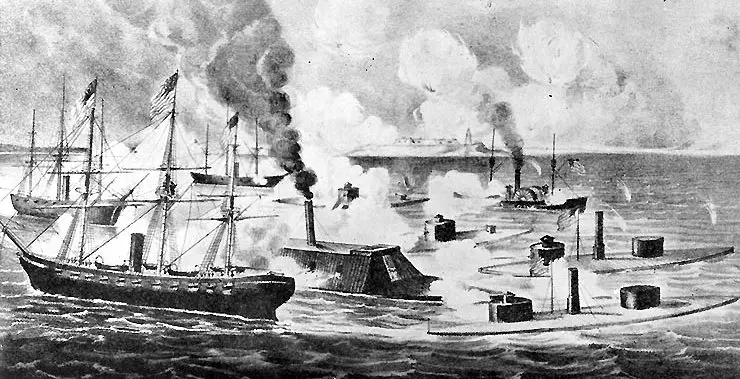
CSS Tennessee (1864-1864).
|
Kindle Available Wolf of the Deep: Raphael Semmes and the Notorious Confederate Raider CSS Alabama In July 1862, the Confederate captain Raphael Semmes received orders to report to Liverpool, where he would take command of a secret new British-built steam warship.  Confederate Ironclad 1861-65 Every aspect of Confederate ironclads is covered: design, construction, armor, armament, life on board, strategy, tactics, and actual combat actions. |
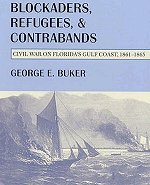 Blockaders, Refugees, and Contrabands: Civil War on Florida'S Gulf Coast, 1861-1865 Coastal Florida had a refugee crisis as the war progressed. Escaped slaves ("contrabands") sought out the blockaders. Some joined the U.S. Navy. White men and their families sought to avoid conscription or vengeful neighbors/regulators and eventually sought refuge with the blockaders |
Battle of Mobile Bay, 5 August 1864When Federal warships steamed into Mobile Bay on the morning of 5 August 1864, Confederate Admiral Franklin Buchanan stationed CSS Tennessee , his flagship, and her unarmored consorts, gunboats Morgan , Gaines and Selma , at the head of the channel. As the enemy moved up, exchanging fire with Fort Morgan, Buchanan's ships shot at them from ahead. The Union monitor Tecumseh , maneuvering to engage the Tennessee , struck a mine and sank, temporarily throwing the Federal column into confusion. Rear Admiral Farragut's flagship, USS Hartford , forged ahead and drove off the Confederate gunboats, but Tennessee remained in the battle zone, firing on the U.S. Navy ships as they passed and doing considerable damage to the last in line, USS Oneida . With the enemy was safely inside Mobile Bay, Buchanan understood that the Confederate forts at the bay's entrance would soon be untenable unless the Union ships could somehow be destroyed. In a desperate, solitary effort, Tennessee steamed toward Farragut's ships. As she slowly moved along, the sloops of war USS Monongahela and Lackawanna repeatedly rammed her, doing more damage to themselves than to their target. When Tennessee reached the Federal anchorage area, she was also rammed by the Hartford and subjected to a terrific cannonade. The U.S. monitors Chickasaw and Manhattan then engaged her at close range with their heavy guns, while other Union ships fired from a distance. Tennessee 's smokestack and most other exposed fittings were hammered away, further reducing her never very great speed; her gunport shutter chains were cut, closing the ports so the Confederates could not shoot back; and her exposed steering chains were severed, leaving her unmanageable. The Manhattan blew a hole in Tennessee's armor with her massive fifteen-inch gun. The twin-turret monitor Chickasaw stationed herself off the beleagered ship's stern, firing her eleven-inch guns "like pocket pistols" and seriously weakening the after end of Tennessee 's armored casemate. With his flagship unable to fire her guns, steam or steer, and with the collapse of the casemate seemingly imminent, Admiral Buchanan, who had been wounded in the battle, authorized her surrender. The ship's Commanding Officer, Commander James D. Johnston poked a white flag up from the top of the casemate. Firing soon ceased, though USS Ossipee, coming on fast in another ramming attempt and unable to stop in time, struck a post-surrender blow. Federal Navy officers soon took possession of their battered prize, effectively concluding the Battle of Mobile Bay. This view depicts, none too accurately, the CSS Tennessee in the center at the time she surrendered, surrounded by the Union warships. The latter include (at right) the twin-turret monitors Chickasaw and Winnebago at right. One of the single-turret monitors would be Manhattan . There was no second single-turret monitor present at this stage of the battle. The large ship in the left foreground is presumably USS Hartford . Fort Morgan is shown in the right distance More on the Battle at Mobile Bay |
 Sid Meier's Civil War Collection Take command of either Confederate or Union troops and command them to attack from the trees, rally around the general, or do any number of other realistic military actions.  History Channel Civil War A Nation Divided Rally the troops and organize a counterattack -- Your strategic decision and talent as a commander will decide if the Union is preserved or if Dixie wins its independence |
Civil War Ships and Battles Civil War Submarines RAM Ships Civil War Naval Timeline American Civil War Exhibits State Battle Maps Civil War Summary Civil War Timeline Women in the Civil War Battles by Campaign |
|
 Ironclads and Big Guns of the Confederacy : The Journal and Letters of John M. Brooke Information about the Confederate Navy's effort to supply its fledgling forces, the wartime diaries and letters of John M. Brooke tell the neglected story of the Confederate naval ordnance office, its innovations, and its strategic vision. |
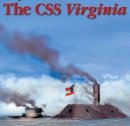 Confederate Phoenix The CSS Virginia The CSS Virginia of the Confederate States Navy destroyed two of the most formidable warships in the U.S. Navy. Suddenly, with this event, every wooden warship in every navy in the world became totally obsolete |
Kindle Available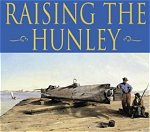 Raising the Hunley: The Remarkable History and Recovery of the Lost Confederate Submarine For more than a century the fate of the Hunley remained one of the great unsolved mysteries of the Civil War. Then, on August 8, 2000, with thousands of spectators crowding Charleston Harbor, the Hunley was raised from the bottom of the sea and towed ashore. |
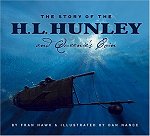 The Story of the H.L. Hunley During the Civil War, Union forces blockade the port of Charleston so the Confederate army seeks a way to attrack the Yankee Ships. George Dixon is part of the group of men given the task of creating and building the "fish boat," a submarine. The H.L. Hunley ultimately sets out on its mission to sink Yankee ships, but fails to return, its whereabouts unknown. |
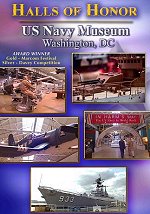 Halls of Honor The U.S. Navy Museum takes you on an informed and entertaining romp through one of North America s oldest and finest military museums. The museum has been in continuous operation at the Washington Navy Yard since the American Civil War |
 Raise The Alabama She was known as "the ghost ship." During the Civil War, the CSS Alabama sailed over 75,000 miles and captured more than 60 Union vessels. But her career came to an end in June of 1864 when she was sunk by the USS Kearsarge off the coast of Northern France |
 The Civil War - A Film by Ken Burns Here is the saga of celebrated generals and ordinary soldiers, a heroic and transcendent president and a country that had to divide itself in two in order to become one |
 Civil War Journal The Conflict Begins These four programs from the History Channel series Civil War Journal cover critical aspects of the early days of the war. |
|
Books Civil War Womens Subjects Young Readers Military History DVDs Confederate Store Civil War Games Music CDs Reenactors |
Sources:
U.S. National Park Service
U.S. Library of Congress
US Naval Archives