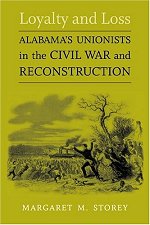
 Loyalty And Loss: Alabama's Unionists In The Civil War And Reconstruction Though slavery was widespread and antislavery sentiment rare in Alabama, there emerged a small loyalist population, mostly in the northern counties, that persisted in the face of overwhelming odds against their cause. |
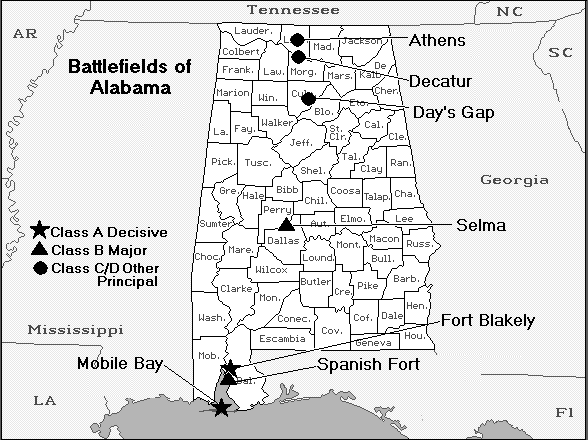
Alabama Civil War Map of Battles
 |
 Blockaded Family Life in Southern Alabama This reminiscence of daily life on a Southern plantation during the Civil War was originally published in 1888. This book is filled with vivid details of everything from methods of making dyes and preparing foods to race relations and the effects of the war. The book is an unusual and beautifully written primary source of Southern life inside the blockade imposed by the Union |
| May 4, 1863 Day's Gap / Sand Mountain January 26, 1864 Athens August 2-23, 1864 Mobile Bay / Fort Morgan Fort Gaines October 26-29, 1864 Decatur March 27-April 8, 1865 Spanish Fort April 2-9, 1865 Fort Blakely April 2, 1865 Selma |
 Voices from Company D: Diaries by the Greensboro Guards, Fifth Alabama Infantry Regiment, Army of Northern Virginia writings from the diaries of eight members of the Greensboro Guards, Fifth Alabama Infantry Regiment. Woven into a single chronological narrative, these writings provide a unique perspective not only on many of the war's battles and campaigns but also on aspects of life and culture in the nineteenth-century South |
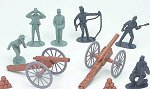 20 piece Civil War Artillery Playset Civil War Artillery Set: 20 piece set includes 12 Artillery Crew Figures in Blue and Gray that stand up to 58mm tall, 4 Parrott Rifle Gun Cannon about 4 inches long, and 4 Cannonball stacks |
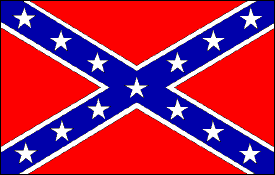
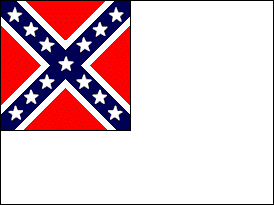
Civil War State Battle Maps American Civil War Exhibits American Civil War Timeline Civil War Summary Picture Album Civil War Cooking Civil War Submarines History of the Confederate Flag |
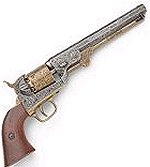 Civil War Model 1851 Naval Pistol with Engraved Silver Tone / Gold Tone Finish and Wooden Grips - Replica of Revolver Used by Both USA / Union and CSA / Confederate Forces |
Kindle Available Civil War Curiosities: Strange Stories, Oddities, Events, and Coincidences |
 The Battle of the Wilderness May 5-6, 1864 Fought in a tangled forest fringing the south bank of the Rapidan River, the Battle of the Wilderness marked the initial engagement in the climactic months of the Civil War in Virginia, and the first encounter between Ulysses S. Grant and Robert E. Lee |
 The Civil War Day By Day An Almanac, 1861-1865 The most exhaustively detailed and fascinating book on the American Civil War of its kind. Not only does it provide a day-by-day look at the major events of the war, but lists so many of the small skirmishes and actions as well. Accurate and enjoyable |
Kindle Available Civil War Medicine The staggering challenge of treating wounds and disease on both sides of the conflict. Written for general readers and scholars alike, this first-of-its kind encyclopedia will help all Civil War enthusiasts to better understand this amazing medical saga. Clearly organized, authoritative, and readable |
|
 Southerners at War: The 38th Alabama Infantry Volunteers This is a well written, well researched book on the men of the 38th Alabama Infantry. |
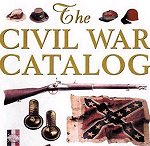 The Civil War Catalog More than 200 illustrations and restored photographs, all the weapons, uniforms, and implements of battle. Packed with color photos of insignia, medals, kits, paper ephemera, rare uniforms, and personal equipment for all enlisted ranks. |
Kindle Available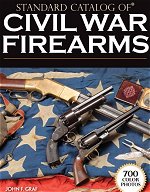 Standard Catalog of Civil War Firearms Over 700 photographs and a rarity scale for each gun, this comprehensive guide to the thousands of weapons used by Billy Yank and Johnny Reb will be indispensable for historians and collectors. |
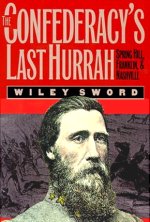 The Confederacy's Last Hurrah: Spring Hill, Franklin, and Nashville John Bell Hood rallied his demoralized troops and marched them off the Tennessee, desperately hoping to draw Sherman after him and forestall the Confederacy's defeat |
|
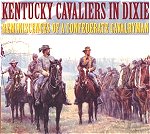 Kentucky Cavaliers in Dixie Reminiscences of a Confederate Cavalryman Mosgrove was born in Kentucky, in 1844, and enlisted in the Fourth Kentucky Cavalry Regiment on September 10, 1862. His eyewitness account illuminates the western theater of the Civil War in Kentucky, east Tennessee, and southwest Virginia |
Kindle Available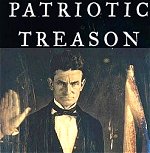 Patriotic Treason John Brown and the Soul of America The life of the first citizen committed to absolute racial equality. His friendships in defiance of the culture around him, He turned his twenty children into a dedicated militia. He collaborated with black leaders such as Frederick Douglass, Martin Delany, and Harriet Tubman to overthrow slavery. |
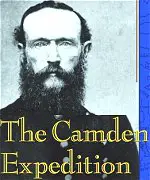 The Camden Expedition of 1864 and the Opportunity Lost by the Confederacy to Change the Civil War The Confederacy had a great opportunity to turn the Civil War in its favor in 1864, but squandered this chance when it failed to finish off a Union army cornered in Louisiana because of concerns about another Union army coming south from Arkansas. The Confederates were so confused that they could not agree on a course of action to contend with both threats, thus the Union offensive advancing from Arkansas saved the one in Louisiana and became known to history as the Camden Expedition. |
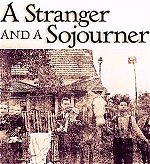 A Stranger And a Sojourner: Peter Caulder, Free Black Frontiersman in Antebellum Arkansas An illiterate free black man, defied all generalizations about race as he served with distinction as a marksman in the U.S. Army during the War of 1812, repeatedly crossed the color line, and became an Arkansas yeoman farmer, thriving and respected by white neighbors until he fell victim of new discriminatory legislation on the eve of the Civil War |

|