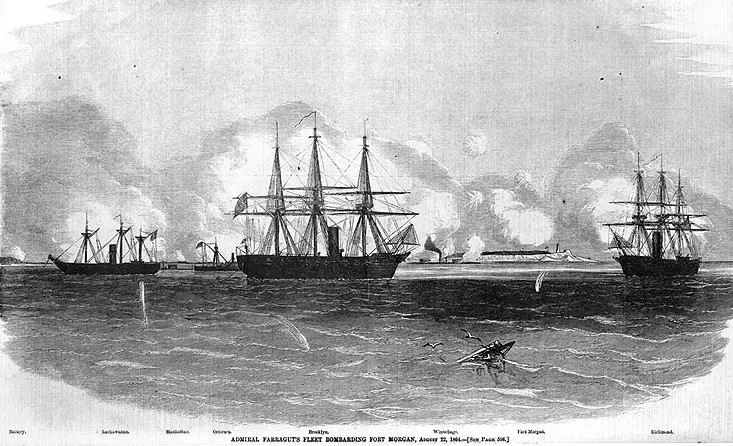
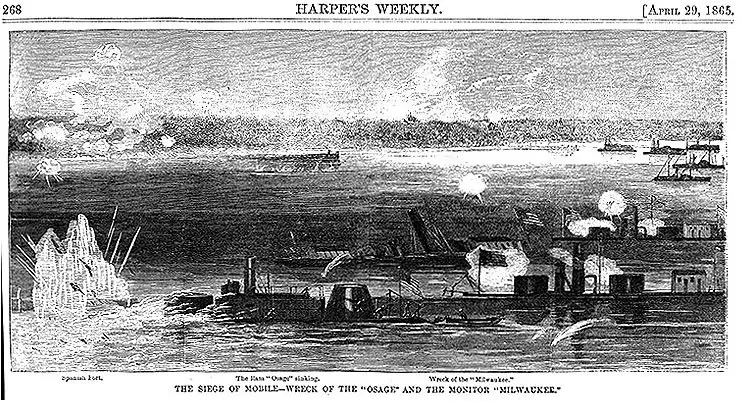
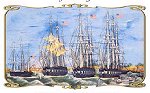
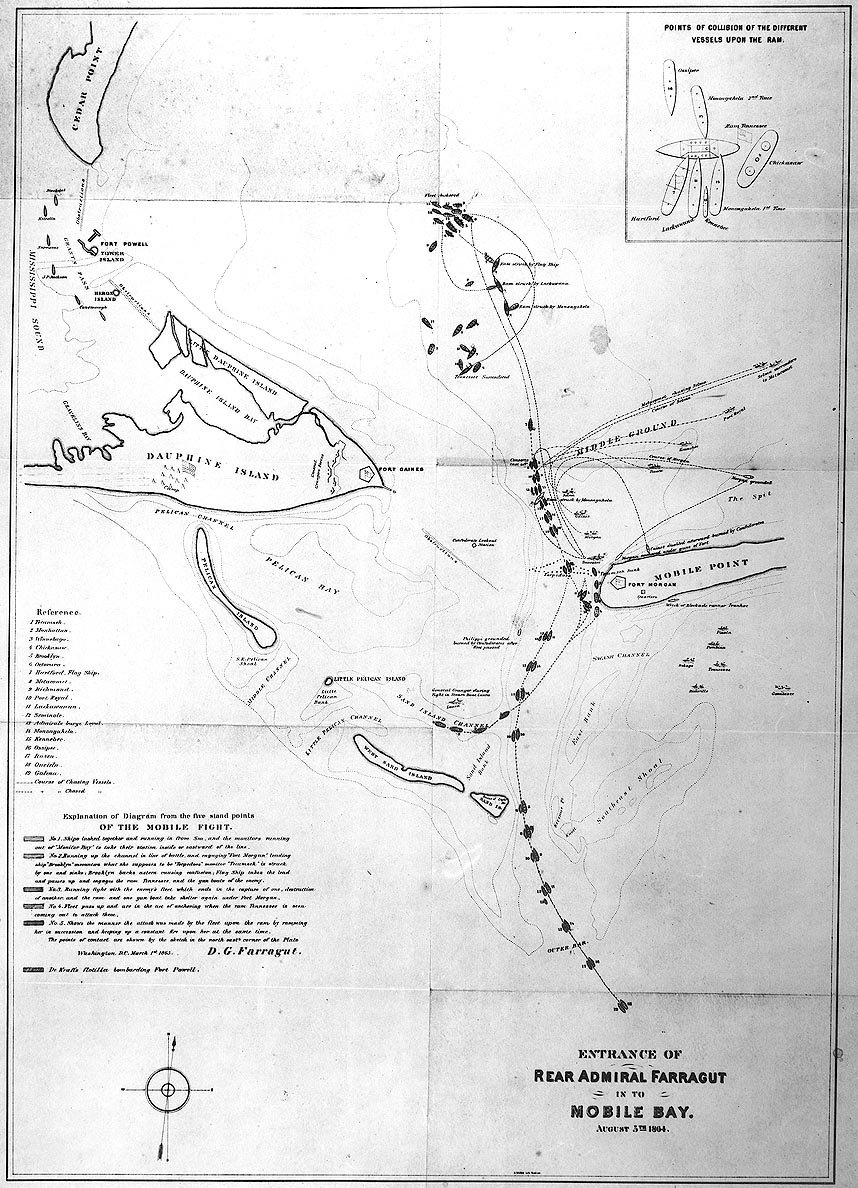
Entrance of Rear Admiral Farragut in to Mobile Bay
August 5th 1864
Chart of the action, prepared by RAdm. D.G. Farragut, Washington, D.C., March 1st, 1865. "Explanation of Diagram from the five stand points of the Mobile fight." (printed in the lower left):
"No.1. Ships lashed together and running in from Sea, and the monitors running out of "Monitor Bay" to take their station inside or eastward of the line."
"No.2. Running up the channel in line of battle, and engaging 'Fort Morgan' leading ship 'Brooklyn' encounters what she supposes to be 'torpedoes' monitor 'Tecumseh' is struck by one and sinks; Brooklyn backs astern causing confusion; Flag Ship takes the lead and passes up and engages the ram Tennessee and the gun boats of the enemy."
"No.3. Running fight with the enemy's fleet which ends in the capture of one, destruction of another, and the ram and one gun boat take shelter again under Fort Morgan."
"No.4. Fleet passes up and are in the act of anchoring when the ram Tennessee is seen coming out to attack them"
"No.5. Shows the manner the attack was made by the fleet upon the ram by ramming her in succession and keeping up a constant fire upon her at the same time."
"The points of contact are shown by the sketch in the north east corner of the plate."
"De Kraft's flotilla bombarding Fort Powell." (in upper left of the chart).
Ships are (as numbered in "Reference" list at left):
1. Tecumseh ; 2. Manhattan ; 3. Winnebago ; 4. Chickasaw ; 5. Brooklyn ; 6. Octorara ; 7. Hartford , Flag Ship; 8. Metacomet ; 9. Richmond ; 10. Port Royal ; 11. Lackawanna ; 12. Seminole ; 13. Admiral's barge Loyal ; 14. Monongahela ; 15. Kennebec ; 16. Ossipee ; 17. Itaska ; 18. Oneida ; 19. Galena .
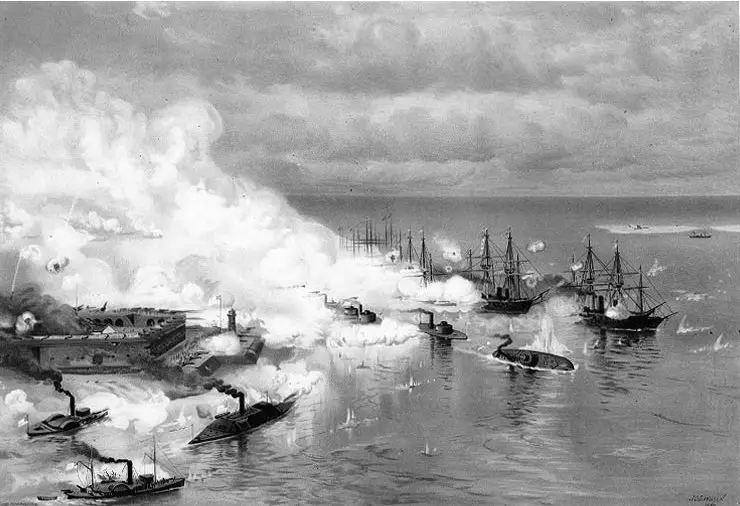
Passing Fort Morgan and the Torpedoes
Artwork by J.O. Davidson, 1886, depicting the Union and Confederate squadrons at the moment that USS Tecumseh sank after striking a mine ("torpedo").
Confederate ships (left foreground) are Morgan , Gaines and Tennessee . Union monitors visible astern of Tecumseh are Manhattan and Winnebago . USS Brooklyn is leading the outer line of Union warships, immediately followed by USS Hartford .
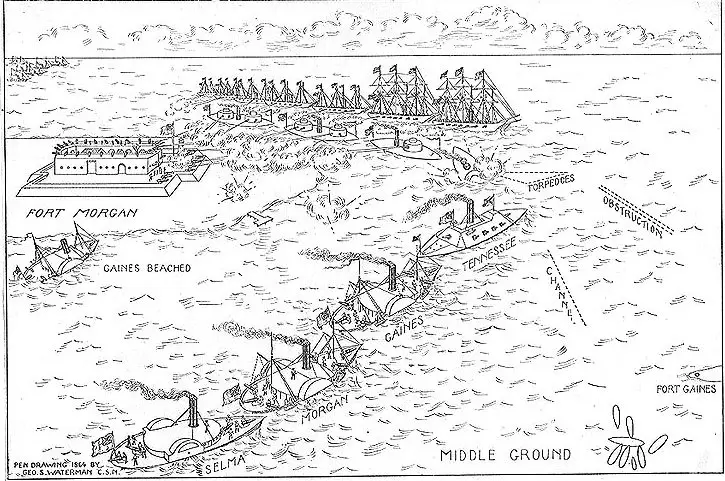
Reproduction of an 1864 pen & ink drawing by George Waterman, C.S.N., depicting the action as seen from above and inside the entrance to Mobile Bay.
Confederate ships present are (as identified on the drawing): Selma , Morgan , Gaines (shown twice, in the battle line, and beached off Fort Morgan after the battle) and Tennessee .
Union monitors shown are (from the front of the line): Tecumseh (sinking after striking a mine), Manhattan , Winnebago and Chickasaw . The leading two steam sloops in the Union line are Brooklyn and Hartford .
Small diagram in the lower right represents the various efforts by Union ships to ram the Tennessee later in the action.
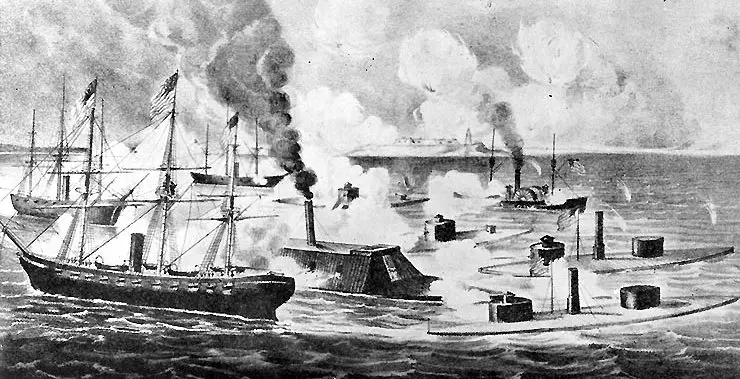
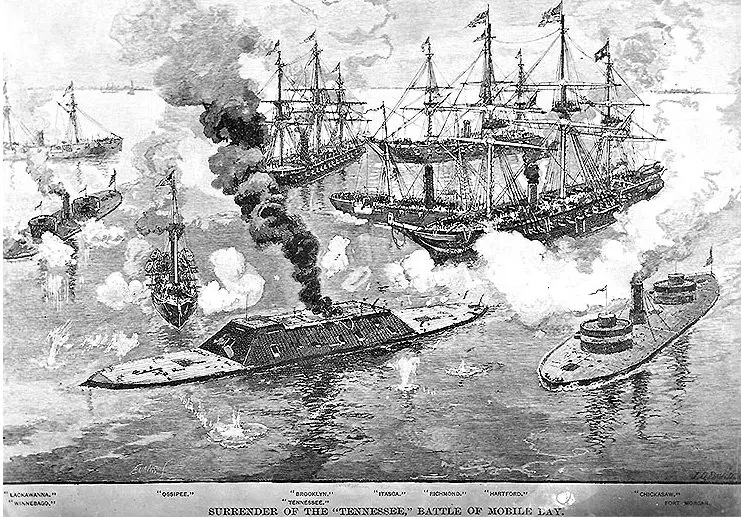
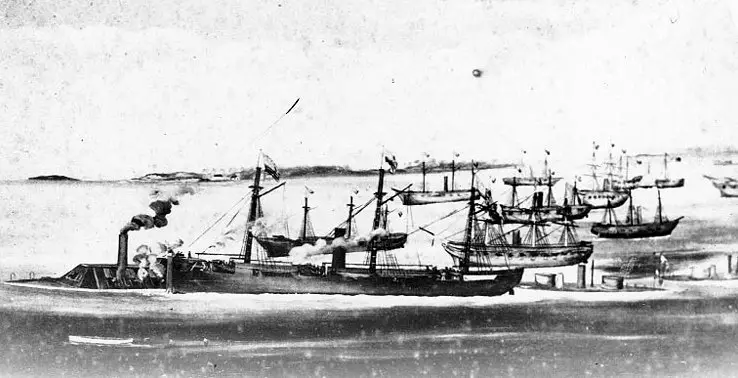
USS Monongahela rams CSS Tennessee as other Union warships move into position to engage. The two twin-turret monitors depicted at the right are USS Winnebago and USS Chickasaw .
Civil War vintage artwork, photographed by T. Lilienthal, New Orleans, Louisiana.
Monitor 21" Civil War Ship
Wood Model Fully Assembled
-
Dimensions 21" Long x 5" Wide x 3" High
-
Meticulously painted to the actual Monitor
-
Museum quality model. Fully assembled and ready to display.
-
The model rests perfectly on a polished marble base and 4 arched dolphins
-
Built with rare, high quality rosewood.

Ironclads and Big Guns of the Confederacy : The Journal and Letters of John M. Brooke
Information about the Confederate Navy's effort to supply its fledgling forces, the wartime diaries and letters of John M. Brooke tell the neglected story of the Confederate naval ordnance office, its innovations, and its strategic vision.
Life in Mr. Lincoln's Navy
A tantalizing glimpse into the hardships endured by the naval leadership to build and recruit a fighting force. The seaman endured periods of boredom, punctuated by happy social times and terrifying bouts of battle horror
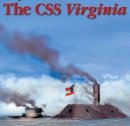
Confederate Phoenix
The CSS Virginia
The CSS Virginia of the Confederate States Navy destroyed two of the most formidable warships in the U.S. Navy. Suddenly, with this event, every wooden warship in every navy in the world became totally obsolete
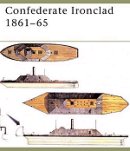
Confederate Ironclad 1861-65
Every aspect of Confederate ironclads is covered: design, construction, armor, armament, life on board, strategy, tactics, and actual combat actions.
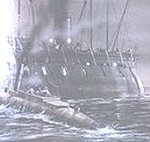
Confederate Submarines and Torpedo Vessels 1861-65
Interesting information and many excellent illustrations. It addresses the CSA David class torpedo boats and the Hunley (and its predecessors), as well as Union examples such as the Alligator and the Spuyten Duyvil
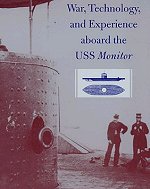
War, Technology, and Experience aboard the USS Monitor
The experience of the men aboard the Monitor and their reactions to the thrills and dangers that accompanied the new machine. The invention surrounded men with iron and threatened their heroism, their self-image as warriors, even their lives