|
|
|
Most of the fighting on July 1 was west and north of Gettysburg. The Union troops fought valiantly against overwhelming numbers of Confederates, directed toward Gettysburg by General Lee who arrived on the battlefield at the height of the fighting. The general was slightly frustrated that his officers started a battle without his permission, for he planned to concentrate his army west of Gettysburg and fight a battle in the mountains. The heavy fighting near Gettysburg upset his plan, so Lee and watched his victorious soldiers drive the Union troops through Gettysburg to the hills south of town. It was a great victory for Lee, but not a decisive one as the Union Army did not retreat from the hills but concentrated there. General Meade arrived that night and decided to fight the battle by defending the hills and letting Lee make the next move. By the morning of July 2, the Union army had established strong positions in a giant U-shaped line from Culp's Hill to Cemetery Ridge. Satisfied with the line, General Meade decided to wait for Lee to make the next move while the remainder of the Army of the Potomac hurried to the battlefield. Early that morning, General Lee surveyed the strong Union line from his position on Seminary Ridge and realized that a weakness might be with the Union flanks. A simultaneous strike on both the right and left of Meade's position could roll up the Union line toward Cemetery Hill. Lee directed General James Longstreet to attack the Union left and General Richard S. Ewell to attack the Union right. The fighting began that afternoon at 4 o'clock and quickly spread up and down the ridges. Union cannon posted on the ridge above Devil's Den roared to life. Fighting erupted on the slopes of Little Round Top, in the Wheatfield, and at the Peach Meanwhile, Confederate troops made a brilliant charge to the base of Cemetery Hill and overran Union troops stationed behind stone walls. Through the gap poured soldiers from Louisiana, called "Louisiana Tigers", who attacked Union artillery at the summit. Union reinforcements rushed to the scene and immediately attacked with rifles and bayonets, driving off the Confederates. Though General Meade's line had been heavily beaten on and almost broken, he was still able to hold his position on Cemetery Ridge.
The Southern cannonade began at 1 o'clock and lasted for almost two hours. It was followed by the charge of 12,000 Confederates, half of them Virginia troops commanded by General George E. Pickett, and the other half commanded by Brig. General James J. Pettigrew. The Confederates succeeded in breaking the Union line at the angle near a copse of trees, but were thrown back with heavy losses. A down hearted General Lee saw the results of the charge and rode into the field to rally his soldiers. That evening, General Lee ordered his troops to prepare to retreat to the Once back in Virginia, General Lee reported to President Jefferson Davis on what happened at Gettysburg and how is soldiers had done their best to win the battle. The general never criticised any of his commanders for mistakes that may have been made, nor did he write badly of his soldiers. He knew how hard they had fought and how many of them had been left behind, including many good officers. General Meade also reported to President Lincoln and though the president was disappointed that the Union army had not destroyed Lee's army, he thanked the general for doing such a good job. Congress also thanked General Meade for the victory at Gettysburg, but there were some Union officers who were not quite so pleasant to the general, including General Sickles. General Meade was forced to defend his actions for many years to come. The cost of the battle was high- 51,000 casualties, which are all of the soldiers who were killed, wounded, captured, or missing. Every home and church in Gettysburg was a hospital, and every field and yard held a grave of a soldier, hastily dug and filled. To provide a proper burial for the Union dead, local citizens began a project for a national cemetery to be placed at Gettysburg. It was dedicated on November 19, 1863, and featured a short speech by President Lincoln. The president's Gettysburg Address is the best remembered and most revered speech of the Civil War. |
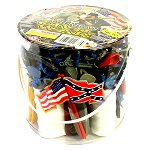 Civil War Soldier 102 Piece Playset
|
More on Gettysburg Civil War Picture Album Kids Zone Exhibits Civil War Summary Kids Zone Medicine Civil War Navy Ships Civil War Cooking Civil War Exhibits Women in the War Young Reader Books |
 The Gettysburg Address in Translation: What It Really Means How long is four score and seven years? Just what are unalienable rights? |
 Unconditional Surrender U. S. Grant and the Civil War This is the best juvenile biography on Ulysses S. Grant by a wide margin. Marrin has done an excellent job in introducing Grant to a young audience. I highly recommend it. |
 Weapons and Strategies of the Civil War For grades 3-6 which packs 48 pages with color photos and 30 links providing quality Internet sites for more research. Chapter notes, a bibliography and an index round out information and assure not just accuracy, but constant updates to research information. |
 A Ballad of the Civil War A wonderful chapter book for children that should help them to appreciate the fact that some people could not defend a person's right to own other people and to understand that sad era that ended in the "brothers' war." It has four chapters with a prologue and a closing author's note. The conversations that Tom has with the household slave "Uncle Roger" provide some unique insight into the dilemma that slaves faced in the antebellum South |
 Fields of Fury The American Civil War Written for young readers a stirring account of the greatest conflict to happen on our nation's soil, the Civil War, bringing to life the tragic struggle that divided not only a nation, but also friends and family. well-organized, well-executed, kid-friendly history of the Civil War was a brilliant idea if there ever was one. It's difficult to imagine anyone doing a better job than McPherson at breaking down this complex, interrelated series of events. |
 Allen Jay and the Underground Railroad Allen Jay and the Underground Railroad is the retelling of a man's recollections of his first experience helping an escaped slave. The book brings the underground railroad down to the level primary students can comprehend. This book makes for wonderful discussions regarding overcoming one's fears, going against the norm and doing what you believe to be morally correct. |
Kindle Available The Glory Cloak: A Novel of Louisa May Alcott and Clara Barton From childhood, Susan Gray and her cousin Louisa May Alcott have shared a safe, insular world of outdoor adventures and grand amateur theater -- a world that begins to evaporate with the outbreak of the Civil War. Frustrated with sewing uniforms and wrapping bandages, the two women journey to Washington, D.C.'s Union Hospital to volunteer as nurses. |
 Clara Barton Founder of the American Red Cross Young Clara Barton is shy and lonely in her early days at boarding school. She is snubbed by the other girls because she doesn't know how to talk to them. But when she gets an opportunity to assist the local doctor, her shyness disappears, and Clara begins to discover her true calling as a nurse. |
Kindle Available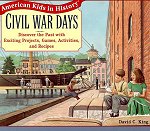 Civil War Days: Discover the Past with Exciting Projects, Games, Activities, and Recipes Dozens of projects and activities that will take you back to the days of the American Civil War Travel back to 1862 and spend a year with the Wheelers, an African American family in New York City, and the Parkhursts, a white family in Charleston, South Carolina, Eleven-year-old Emily Parkhurst and twelve-year-old Timothy Wheeler are eager to share the fun, adventure, and hard work of their daily lives. Along the way, they'll show you how to play the games they play and make the toys and crafts they make. |
Kindle Available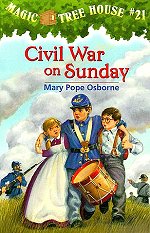 Civil War on Sunday Mary Pope Osborne's tremendously popular Magic Tree House series launches into a new realm, as Jack and Annie are challenged to save Camelot. Young readers will effortlessly learn the basics of Civil War history, while losing themselves in another gripping tale that has turned many a nonreader into a bookworm. (Ages 5 to 8) |
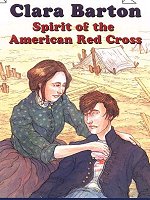 Clara Barton: Spirit of the American Red Cross Ready To Read - Level Three Clara Barton was very shy and sensitive, and not always sure of herself. But her fighting spirit and desire to help others drove her to become one of the world's most famous humanitarians. Learn all about the life of the woman who formed the American Red Cross. |
Kindle Available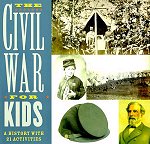 The Civil War for Kids History explodes in this activity guide spanning the turmoil preceding secession, the first shots fired at Fort Sumter, the fierce battles on land and sea, and finally the Confederate surrender at Appomattox. Making butternut dye for a Rebel uniform, learning drills and signals with flags, decoding wigwag, baking hardtack, reenacting battles, and making a medicine kit bring this pivotal period in our nation's history to life. |
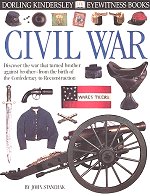 Eye Witness Civil War Eyewitness Civil War includes everything from the issues that divided the country, to the battles that shaped the conflict, to the birth of the reunited states. Rich, full-color photographs of rare documents, powerful weapons, and priceless artifacts plus stunning images of legendary commanders, unsung heroes, and memorable heroines |
 If You Lived at the Time of the Civil War All of the "If you Lived at the Time of..." books are great for kids, and also a nice, quick read for adults! What I like about them is their layout, which is easy for readers to follow. Each page begins with a question, "Would you have seen a battle in the South?" for example. Nicely drawn illustrations accompany each answer. |
 Day Of Tears Through flashbacks and flash-forwards, and shifting first-person points of view, readers will travel with Emma and others through time and place, and come to understand that every decision has its consequences, and final judgment is passed down not by man, but by his maker. |
Kindle Available The Civil War Introduces young readers to the harrowing true story of the American Civil War and its immediate aftermath. A surprisingly detailed battle-by-battle account of America's deadliest conflict ensues, culminating in the restoration of the Union followed by the tragic assassination of President Lincoln |
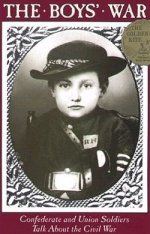 The Boys War With the many boys who fought in the civil war most of them lied about their age. A lot of them wrote letters or had a diary. Johnny Clem had run away from his home at 11. At age 12 he tried to enlist but they refused to let him join because he was clearly too young. The next day he came back to join as a drummer boy. |
Reference:
National Park Service
| Search AmericanCivilWar.com |
| Enter the keywords you are looking for and the site will be searched and all occurrences of your request will be displayed. You can also enter a date format, April 19,1862 or September 1864. |


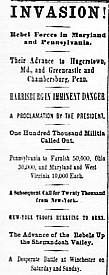 Fought during the first three days of July 1863, the Battle of Gettysburg was one of the most critical battles of the Civil War. The battle was the centerpiece of the Gettysburg Campaign, which began in the middle of June 1863, when Confederate General Robert E. Lee marched his army, the Army of Northern Virginia, out of central Virginia and north toward the Potomac River with the objective of invading Maryland and Pennsylvania. Lee had several reasons for wanting to invade the Union. His army was in need of supplies and raw materials that could not be easily obtained in the Confederacy. Lee's men had suffered greatly for want of food during the winter and spring of 1863 and he hoped that food supplies could be obtained from northern farms and warehouses, giving farmers in Virginia a chance to plant and nurture their crops without armies tramping over them. General Lee also hoped to obtain a victory on northern soil to take attention away from a dismal situation at Vicksburg, Mississippi, the last Confederate stronghold on the Mississippi River, where a Union army under General Ulysses S. Grant had surrounded the city and lay siege to it. It was also thought that a victory over the Union army on northern soil may cause Great Britain and France to recognize the Confederacy as an independent nation, and provide the growing peace movement in the North with enough reasons to press the Lincoln administration to sue for peace. All of these things could possibly end the Civil War.
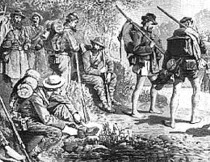 General Lee's hungry Confederates crossed the Potomac River, the border between Virginia and Maryland, and marched into Pennsylvania. There they found food, supplies, and many frightened civilians. The Union army, called the Army of the Potomac, cautiously followed Lee, shielding the capitol of Washington, DC from the Confederate forces and stopped at Frederick, Maryland, while the army commander, General Joe Hooker, argued with his commanders in Washington for more troops. On June 29, the Union army set out from their camps with a new commander, General George Gordon Meade, to find Lee and put a stop to his invasion. By this time, Confederate forces were spread throughout southern Pennsylvania. On June 30, a group of Confederates were marching eastward from Cashtown, Pennsylvania, when they spied Union cavalrymen just ahead near the town of Gettysburg. Under orders not to start an battle, the southerners retreated to Cashtown where they told their commander, General A.P. Hill, what they had seen. General Hill decided to send a larger part of his command toward Gettysburg the next morning to find out who those blue-clad troopers really were. He did not know they were Union cavalry from the Army of the Potomac, commanded by General John Buford.
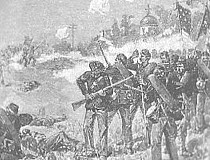 The Battle of Gettysburg began early on the morning of July 1, 1863, when General Buford's pickets three miles west of Gettysburg spotted the Confederate column sent by General Hill. A Union cavalry officer fired the first shot of the battle and the Confederates answered back with gun shots of their own. The cavalrymen knew they could not stop the southern infantry, so they slowly fell back toward Gettysburg until they reached the McPherson Farm. The cavalry was making one last, determined stand when Union infantry arrived just in time to throw back the Confederates. One of the first Union soldiers to fall was Major General John Fulton Reynolds, instantly killed while leading his troops into the fray.
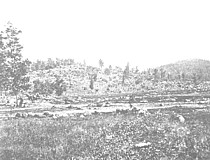 Orchard as General Longstreet's Confederates attacked these positions. At Little Round Top, Union troops threw back repeated Confederate attacks and finally saved the hill from capture after several hours of combat. Fighting swept into Devil's Den and up the line to the Peach Orchard. The situation was desperate for the Union forces who fought valiantly but were slowly forced back. The line of General Daniel Sickles, a Union corps commander, collapsed under the relentless southern attacks, Sickles himself so severely wounded that his leg required amputation. A brisk counterattack of Union reserves drove the Confederates back. Darkness put a grateful end to the slaughter on the Union left, but the battle was just beginning at Culp's Hill. Night had fallen by the time Confederate infantrymen under General Edward Johnson splashed across Rock Creek and began the climb up the wooded slopes of Culp's Hill. Union troops quietly waited behind earthen defenses stretched southward from the summit of the hill to a small knoll above Spangler's Spring. Union musketry and confusion in the darkness made the Confederate commander believe that he was heavily outnumbered and he stopped the attack to wait for reinforcements.
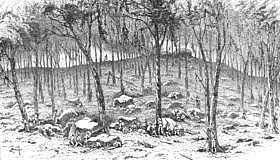 Fighting erupted on Culp's Hill early on the morning of July 3 when Union troops attacked Confederates who had taken a portion of the hill the night before. The Confederates had been reinforced by other troops and tried to drive the Union troops off of the summit of the hill, but could not get beyond the Union earthworks because of the stubborn defense they put up. After six hours of intense fighting, the Union succeeded in driving off the southerners. General Lee decided to alter his strategy. Having already ordered his cavalry chief, J.E.B. Stuart, to ride around the Union army and attack the Union supply line, Lee decided to strike the weakened Union center. He issued orders for a bombardment of the center followed by an infantry assault to be commanded by his trusted corps commander, General James Longstreet. General Longstreet's assault, better known today as "Pickett's Charge", would be Lee's last gamble for victory at Gettysburg.
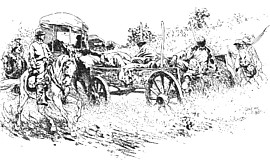 Potomac River where they would cross back into Virginia. General Meade, satisfied that his army held a superior position, waited for Lee's next move but then followed the Confederates as they marched away from Gettysburg and wound their way west to Williamsport, Maryland on the Potomac River. Swelled by heavy rains, the river could not be crossed and the Confederates were forced to build defenses in case of a Union attack. But Confederate engineers were able to place floating bridges across the river and the last troops of Lee's army stepped onto the Virginia side just as Meade's soldiers began to close in. The bloody Gettysburg Campaign was over.