Union General Edward R.S. Canby
|
|
|
|
| Edward R.S. Canby was born at Piatt's Landing Kentucky, on November 9, 1817. He attended local schools before going to Wabash College, Crawfordsville, Indiana. He was then appointed to West Point, from where he was graduated 30th, next to the bottom, of the class of 1839, the same year as Henry Halleck. As a second lieutenant in the 2nd infantry. He saw service against the Seminoles, Creeks, Cherokees, and choctaws. In the Mexican War (1846-48) he served on a brigade staff but still received brevets to captain and major for his actions at Contreras and Churubusco, and a lieutenant-colonel's brevetsfor gallant conduct at the Belen Gate, Mexico City, in 1847. Canby became a major in the 10th Infantry in 1855; he was named colonel of the new 19th Infantry Canby's department had little in the way of troops or supplies, being considered a backwater of the war. Nonetheless the Confederates invaded his domain, on what they planned to be their way to the silver mines of Colorado and the gold fields of California, in January 1862. His outnumbered troops fell back from Valverde, destroying resources upon whos capture the Confederate plan depended. Finally, reinforced by Colorado volunteers, he met the Confederates at Glorieta (called "the Gettysburg of the West"), and destroyed their supplies. The Confederates were forced to fall all the way back to Texas; Canby followed them, not needing to fight again since nature itself was going against them. On May 23 1862, he was named brigadier-general of volunteers and sent East to serve latgely in staff functions, although he did take command at New York City during the draft riots of July 1863. He was named major-general of volunteers on May 7 1864, and given command of the Miltary Division of West Mississippi. He reorganized the army which had suffered so much under Banks in the Red River campaign, and began the capture of Mobile, Alabama. Mobile surrendered to his forces on April 12 1865; Canby then accepted the surrender of the forces under General Richard Taylor, one of the last Confederate armies in the field. In 1866 Canby named a regular army brigadier-general. In 1870 he was given command of the Department of Columbia, and three years later the Division of the Pacific. It was on April 11 1873, in the lava beds of northern California, while negotiating with the Modoc Indians for their removal, that he was suddenly shot through the head and stabbed by several of the Native-American negotiators, including their chief "Captain Jack". Canby was killed on the spot; his body was buried in Crown Hill Cemetary, Indianapolis, Indiana. Grant later recalled that "General Canby was an officer of great merit. He was naturally studious, and inclined to the law. There have been in the army but very few, if any, officers whi took as much interest in reading and digesting every act of Congress and every regulation for the government of the army as he. His knowledge gained in this way made him a most valuable staff officer, a capcity in which almost all his army services were rendered up to the time of his being assigned to the Military Division of the Gulf. He was an exceedingly modest officer, though of great talent and learning.... . His character was as pure as his talent and learning were great. His services were valuable during the war, but principally as a bureau officer. I have no idea that it was from choice that his services were rendered in an office, but because of his superior efficiency there" Copyright Osprey Publishing 2003 |
 The New York City Draft Riots: Their Significance for American Society and Politics in the Age of the Civil War For five days in July 1863, at the height of the Civil War, New York City was under siege. Angry rioters burned draft offices, closed factories, destroyed railroad tracks and telegraph lines, and hunted policemen and soldiers. Before long, the rioters also turned their murderous wrath against the black community |
 A Battlefield Atlas of the Civil War Informative text enhanced 24 three-color maps and 30 black/white historical photographs. |
 The Official Virginia Civil War Battlefield Guide Virginia was host to nearly 1/3rd of all Civil War engagements. This guide covers them all like a mini-history of the war. This guide organizes battles chronologically. Each campaign has a detailed overview, followed by concise descriptions of the individual engagements |
Kindle Available The Maps of First Bull Run: An Atlas of the First Bull Run (Manassas) Campaign, including the Battle of Ball's Bluff, June-October 1861 The Maps of First Bull Run breaks down the entire operation (and related actions) into numerous map sets or "action-sections" enriched with more than fifty full-color original full-page maps. These cartographic originals bore down to the regimental and battery level and include the march to and from the battlefield and virtually every significant event in between. |
 The Constitution of the Confederate States of America The original document consisted of five vellum sheest pasted together to form a scroll over twelve feet long. The original document was found at a train station in 1865 by Felix DeFontaine. In 1883, he sold the manuscript to Mrs. George Wymberley Jones DeRenne. In 1939, the DeRenne family sold the document to the University of Georgia |
 Shiloh and Corinth: Sentinels of Stone The brave deeds performed by soldiers of the North and South. Approximately 93 striking photographs and accompanying histories bring the battlefields to life, from Shiloh and Savannah, Tennessee, to Iuka and Corinth, Mississippi |
Kindle Available One Continuous Fight: The Retreat from Gettysburg and the Pursuit of Lee's Army of Northern Virginia The first detailed military history of Lee's retreat and the Union effort to catch and destroy the wounded Army of Northern Virginia Complimented with 18 original maps, dozens of photos, and a complete driving tour with GPS coordinates of the entire retreat |
 Bloody Roads South: The Wilderness to Cold Harbor, May-June 1864 This chronicles the great 1864 Overland Campaign, forty days that marked the end of the Civil War. In detail the battles in Virginia's Wilderness to the combat at Spotsylvania the trap laid by Lee at the North Anna River, to the killing ground of Cold Harbor |
Sources:
Osprey Publishing
| Search AmericanCivilWar.com |
| Enter the keywords you are looking for and the site will be searched and all occurrences of your request will be displayed. You can also enter a date format, April 19,1862 or September 1864. |


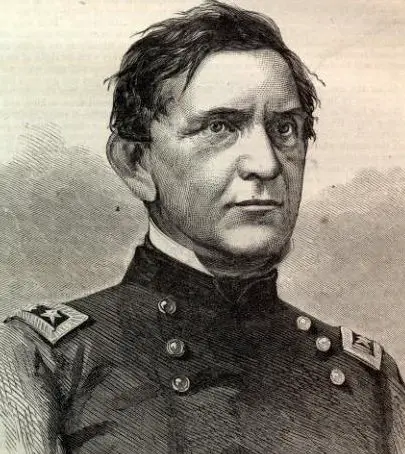 on May 14, 1861, and given command of the Department of New Mexico.