Assessing Civil War Historiography
|
|
|
|
By
Jonathan Gianos-Steinberg
May 12, 2005
Historian George G. Iggers, in analyzing the formation of history and historiography, once wrote that there were two “dominant traditions” in the practice of writing history. According to Iggers, the first tradition was “predominantly learned and antiquarian” while the other was “literary.” Thus, Iggers argued, the writing of history had inevitably contained subjectivity since the inception of the practice.[1] Other historians believe the issue of subjectivity was a factor in precipitating Enlightenment. In Telling the Truth About History, Joyce Appleby notes that during the Enlightenment, thinkers began to believe that science could be objective, and that science could build a “platform upon which all knowledge could rest.” This idea was extrapolated to the field of history through the belief that objectively studying history could ultimately help to explain it.[2] From the Enlightenment, it was believed that the specialization of history as a “professional discipline” could be done objectively. Historiography as a profession and subject matter came into being because it was believed that history itself could become a profession and subject matter. According to Iggers, historiography was borne out of the notion that history “needed” to be written by professional historians not just for each other, but for society as a whole. Iggers argued that the public “turned to the historians in search of their own historical identity.” In that manner, history would be “both a scientific discipline and a source of culture.”[3] Therein lay a paradox that Iggers himself identified. In attempting to satiate that dichotomy, the practice of historiography has a natural “tension,” since the “scientific ethos of the profession” necessitates objectivity and the “political function” of the profession is inherently subjective.[4] In this sense, historiography could not merely be the study of writing history; historiography naturally has to affect the writing of history as well. While Iggers focused on historiography's influence on culture and society, his description of historiography fails to account for society's influence on historiography. This notion has only recently begun to be expounded upon by historians. In New Perspectives on Historical Writing, historian Peter Burke writes that history “is now viewed as a cultural construction, subject to variation over time...” Thus, the idea of objective history becomes “unrealistic.”[5] In a recent dissertation, one scholar defined public memory, a “constant series of rememberings and forgettings which, more often than not, are prompted or privileged in order to legitimize social and political orders.”[6] Historiography, far from being a professional subject detached from the public, has been directly affected by the public's perception of history. Despite the fact that the Civil War ended 140 years ago, it remains a polarizing topic for the country to this day. Thomas Pressly, author of Americans Interpret Their Civil War, believes the “continued appeal of Civil War themes…can be explained in part by the opportunity such themes have afforded…for escape from present reality into a past that was appealingly pictured as colorful and idyllic.”[7] Pressly further notes the Civil War “involved vital issues of lasting significance,” thus the war “enlisted not only the interest of successive generations but also their loyalties and their emotions.”[8] Far from being a 20th or 21st century phenomenon, David Blight notes the “troubled career of Civil War memory began well before the conflict ended.” Americans have been dealing with these emotions and memories since the 1860s, and it became the principal driving force of Civil War history and historiography. The shaping of Civil War history and historiography is a very poignant example of the influence memory. In Race and Reunion, Blight describes Civil War historiography as a “story of how in American culture romance triumphed over reality.”[9] Moreover, scholarship discussing social influences on Civil War historiography has only recently come about. Since Civil War historiographical trends had always been neatly divided along established lines, which may help explain why historians took so long to thoroughly analyze the formulation of those trends. Studying the historiography and social perception of Confederate Lieutenant General Nathan Bedford since the 1860s offers scholars a chance to comprehensively analyze how social undercurrents and memory shape historiography. Born into poverty in the backwoods of Tennessee in 1821 and raised without formal education, Forrest was “inured to hardship by seemingly endless labor,” but that hard work would help Forrest establish himself as a prominent plantation owner and slave trader in the antebellum South.[10] When the war broke out, Forrest enlisted in the army and was instructed to raise a battalion of cavalry. Forrest spent the entire war fighting in the Western theater, becoming the only individual in the war to rise from the rank of Private to Lieutenant General. By the end of the war, Forrest was known throughout the South as the “Wizard of the Saddle,” and anecdotes of his prowess in battle were legendary.[11] In addition to being injured multiple times in battle, Forrest has been credited with having killed 30 Union soldiers in combat and having 29 horses shot out from under him.[12] History has properly accorded Forrest his place as one of the most courageous soldiers of the Civil War, and Forrest attained a number of command successes in the Western theater of the war. But Forrest was also a rough and tumble frontiersman who became a prominent slave trader, an overt racist, and likely a leader of the Ku Klux Klan after the Civil War. John E. Stanchack, an editor of the Civil War Times Illustrated, aptly noted in 1993, “Everything…about [Forrest] is bent to fit some political or intellectual agenda.”[13] Ashdown and Caudill, authors of The Myth of Nathan Bedford Forrest, write that the story of Forrest “embraces violence, race, realism, sectionalism, politics, reconciliation, and repentance. It is a story about the fall and redemption of the darker side of the American dream.”[14] With these characteristics, it has proven almost impossible for any American to have a neutral view of Forrest, and it is even harder to ignore him. Subsequently, Forrest's image has vacillated from celebrated to reviled, sometimes both at the same time, over the last 140 years, as the numerous and notable aspects of Forrest's life and legacy were considered by different people at different times. Analyzing how public perception of Forrest has been affected by Civil War historiography and the historiography regarding Forrest, it is possible to gauge how historiography and memory influence and interconnect with each other. The study of Nathan Bedford Forrest and Civil War historiography asserts that society's collective perceptions of history, often fueled by sectionalism, racism and nationalism, strongly influence the formation of historiography, which then reflects and perpetuates those sentiments. In 1865, the South was a “bleak landscape of destruction and desolation,” and the Southern Confederacy had just lost its rebellion with its military defeat. James McPherson described the region as a “vacuum of devastation and chaos.” Fearing lawlessness in the South and seeing the need to rebuild its infrastructure, the federal government, headed by Northern Republicans, believed it was necessary to impose a military subjugation of the South to restore order, placing the rebellious states under martial law.[15] But the sectional animosity that originally led to secession still remained, leaving the country as politically fractured as it was in 1861. And though the South may have been physically subdued, the rebellion was spiritually alive for many Southerners. As McPherson noted, the Southerners “were a proud people who had staked all and lost all,” and Southern contempt for the North was just as strong among noncombatants as it had been amongst soldiers.[16] Reconstruction historian Eric Foner wrote that "from the moment the Civil War ended, the search began for legal means of subordinating a volatile black population that regarded economic independence as a corollary of freedom and the old labor discipline as a badge of slavery."[17] Though the Confederacy was “decisively defeated,” David Blight writes that Reconstruction would “determine just how defeated the South really was…”[18] To continue their resistance, Southerners simply dropped the gun and picked up the pen, intending to project the history of their failed rebellion as a just and heroic cause doomed to failure because of the North's large advantage in military resources. Writing after the war, former Confederate General Jubal Early described the Confederates as “patriots…vindicating the true principles of the government founded by our fathers.” [19] In 1867, Edward Pollard, an editor for a Richmond newspaper, published The Lost Cause, championing his voluminous book as a “New Southern history” of the war. Pollard's work poignantly reflected the sentiments of unrepentant rebels clinging to their ideology. Pollard explicitly explained the motivation behind what he termed the “Lost Cause.” Although the South had lost the Civil War, he argued that the South could still wage and win the “war of ideas.” Conceding that the South's loss meant “restoration of the union and the excision of slavery,” Pollard was still defiant, writing that “the war did not decide Negro equality.” Taking that into account, historian David Blight noted, “Reconstruction was at once a struggle over ideas, interests, and memory.” These Southerners vowed to defy the North, the Republicans and Reconstruction, and “Lost Cause” sentiments began to quickly spread across Southern white society.[20] Though he was uninterested in reinterpreting Southern history, one of the most renowned “unrepentant” rebels during this period was Nathan Bedford Forrest, despite having a war record that one writer described as containing “limited victories.” Nonetheless, Forrest was considered one of the most controversial soldiers during the war, and Forrest's individual exploits had reached a “mythic stature” by war's end.[21] In a letter after the war, Forrest wrote that he could sense he was “regarded in…the North, with abhorrence, as a detestable monster…guilty of unpardonable crimes…”[22] For the most part however, due to his frontier background and lack of education, Forrest wrote and spoke very little regarding his own legacy before or after the war, even if he was aware of it. This left his image destined to be shaped by others in the form of extemporaneous undercurrents of public perception and historiography, allowing scholars a more pristine look at how Forrest's legacy has been molded and changed over time. While Forrest is almost universally regarded as a courageous and capable cavalry officer, agreements over his legacy end there. In the first few decades after the war, “issues of race and racism tended to frame conflicting interpretations of Forrest's image.”[23] These conflicting interpretations initially delineated themselves along sectional differences. While Forrest was celebrated throughout the South, he was concurrently notorious and controversial in the North. The New York Times referred to Forrest as “Fort Pillow Forrest,” referring to allegations that his soldiers massacred a Union garrison, a sizable portion of which was black, after it had surrendered at the Battle of Fort Pillow in 1864.[24] With such a legacy, Forrest was viewed in the North as a “potent” symbol of the Lost Cause and unreconstructed Southern white males.[25] During the beginning of Reconstruction, authors such as Pollard and Early were busy reinterpreting the Civil War and posing the Confederate soldier as a superior embodiment of the Southern males' “martial perfection.”[26] Instead of attempting to rewrite the South's past, Forrest was more interested in affecting the South's future. Having spent his own money to finance his soldiers, Forrest spent the first few years of Reconstruction involving himself in failed business ventures and Democratic politics, even traveling to New York for the Democratic convention.[27] In an open letter printed in the New York Times in May 1868, Forrest noted that Southerners “barely live under the accumulated weight of disfranchisement and oppression.”[28] Forrest's letter aptly described Southern white Democrats' infuriation with Reconstruction. Through their writings about “Negro Rule” “carpetbaggers” and Southern white Republican “scalawags,” the perception of Reconstruction as unusually and unnecessarily harsh took hold throughout the country.[29] This interpretation of Reconstruction “remained fundamentally the standard way of looking at the subject” until the 1960s.[30] Given these Southern sentiments about Reconstruction, Forrest and many others began to join groups “pledged to protect the weak and innocent and to keep order.”[31] Prevailing rumors surrounding Forrest's activities within a new secret society in Tennessee ensured that his legacy would forever remain controversial. Although no source has ever substantiated the rumors, Forrest has become widely recognized as the founder of the Ku Klux Klan.[32] Whether the rumors are true or not, the rumors themselves have played a principal role in the shaping of Forrest's image, starting with the Klan's inception. The Klan was loosely centralized, with one writer describing Forrest's group as an “anarchic local autonomy.” According to that writer, Forrest was the “Imperial Wizard,” and Forrest is credited with disbanding the Klan in 1869. Allegedly, the original Klan was completely dispersed by 1871.[33] Whether properly credited or not, vigilante groups which increased violence against blacks throughout the South during the late 1860s were labeled the Ku Klux Klan. Since “martial law and the large-scale use of troops seemed to be the only answer to Klan violence,” the Federal government focused on cracking down on the Klan.[34] Forrest himself was called to testify about his connections with the Klan before a United States Senate Select Committee, which published his testimony in 1872. Forrest, as resolute as any Confederate in confronting armed Northern soldiers, could not have been more irresolute in confronting unarmed Northern politicians. While refusing to admit that the Klan existed, Forrest nonetheless justified subversive actions by vigilante groups, arguing that they were defending against Northern Republican aggression. When asked about the size of the Klan, Forrest estimated that the number of vigilantes was in the hundreds of thousands, although he “could not speak of anything personally” and got all his “information from others.”[35] Though Forrest's testimony on the Klan was deliberately shifty and non committal, there were elements of truth to the testimony in that the Klan, even by the early 1870s, was not centrally controlled or even completely identifiable. If the Klan connections attributed to Forrest did exist, Forrest was, in effect, powerless to control or stop the terrorism being attributed to the Klan.[36] 1877 would mark the end of both political Reconstruction and Forrest's life. In both cases, social collective memory greatly influenced the historiography of both subjects. McPherson writes that the end of Reconstruction ultimately was brought about by the “wavering commitment” of Northern Republicans. Due in part to Southern castigation of Reconstruction, Northern society had become disillusioned with carpetbaggers and was not committed to black rights. The war's “revolutionary achievements” had thus been based more on anti-Southern motivation than pro-black sentiment. [37] To “emancipationist” writers, most notably Frederick Douglass and W.E.B. DuBois, “Reconstruction required a full accounting of the past,” an accounting that was not coming in the foreseeable future. Though they appealed to people to remember the necessity of Reconstruction for black Americans, their vision would be obscured in the North out of political expediency. [38] It would take another 80 years before historians started to challenge the view of Reconstruction as being a harsh and detrimental occupation of the South.[39] Forrest's health had been rapidly declining throughout 1877, in conjunction with the end of political Reconstruction. In October 1877, he died in Memphis at the age of 56, due to various war wounds. Conflicting opinions of Forrest were palpable throughout the country in the wake of his death. Papers in the North were extremely critical of Forrest in obituaries. The Boston Globe sardonically referred to Forrest as “General Napoleon Bonaparte Forrest.”[40] The New York Times, while lauding “dignified” and “gallant soldiers” like Lee, criticized “Fort Pillow Forrest” for his “ruffianism” and “cut-throat daring.”[41] Meanwhile, those same qualities were being celebrated by Southerners. The Memphis Daily Appeal exhorted Forrest for “the courage of his heart, the valor of his principles, and the energy of his character,” comparing his tactics to “the methods of the Crusaders.”[42] The Charleston News and Courier simply labeled Forrest the “hero of Tennessee.”[43] Forrest remained unreconstructed to his death, but society around him was in a state of flux. As a result of the 1877 Compromise and the end of political Reconstruction, “reconciliation seemed to sweep over the country's political spirit,” and sectional reconciliation became politically expedient in the North.[44] This gave embittered Southerners a chance to influence the national perception of Civil War memory, leading historian David Blight to note that “those who own the public memory…will achieve political and cultural power.”[45] The Southerners had already started that process with the concrete beginnings of Pollard's “Lost Cause,” which was already finding its way into Southern writing, most notably in the Southern Historical Society. Described by Blight as “the vehicle for presenting the Confederate version of the war to the world,” Civil War historiography originated with the papers published by the Society. [46] Written mostly by unreconstructed veterans aiming to relate and rewrite the history of the Civil War, the Society's papers became the most important driving force for Southern revisionism, dedicated to making their vision of Civil War history the dominant one.[47] The Society would prove to be extremely successful at this. In writing about Forrest's legacy, historian Mark Grimsley wrote that the “truth behind the legend matters less than the legend's sheer existence, its power, its pervasiveness.” Grimsley's description accurately reflected the aims of the Society. [48] The Society's stated aim was the homogenization of Southern white males, but longstanding feuds between former generals found their way into the papers, and the feuds were frequently based on regional differences. These former Confederates looked to their idealized war heroes as symbols of their suffering and struggle. Based in Richmond, the Society's ideal Southern white male embodied the “Virginian” essence of aristocracy, morality and chivalry. The Society's ideal male, of course, was Robert E. Lee.[49] David Blight credits the Society for creating a “Lee cult” that dominates public perception to this day. Writing about this perception of Lee, another historian described Blight's “Lee cult” as “an edifice of myth built on the foundation of truth…the image became an icon.”[50] The writings of these unreconstructed Lost Cause advocates were instrumental in creating a market for literature and memoirs written by Civil War veterans in the 1880s, and those works would ironically became the principal driving force toward sectional reconciliation. “Sentiment” would be “achieved…in a resurgent cult of manliness and soldierly virtues recycled in…veterans' papers, speeches, and reminiscences.” Often written with profit in mind, veterans' memoirs tended to focus on the anecdotes and courage in battles that they experienced. According to Blight, this had the effect of “disembodying” the soldiers' courage from the war's causes, allowing soldiers and citizens of both the North and South to celebrate the Civil War without facing its divisive roots.[51] Though Forrest never wrote memoirs, he was consulted by Thomson Jordan and J.P. Pryor for a book detailing the “remarkable achievements” of Forrest's military campaigns. Jordan 's book on Forrest's war record, published in 1868, was comparable to the 1880s influx of veterans' memoirs. [52] Civil War literature in the 1880s was not restricted solely to veterans' writings. An increased sense of sectional reconciliation, fostered by Northern prejudices and Southern intolerance, manifested itself in a flood of literature that worked to obscure minorities' visions of the war. According to Blight, “Americans needed another world to live in” outside of Reconstruction. Southerners found that world in the “sacred remembrances of the grace and harmony of the Old South.” As a result, literature across the country focused on the “romantic” memory of the Civil War era and antebellum society, frequently including literature about loyal slaves and benign masters.[53] In his dissertation, Lance Allen Rubin noted that memory could be “embodied in a public site as opposed to existing in an unspoken context.”[54] Given the heightened sense of reconciliation and the desire to recognize and glorify Civil War soldiers, states throughout the North and South recognized Memorial Days, and monuments began to be erected across the nation in the 1890s.[55] An equestrian statue of Robert E. Lee that was unveiled in Richmond in 1890 sparked an outburst of sentimentality that affected the North as well as the South. Reporting on the unveiling of the Lee statue, the New York Times referred to the memory of Lee as a “possession of the American people” and called the monument a “National possession.”[56] As far west as Minnesota, it was noted that the “Lee cult” was “in vogue.”[57] Not all Northerners shared the sentimental appreciation of the Lee cult. Frederick Douglass found that he could “scarcely take up a newspaper…that is not filled with nauseating flatteries of the late Robert E. Lee.”[58] Sectional reconciliation was also bolstered by pervasive racism that was now infesting the entire nation. Historian David Blight credited a higher rate of immigration and the Spanish-American War for the increased racism. While old Southern codes and the Lost Cause found even more national support, blacks were “bystanders,” and their “emancipation” was “invisible.” This doomed the efforts of black emancipationists and black veterans to have both the causes of the war and black experiences in the war included in its historiography. [59] Their loss would be Forrest's gain. Court Carney described the effect of racism as “breathing new life” into Forrest's image. By the turn of the century, Forrest's legacy, instead of being controversial, became celebrated nationally. With the extension of Jim Crow and racism, Forrest's connections to the original Klan became prevalent and glorified. [60] Weeks before an equestrian statue of Forrest was to be unveiled, a writer for the Memphis News-Scimitar could not help but compare the veil to a Klan robe.[61] Sentimentality had completely “replaced lingering sectional hostility,” and the Memphis Commercial Appeal could correctly claim, “Those who saw nothing specially brilliant in [Forrest's] record before are beginning to acknowledge him one of the greatest generals that fought on either side.”[62] When Memphis unveiled an equestrian statue of Forrest in 1905, the New York Times, which had 30 years earlier dubbed him “Fort Pillow Forrest,” now wrote that Forrest “won quite as much appreciation in the North as in the South, though in the former, of course, the appreciation was a little slow in finding expression.” [63] The Lost Cause sentiment was clearly discernible in the Memphis News Scimitar's description of the Forrest statue as an “emblem of a standard of virtue.”[64] By the turn of the century, President McKinley praised all Civil War soldiers for displaying “American valor.” Sectional reconciliation, initiated largely by unreconstructed Southerners and accepted by Northerners disillusioned with Reconstruction, was “politically complete” and now totally controlled the course of Civil War historiography, continuing to do so until the 1960s. Republican Reconstruction was viewed negatively and sectional reconciliation was embraced. [65] During that same period of time, Forrest's legacy was influenced by current events, public perception and historiography. In the case of Forrest's legacy, public perception and historiography would influence each other. Though a couple of books about Forrest's war record had already been published, the first comprehensive biography on Forrest's life was written in 1899 by John Allen Wyeth. The effects of sectional reconciliation and the domination of the Lost Cause are discernible throughout the book, and Wyeth lauded Forrest in every possible manner with those sentiments in mind. Wyeth wrote that Forrest's “strict morality was evident in every particular.” “Forrest was by nature deeply reverent and religious.” Despite his “terrible temper and violent language,” Forrest had a “natural simplicity and tenderness.” Wyeth celebrated both Forrest's military genius and his courage in battle. Forrest's frontier background and lack of education belied a “remarkable intellect.” Forrest, while having an “extraordinary capacity for war” and a “genius for strategy,” was also “distinctively aggressive” in battle. Forrest's war achievements and successes were due to his “spirit of devotion to the cause…to which all else was a secondary consideration.” It is clear that for Wyeth, Forrest embodied the rough and tumble frontiersman and the chivalrous Lee at the same time. Put simply, Wyeth's Forrest was all things to all Southerners. Racial issues inherent in telling Forrest's life story were either ignored or blamed on blacks, who are once deemed “creatures” in the book.[66] Similar to the effects of the Spanish-American War, the nation's participation in World War I against a common, foreign opponent ensured a heightened sense of American nationalism. In addition, more war solidified Forrest's image as an American military hero. Both the New York Times and New York Tribune published articles praising Forrest's military prowess, neglecting any mention of race issues. The Tribune labeled Forrest the “most extraordinary cavalry leader of the Civil War.” [67] Civil War historiography and Forrest's legacy would remain unchanged heading into the 1920s. Across the nation, romanticizing of history had “emerged” due to “nationwide nostalgia.” The transformation of the nation from an agrarian society to an industrial one was rooted in the Civil War, with the Industrial North facing the Agrarian South. But the economic transformation could not eradicate the “old values” that people still clung to. Progressivism as a political movement aimed to establish individualism. [68] Economic problems suffered by agrarians in the late 19th century led “Progressive” writers to split from standard Civil War historiography. Posing the war as a clash between the “old agrarian” culture versus the “new industrial” one, these authors resoundingly influenced Civil War historiography. [69] By the 1920s, in conjunction with continued economic problems, some writers questioned the primary tenet of slavery being the sole cause of war, choosing instead to focus on economic factors. Richard Hofstadter noted, “Almost every aspect of American life…was being reconsidered” during the Progressive Era in the early 20th century. One scholar who had immersed himself in the Progressive movement was Charles Beard. Charles and his wife Mary published a seminal, two volume history of the country that depicted the war as a clash of different classes, with slavery being the primary difference between Northern industrialists and Southern agrarians. The Beards, while acknowledging the Civil War was an “irrepressible conflict,” described it as a “social war” in which “the main economic results…would have been attained had there been no armed conflict.”[70] In the wake of this agrarian thesis, other historians began to question the war's origins further. Though the Beards believed the war was “irrepressible,” some historians began to openly question whether the war was even necessary in the first place, blaming the war on “extremists” and arguing that slavery was a “non issue” that would have naturally gone extinct.[71] Since this viewpoint “belittled” slavery's importance in starting the war, it also rejected the “moral superiority of the Northern cause.”[72] One of the individuals who supported the Beard thesis was Andrew Nelson Lytle, who wrote that the origins of the war were based on the fact that the “agrarian tradition, South and West, was in danger.” Seeking “epic Southern heroes who could illustrate the virtues of the Old South,” Lytle published a biography on Forrest in 1931 that portrayed him as an agrarian farmer fighting for “plain people” to preserve an archaic way of life against the Northern industrialists. [73] One scholar described this vision of Forrest as a “Southern Horatio Alger parallel.”[74] Lytle cast Forrest as a “son of gods,” and a “hero who could save absolutely.” While Wyeth lamented that Forrest's authorities “were slow to appreciate…his wonderful ability,” Lytle argued that Forrest could have won the war.[75] And whereas Wyeth's biography ties Forrest's legacy to Lee's, Lytle's biography emphasizes the separation between the two, blaming Jefferson Davis, Lee and other educated West Pointers for not realizing Forrest's inherent greatness and for not being able to properly comprehend strategy necessary for a Confederate victory.[76] Instead of glorifying Forrest's morality, Lytle gave Forrest a more “defiant” characteristic, portraying him as “the image of a quick-thinking, bloodied…warrior” who would not hesitate to kill his own men if they attempted to flee.[77] Dealing so heavily with agrarian topics, Lytle excuses Forrest's slave trading by noting that he was benign to his slaves and “burdened by appeals from them to be bought.” And while there were “extraordinary” casualties at Fort Pillow, Lytle blamed the insults of “former slaves” in the Union army as enraging the Confederates. Lytle's portrayal of Forrest would greatly influence future works about him, inevitably influencing the perception of Forrest's legacy.[78] When the United States entered World War II, American nationalism strongly affected Civil War historiography during the time period. The questioning of the Civil War's necessity came to a relatively abrupt end, and Beard's interpretation of the war was strongly challenged. “Instead of ignoring and belittling wars,” historians could find “that war has been an inescapable aspect of the human story.” Pressly argues that the Cold War was interpreted by Americans as “antagonism of irreconcilable ideologies.”[79] Refuting the economic interpretation of the Civil War's origins, Henry Seidel Canby noted Americans “had seen in their own time…economic interpretations bombed into cellars by a war where ideologies have been more significant than potential profits.”[80] Present realities pointed historians to a “new nationalist tradition,” which interpreted the Civil War as a conflict over different ideologies, and a sense of right and wrong were discernible between the North and South. Pressly pointed out that none of the proponents of this interpretation “was born in or had lived in the one-time Confederate states.” The “new nationalist tradition” viewpoint culminated with Allan Nevins' enormous Ordeal of the Union, a multivolume history of 19th century America . Writing that the “main root of the conflict…was the problem of slavery,” Nevins interpreted the Civil War as a “war over slavery and the future position of the Negro race in North America.”[81] World War II also shined the spotlight on Forrest's war record.[82] When the Nazis used blitzkrieg warfare across Europe during World War II, Forrest was compared with Hitler for the first time, and it was a positive comparison. The Memphis Commercial Appeal observed, “Hitler, more than anyone else, is applying Forrest's methods.” Speculation abounded that Nazi generals had studied Forrest's tactics, leading Lawrence Wells to write a fictional tale about Erwin Rommel traveling to America to study Civil War battlefields in Rommel and the Rebel.[83] Another biography on Forrest was published by Robert Selph Henry in 1944. First With The Most, titled after Forrest's famous military maxim, focused almost exclusively on Forrest's war record and attributes in battle. Pointing out that “no book had to teach Forrest” how to successfully conduct war, Henry wrote, “Forrest has become part of the American fighting tradition.”[84] The perception of Forrest as a war hero was also strengthened during this period of time by historically based narratives. Forrest appeared in numerous Civil War narratives by renowned Southern writers William Faulkner and Shelby Foote. Their narratives branded Forrest as a rough, rugged and courageous soldier with almost immortal qualities in battle. [85] In one fictional short story, Faulkner's narrator and his grandmother assist “big, dusty” General Forrest in his efforts to attack Union positions at Hurricane Creek. Forrest then leads his forces to a decisive victory at “Harrykin Creek.” Embracing Forrest's rugged, frontier characteristics, and emphasizing Forrest's lack of education, Faulkner's narrator tells readers it does not matter how one speaks “when you fought battles like he did.” [86] Foote in particular idolized Forrest in his writing. In his popular 1952 narrative Shiloh: A Novel, Foote glorifies Forrest's uneducated background and courage in battle, writing in the novel that Forrest's sword “looked ten feet long.” Foote also distances Forrest from the “Lost Cause” sentiments, crediting Forrest for being a harbinger of total warfare. [87] By the time Foote finished his three volume Civil War: A Narrative, Court Carney wrote that Volume Three “undeniably displayed Foote's passionate admiration” of Forrest. [88] Indeed, that observation is hard to dispute. Foote writes that Forrest was “much feared” for his “unorthodox methods” and Forrest “believed that boldness and the nature of the terrain…would make up for the numerical odds he faced.” Foote would continue to defend Forrest during the second half of the 20th century, and he would become the most prominent pro-Forrest figure in doing so. [89] In the 1950s, the issue of desegregation stirred racial discord and sectional antagonism across the country. Southern whites further embraced Forrest as a representative symbol of their frustration with desegregation. Meanwhile, African Americans began to challenge the national adulation of Forrest. [90] The sectional antagonism would spill into the 1960s, fostering a social Civil Rights movement on a national level. The Civil Rights movement was so nationally divisive during the 1960s that it was termed a “second Civil War,” a “second Reconstruction,” and a second “War of Northern Aggression” by different groups. [91] It also happened to coincide with the centennial of the Civil War, an irony not lost on many. As the country became more divided over race, the Civil War Centennial Commission hoped to establish national unity by ignoring the divisive nature and origins of the war. One brochure referred to the military forces as “starting lineups,” and the Commission director specifically referenced the “outstanding story” that many Southern blacks were loyal to their masters. [92] The Commission was fighting a losing battle. The Civil Rights movement served as a visual reminder of the “diversity, conflict and discontinuity” that brought about the Civil War to begin with. The war was decisively interpreted as a conflict over freedom and even a “revolution.” [93] The alternative “counternarrative ” espoused by African American emancipationists like Douglass, “never forgotten completely,” “resurfaced” in political movements. The Civil Rights movement thus served as a “reunification” of both American society and Civil War historiography. [94] And though their voices had been previously obscured by mainstream perception, Blight noted that blacks had retained a collective memory of hate crimes and the Klan, all of which “reflected a legacy of violence that began during Reconstruction.” [95] With the Civil Rights movement bringing racial issues to the fore, the historiography of African Americans and other minority groups gained national prevalence, and historians began to write about that part of Civil War historiography. Isserman and Kazin remarked, “The cultural mainstream no longer seemed as alien as it had during the era of Jim Crow. [96] The inclusion of African American experience in the Civil War reaffirmed slavery as its primary cause, but more notably, it had a critical impact on the historiography of the Reconstruction Era, which had been almost universally viewed as harsh and overbearing. Taking Southern institutions like Jim Crow and the Ku Klux Klan into account, Reconstruction historians since the 1960s have viewed Republican Reconstruction in a considerably more positive light. Directly answering some of the commonly held views of Reconstruction, McPherson argued “the postwar era…affected the South as it affected the rest of the country.” Southerners had cast a pall over “Negro Rule” Reconstruction in their writings and memory, despite the fact that blacks never held more than 20% of offices in the South. [97] With the inclusion of African American participation in Civil War historiography, racial issues reemerged as an important topic for both historians and society as a whole. The Battle of Fort Pillow, perhaps the most controversial battle involving black soldiers during the Civil War, became a topic of dispute during the 1960s. While historians began to argue about Fort Pillow within academic circles, racial issues as a whole had a very polarizing affect on society and non academic writing. [98] Primary sources tell conflicting accounts of the Battle of Fort Pillow, leaving scholars to piece together the battle and determine whether they think Confederate soldiers purposely shot Union soldiers after they had surrendered. Regardless of what actually occurred, the studies and literature regarding Fort Pillow often devolve into an indictment or acquittal of Forrest himself. Forrest demanded the unconditional surrender of the Union garrison, a normal custom of his, and he warned the Union commanding officer that he would not be responsible for what would ensue. Recent Forrest biographer Brian Steel Wills, taking his subject's past into account, labeled evidence of Forrest's participation in a massacre at Fort Pillow “circumstantial or questionable,” claiming Forrest's war record “does not substantiate this charge.” [99] Fort Pillow historian Richard Fuchs charges Forrest with full complicity in the massacre, arguing that pro-Forrest arguments appear “designed to prevent any distraction from the hero worship” of Forrest. [100] While Foote credited Forrest for “doing all he could to end” the slaughter, Robert Browning Jr. argued that since Forrest “lost control of his men,” he “shoulders the responsibility for the unnecessary deaths.” [101] Fort Pillow and racial atrocities became a big interest for non academic writers as well. Perry Lentz, noting that Fort Pillow “seemed to have slipped from the American imagination,” wrote The Falling Hills, a fictional narrative about Fort Pillow. Lentz describes Forrest as “wrathful and animal-like,” clearly considering Forrest guilty of a massacre. In addition to Lentz's novel, Ashdill and Caudill note a handful of other stories about Fort Pillow that are based more on “Agrarian” or sectional biases than strict historical interpretations of the battle. [102] Aside from the exponential increase of historiography regarding racial issues, there were no major additions to Forrest historiography in the 1970s or 1980s. During that same period of time, however, the public perception of Forrest became more polarized than ever before. Court Carney noted that the continued focus on Forrest's frontier characteristics throughout the 20th century had the affect of “attracting the attention” of Southern men, while “women seemed more comfortable with the gallant image of Lee.” In the 1980s, Forrest was still regarded by many Southerners as “exemplifying the outlaw rebel spirit.” [103] In explaining that fact, Mark Grimsley noted that Southern society still admired the old code that tied honor to “violence, swagger and reckless courage.” [104] African Americans “failed to see anything positive in the continued commemoration” of Forrest. [105] Contesting the popular perceptions of Forrest during the Civil Rights movement, African Americans continued to dispute Forrest's legacy. [106] In the late 1960s, Tennessee's state legislature removed Forrest's birthday from the list of state holidays, and Middle Tennessee State removed Forrest's silhouette as its logo. By the 1980s, Forrest was “an obvious target for African American anger and contempt,” and Forrest's equestrian statue in Memphis “became a focal point for attacks by African Americans incensed by a public memorial to a notorious Klansman.” [107] There was a large outcry in 1988 after Shelby Foote said that blacks had “overlooked the facts about Bedford Forrest. He was certainly not the villain they perceive him to be.” In response, the executive director of the Memphis chapter of the Congress of Racial Equality called for the removal of Memphis' Forrest equestrian statue, by which time Forrest had been re-interred and buried underneath it. [108] An African American published newspaper, the Memphis Tri-State Defender, compared Forrest to Jack the Ripper, Charles Manson and Adolf Hitler, calling him a “whore-mongering mass murderer.” [109] Foote remained undeterred in defending Forrest throughout the 1980s, and that defense of Forrest, emphasizing the same aspects Lytle did, reflected upon later Forrest historiography in the future. In an interview with the Memphis Commercial Appeal, Foote defended the controversial aspects of Forrest. Arguing that the Ku Klux Klan was “not a hate group when Forrest knew it,” Foote alleged Forrest was “not a Klu [sic] Kluxer in the way we know them today.” Calling Forrest “the most man,” Foote also tried to assuage Forrest's slave trader image by claiming that Forrest “avoided splitting up families or selling to cruel plantation owners.” [110] In making those arguments, Foote clearly felt the need to deflect criticisms of Forrest's controversial characteristics, specifically the issue of race. Foote and other defenders of Forrest did so by arguing that Forrest was merely “a product of his time and place,” and that it was unfair “to judge people of the past by the standards of the present.” According to Foote, people “have to take the past as it is.” [111] Richard Fuchs, who held Forrest responsible for Fort Pillow in his book, counters that viewpoint, arguing that historians should not “be guided by the attitudes of Southern society in antebellum America .” [112] Foote would make Forrest an even more recognizable Civil War figure by appearing in Ken Burns' Civil War documentary in 1990. Foote's defense and praise of Forrest in the documentary made Forrest a more central and popular figure in the Civil War, and Forrest's reputation “got a significant boost.” Ashdown and Caudill noted that the documentary “made Foote a national celebrity and Forrest one of the most vividly imagined figures of the war.” [113] Foote's influence is apparent in the two biographies published about Forrest in the 1990s, which remain the only two that have been written since the Civil Rights movement. Though both are comprehensive and more evenhanded than their predecessors, the two biographers, in trying to explain away Forrest from a 19th century perspective, come across as sympathetic toward him. [114] One of the most recent works on Forrest is Robert M. Browning Jr.'s Forrest: The Confederacy's Relentless Warrior, published in 2004. Despite focusing mostly on military matters (due to being part of a military series of books), Browning's book is perhaps the most evenhanded work to date. Browning covers Forrest's overt racism. In addition to considering blacks “deluded,” Forrest is quoted as saying “Negro soldiers cannot cope with southerners.” Browning also considers Forrest responsible for the massacre at Fort Pillow. At the same time, Browning writes, “Historians who have closely scrutinized Forrest…have absolved him of villainy.” And in the spirit of Foote and Lytle, Browning believes “the roots of Forrest's rise to greatness…go back to his childhood on the frontier.” Browning's book appeals in some regard to every conceivable viewpoint of Forrest. [115] Over time, Tennessee erected more monuments to Forrest than Illinois and Virginia did for Lincoln and Washington respectively, including a Forrest monument in the state's Capitol building. [116] Like the debate over the use of the Confederate flag, controversy has ensued over monuments, streets, schools and buildings dedicated to or named after Forrest across the South. Forrest's name has been removed from a street in favor of a civil rights advocate, and there was also an attempt to remove his name from a predominately black school in Alabama. [117] Meanwhile, Forrest's supporters continue to stand defiantly behind him stronger than ever. Even while debates persisted over monuments, another Forrest equestrian statue was erected in 1998. The statue's sculptor described Forrest as a “true chivalric hero” and an “innovator” of war, a fitting allusion to the dichotomy of Southern historiography between the Lost Cause and the Agrarians that had such a large impact on interpretations of Forrest's image. [118] Analyzing the continued debate, Court Carney quipped that some support “raising” monuments to Forrest, and others support “razing” monuments to Forrest. [119] Matthew Grow noted that even as late as the 1980s, the Lost Cause was still the most written about topic regarding Civil War history. [120] If anyone had mistakenly thought the Lost Cause was a thing of the past, the Southern Partisan, in response to efforts aimed at removing Forrest's name from monuments, wrote that Forrest “may just come roaring out of the grave one day…you will see…black men run like you haven't seen in years.” [121] As far as perception of Forrest is concerned, there is no reason to believe that these two sides will ever find a middle ground. However, at least one Civil War writer found evidence that Forrest's image continues to grow more popular with Southern whites. Tony Horwitz , author of the critically acclaimed Confederates in the Attic: Dispatches from the Unfinished Civil War, met a Georgian memorabilia salesman who stated Forrest had “eclipsed Lee fivefold” in sales of T-shirts in recent years. Horwitz attributed this finding to “a hardening ideological edge to Confederate remembrance,” while Ashdown and Caudill attribute Forrest's growing popularity to his “spirit of resistance” and the South's “swelling racial pride.” [122] Beginning in the 1980s, the most recent Civil War historiographical trend consists of cultural and memory studies. As Matthew Grow notes, the historiography of Civil War memory is a relatively nascent field, with historians just recently beginning to realize that it “potentially can reveal much about the cultural, political, and intellectual world of the Civil War, Reconstruction, and the Gilded Age.” Only over the last few decades have cultural and memory studies become “vibrant fields” both for Civil War historiography and general historiography. Through the study of memory, historians understood the most central factor of Civil War historiography: that “Americans sought to unite their nation by celebrating their past.” Referring to Civil War memory studies, Grow writes, “Many significant areas remain to be explored.” [123] Academic attempts to understand and decipher the formation of Civil War historiography bolster Grow's contention that “formation of the war's memory” will continue to be “a central component of post-Civil War American history.” [124] Analyzing the changing situation of post Civil War America , Lance Allen Rubin wrote that the war's aftermath “triggered…obsessive concern about the way the present (the inevitable past) would be remembered.” To create those memories, blurring of fact and fiction became “inevitable.” [125] This was especially true for the defeated South, and many embittered, unreconstructed Southerners began to write about the Civil War, “forging” what Blight called “unifying myths.” [126] This rewrite of history was convenient for the South and had the effect of perpetuating “cultural amnesia.” [127] When the North's public and politicians yearned for sectional reconciliation, they embraced that amnesia. Thus, initial Civil War historiography focused on the romanticism of the 1860s and criticized the Republicans for an unnecessarily harsh Reconstruction of the South. This trend brought about a starkly different northern perception of Forrest, shifting from revulsion over his controversial war record in the 1870s to adulation in the 1900s. Around the turn of the century, Forrest biographer John Allen Wyeth , combining the dominant social memories of sectional reconciliation, the Lost Cause and national adulation of Civil War soldiers, molded Forrest's image to appeal to as many groups possible. The same “obsessive concern” over the future left many Americans finding comfort in the past. While “Lost Cause” advocates expressed this concern in their attempts to reinterpret the Civil War and celebrate the Old South's antebellum codes, Progressive historians like Beard lamented the loss of individualism and uniqueness in the wake of the country's industrial transformation. Fondly remembering the period when America was mostly an agrarian society, these historians turned to economic factors and “class struggle” in explaining the war's origins, most poignantly in the midst of agrarian economic struggles. When the agrarian society's economic struggles culminated in the 1920s, Progressive historians depicted the Civil War as a culture clash between the agrarian South and the industrial North. This interpretation belittled slavery, arguing that it was only one aspect of the overriding economic issue, or that it would have naturally gone extinct. It led some historians even further, going so far as to question whether the war was necessary or not. The agrarian interpretation led Lytle to write a biography on Forrest emphasizing that aspect of Forrest's life. By doing so, Lytle recast Forrest as an individual fighting for “plain people” and common Southern farmers, not the dignified “Virginian” aristocrats of the Lost Cause. Separating Forrest from the Lost Cause and the “Lee cult,” Lytle focused on Forrest's uneducated, frontier background. Distancing Forrest from the Confederacy's authorities, who he blamed for not properly comprehending necessary strategy, Lytle emphasized the natural, untutored genius that Forrest possessed and demonstrated throughout the war. Furthermore, Lytle described Forrest as a defiant, rugged warrior who displayed unbelievable courage and ability in battle, all but turning Forrest into a caricature. Lytle's biography of Forrest would influence acclaimed Southern writers like William Faulkner and Shelby Foote to adopt that caricature and embellish it further in future narratives. The World Wars served to reunify the country and instill a further sense of nationalism throughout the country. The effects on Forrest's image and Civil War historiography were palpable. World War I solidified the national perception of Forrest as an American military hero who represented natural ability for command and unmistakable courage in combat. World War II directly affected Civil War historiography, quieting individuals who questioned the necessity of the Civil War and leading to reinterpretations of the war as being fought over conflicting ideologies between North and South. World War II further placed an emphasis squarely on Forrest's war record, particularly with Henry's 1944 biography on him. Throughout the 1940s and 1950s, fictional narratives written by Faulkner and Foote, previously influenced by Lytle, made Forrest a common literary figure and continued to separate Forrest's image from the “Lee cult.” The Civil Rights movement of the 1960s radically altered Civil War historiography, changing fundamental views on Reconstruction and adding conveniently obscured and long forgotten racial issues back into Civil War historiography. The issue of race relations had an extreme effect on Forrest's image by manifesting itself in the emergence of Fort Pillow historiography. Though it would be decades before academic works focused solely on Forrest were published, the issue of race had a dramatic effect on the public's perception of both the war and Forrest. At the end of the Civil Rights movement, the national perception of Forrest was as polarized as it was in the 1860s, and public debate over Forrest's monuments in the South became a hot topic by the late 1960s. Over the following 20 years, the overall Civil War historiographical theme remained relatively unchanged, but the opposing perceptions of Forrest have gradually grown more divergent. While Forrest supporters like Foote continued to glorify his achievements and excuse his actions by framing them in a 19th century perspective, detractors continued a prolonged effort to remove Forrest's name from monuments, schools and buildings across the South. The conflicting interpretations of Forrest heading into the 21st century center around whether the individual excuses or justifies Forrest's controversial characteristics by framing him in a 19th century context. The two most recent biographies of Forrest, which most notably apply Foote and Lytle's frontier characteristics to the study of Forrest, treated him apologetically. Browning's study of Forrest's military record, published in 2004, was more evenhanded than the biographies, blaming Forrest for racism and the massacre at Fort Pillow while trumpeting his frontier background as the “root” of his military success and greatness. African Americans who hold Forrest in contempt would relate to Browning's conclusion on Fort Pillow and racism. At the same time, Southern whites have become increasingly attracted to Forrest's rugged courage and frontier upbringing, sculpted by writers like Foote and Lytle. According to Horwitz , this virile, frontier image of Forrest as an almost immortal figure in combat continues to appeal to Southern men more so than the gallantry of Lee. Adding to that, Carney notes that women are more drawn to the dignified, aristocratic Lee than to the “unpolished” Forrest. The study of the relationship between public perception and historiography demonstrates that the two are very strongly correlated and reciprocating in nature. Additionally, it is clear that public perception and historiography were and continue to be influenced by sectional, racial and gender biases, structured in this case for political expediency and reunification. Influenced by these factors, society's role in crafting history may be commonly understated by professional historians, but it is apparent throughout Civil War historiography that public interpretations of the Civil War greatly influenced historians' interpretations of the Civil War in turn. Historiography, instead of being the professionally objective study of history that Iggers and others envisioned, is subjective by nature and inherently influenced by society's collective perception of its own history. Works CitedJoyce Oldham Appleby , Lynn Hunt , Margaret Jacob Telling the Truth About History New York: W. W. Norton & Company, 1995. Ashdown, Paul., and Caudill, Edward. The Myth of Nathan Bedford Forrest (The American Crisis Series) Lanham, MD: Rowman & Littlefield, 2005. Beard, Charles A., and Beard, Mary. The Rise of American Civilization Vol. II. New York: Macmillan Company, 1927. Blight, David. Race and Reunion : The Civil War in American Memory Cambridge, MA: Harvard University Press, 2001. --------. “Epilogue: Southerners Don't Lie, They Just Remember Big.” Where These Memories Grow: History, Memory, and Southern Identity Boston Globe. October 30, 1877 . Browning, Jr., Robert M. Forrest: The Confederacy's Relentless Warrior (Military Profiles) Washington D.C: Brassley's Inc., 2004. Burke, Peter. “Overture. “The New History: Its Past and its Future.” New Perspectives on Historical Writing Edited by Peter Burke. 2nd ed. Canby, Henry Seidel. Walt Witman an American Boston : Houghton Mifflin Company, 1943. Carney, Court. “The Contested Image of Nathan Bedford Forrest.” Journal of Southern History, 67 (3), 601-630. Chalmers, Mark David. Hooded Americanism: The History of the Ku Klux Klan New York: F. Watts, 1981. Charleston News and Courier. November 1, 1877 . Davis, William C. “Behind the Lines.” Civil War Times 18 (1979), 50. Faulkner, William. “My Grandmother Millard and General Bedford Forrest and the Battle of Harrykin Creek,” Collected Stories New York, Random House, 1950. Fehrenbacher , Don E. “Disunion and Reunion.” The Reconstruction of American History. Edited by John Higham . New York: The Humanities Press, 1962. Foner , Eric. Reconstruction: America's Unfinished Revolution, 1863-1877 New York: Harper and Row, 1989. Foote, Shelby. Shiloh: A Novel; New York: Dial, 1952. Fuchs, Richard L. An Unerring Fire: The Massacre at Fort Pillow. Rutherford, N.J.: Fairleigh Dickinson University Press, 1994. Grimsley , Mark. “The Life of Nathan Bedford Forrest.” Civil War Times Illustrated, 32 (1993), 58-73. Grow, Matthew J. “The Shadow of the Civil War – A Historiography of Civil War Memory,” American Nineteenth Century History, 4 (2, 2003) 77-103. Henry, Robert Selph . As They Saw Forrest: Some recollections and comments of contemporaries. Jackson, T.N.: McCowat -Mercer Press, Inc., 1956. --------. ”First With the Most:” Forrest. Indianapolis , I.N.:Bobbs -Merrill Company, 1944. Hofstadter, Richard. The Progressive Historians: Turner, Beard, Parrington . New York : Alfred A. Knopf, 1968. Horwitz , Tony. Confederates in the Attic: Dispatches from the Unfinished Civil War. New York : Vintage Books, 1999. Hurst, Jack. Nathan Bedford Forrest: a Biography,; New York: A.A. Knopf, 1993. Iggers , Georg G. Historiography in the 20th Century From Scientific Objectivity to the Postmodern Challenge. London: Wesleyan University Press, 1997. Isserman , Maurice., and Kazin , Michael. America Divided: The Civil War of the 1960s. New York: Oxford University Press, 2004. Joint Select Committee to Inquire into the Condition of Affairs in the Late Insurrectionary States. Jordan, Thomson., and Pryor, J.P. The Campaigns of General Nathan Bedford Forrest. Foreword by Albert Castel (DaCapo Press, 1996). Kolchin , Peter. Sphinx on the American Land: The Nineteenth-Century South in Comparative Perspective . Baton Rouge: Louisiana State University Press, 2003. Lentz, Perry. The Falling Hills. New York: Charles Scribner's Sons, 1967. Lytle, Andrew Nelson. Bedford Forrest: and His Critter Company (Southern Classics Series) New York: G.P. Putnam's Sons, 1931. McPherson, James. Ordeal By Fire: The Civil War and Reconstruction New York: Alfred A. Knopp , Inc., 1964. Memphis Commercial Appeal. May 31, 1901. July 13, 1940. July 13, 1985. Memphis Daily Appeal. October 30, 1877. November 1, 1877. Memphis News Scimitar. May 17, 1905. Memphis Tri-State Defender. June 11, 1988. Mendel-Reyes, Meta. Reclaiming Democracy: The Sixties in Politics and Memory New York: Routledge , 1995. Murdoch, David. The American West: The Invention of a Myth. Reno & Las Vegas, NV, University of Nevada Press, 2001. Nevins , Allan. Ordeal of the Union . Vol. IV. New York: Scribner, 1947-1950. New York Times. May 24, 1868. September 13, 1868. October 30, 1877. May 30, 1890. May 12, 1905. New York Tribune . May 27, 1918 . “Old South Rears Its Head Along Interstate.” American Enterprise. 1998. Vol. IX. Osborne, Charles C. Jubal The Life and Times of General Jubal A. Early, CSA, Defender of the Lost Cause. Chapel Hill, N.C: Algonquin Books, 1992 Panabaker , James. Shelby Foote and the Art of History. Knoxville, T.N.: University of Tennessee Press, 2004. Pollard, Edward. The Lost Cause: A New Southern History of the War of the Confederates. New York : E.B. Treat & Co., 1867. Pressly , Thomas J. Americans Interpret Their Civil War. New York : Collier Books, 1962. Rubin, Lance Allen. ‘Remembering is Hell' William Dean Howells, Realism, and the American Memory Crisis. Ph.D. diss . University of Denver , 1997. Stamp , Kenneth M. The Era of Reconstruction, 1865-1877. United States : Vintage Books, 1965. Stanchack , John E. “Behind the Lines,” Civil War Times Illustrated, 32, (September/October 1993), 14. Steiner, Paul. Medical-Military Portraits of Union and Confederate Generals. Philadelphia: Whitmore Publishing Co., 1968. Wyeth , John Allen. That Devil Forrest: Life of Nathan Bedford Forrest. New York: Harper & Brothers, 1959. [1] Georg G. Iggers , Historiography in the 20th Century From Scientific Objectivity to the Postmodern Challenge (London: Wesleyan University Press, 1997), p. 23. [2] Joyce Appleby, Lynn Hunt, and Margaret Jacob, Telling the Truth About History (New York: W. W. Norton & Company, 1995), pp. 15-17. [3] Iggers , Historiography in the 20th Century, pp. 23-5. [4] Ibid. [5] Peter Burke, “Overture. The New History: Its Past and its Future,” in New Perspectives on Historical Writing, ed. by Peter Burke, 2nd ed. [6] Lance Allen Rubin, "‘Remembering is Hell' William Dean Howells, Realism, and the American Memory Crisis." Ph.D. diss . University of Denver , 2002, p. 144. [7] Thomas J Pressly , Americans Interpret Their Civil War (New York: Collier Books, 1962), p. 17. [8] Ibid., p. 18. [9] David Blight, Race and Reunion : The Civil War in American Memory (Cambridge & London, England : Harvard University Press, 2001), pp. 4-6 [10] Brian Steel Wills, A Battle from the Start: The Life of Nathan Bedford Forrest (New York: Harper Collins, 1992), p.8, Andrew Nelson Lytle, [11] Lytle, Bedford Forrest and His Critter Company, pp. 175, 371. [12] Paul Steiner, Medical-Military Portraits of Union and Confederate Generals (Philadelphia: Whitmore Publishing Co., 1968) p. 297. [13] Paul Ashdown and Edward Caudill, The Myth of Nathan Bedford Forrest, (Lanham, MD: Rowman & Littlefield, 2005), p. xiii, John E. Stanchack , “Behind the Lines,” Civil War Times Illustrated, XXXII (September/October 1993), p. 14. [14] Ashdown and Caudill, The Myth of Nathan Bedford Forrest, p. xx. [15] James McPherson, Ordeal By Fire: The Civil War And Reconstruction (New York: Alfred A. Knopp , Inc., 1964), p. 493. [16] Ibid., 494. [17] Eric Foner , Reconstruction: America 's unfinished revolution, 1863-1877 (New York: Harper and Row, 1989) p. 198. [18] Blight, Race and Reunion, p. 44. [19] Charles C. Osborne, Jubal : The Life and Times of General Jubal A. Early, CSA, Defender of the Lost Cause (Chapel Hill, N.C.: Algonquin Books, 1992), p. 433. [20] Edward Pollard, The Lost Cause: A New Southern History of the War of the Confederates (New York: E.B. Treat & Co., 1867), [21] Court Carney, “The Contested Image of Nathan Bedford Forrest,” Journal of Southern History, LXVIII, no. 3 (2000), p. 601. [22] Forrest quoted in Robert M. Browning Jr., Forrest: The Confederacy's Relentless Warrior, (Washington D.C.: Brassley's Inc., 2004) p. 98. [23] Carney, “The Contested Image of Nathan Bedford Forrest,” p. 601. [24] “Death of General Forrest,” New York Times, Oct. 30, 1877, p.5. [25] Carney, “The Contested Image of Nathan Bedford Forrest,” pp. 606-607. [26] Osborne, Jubal , p. 432. [27] Lytle, Critter Company, p. 381. [28] “Tennessee Politics.; Letter from Gen. N.B. Forrest.,” New York Times, May 24, 1868, p.1 [29] McPherson, Ordeal By Fire, pp. 556-557. [30] Don E. Fehrenbacher , “Disunion and Reunion,” in The Reconstruction of American History, ed. by John Higham (New York: The Humanities Press, 1962), p. 107. [31] Browning, Jr. Forrest: The Confederacy's Relentless Warrior, p. 98 [32] Lytle, Critter Company, pp. 382-385. [33] David Mark Chalmers, Hooded Americanism (New York: F. Watts, 1981), pp. 2-6. [34] McPherson, Ordeal By Fire, pp. 565-567. [35] Joint Select Committee to Inquire into the Condition of Affairs in the Late Insurrectionary States , [36] McPherson, Ordeal By Fire, p. 564. [37] Ibid., 593 [38] Blight, Race and Reunion, pp. 15-18, 43. [39] Kolchin , Sphinx, pps . 20-1 [40] Boston Globe, Oct. 30, 1877. [41] “Death of General Forrest,” New York Times, Oct. 30, 1877, p. 5. [42] “In the Silent Grave,” Memphis Daily Appeal, Nov. 1, 1877, Memphis Daily Appeal, Oct. 30, 1877. [43] Charleston News and Courier, Nov. 1, 1877 [44] Blight, Race and Reunion, p. 87. [45] David Blight, “Epilogue: Southerners Don't Lie, They Just Remember Big,” in Where These Memories Grow: History, Memory, and Southern Identity, [46] Blight, Race and Reunion, pp. 78-79. [47] Osborne, Jubal , p. 439. [48] Mark Grimsley , “The Life of Nathan Bedford Forrest,” Civil War Times Illustrated, XXXII, no. 4 (1993), p. 60. [49] Osborne, Jubal , p. 448. [50] Blight, Race and Reunion, pp. 270-271, Osborne, Jubal , p. 448. [51] Blight, Race and Reunion, p. 95. [52] Thomson Jordan and J.P. Pryor, The Campaigns of General Nathan Bedford Forrest, with a Foreword by Albert Castel (DaCapo Press, 1996) p. 39. [53] Blight, Race and Reunion, pp. 222-32, 276. [54] Lance Allen Rubin, Rubin's dissertation p. 142. [55] Blight, Race and Reunion, pp. 267-271. [56] “The Lee Statue Unveiled; Thousands of Veterans Honor His Memory. A Great Day For The City Of Richmond – Tributes Paid [57] Blight, Race and Reunion, p. 269. [58] Frederick Douglass quoted in Blight, Race and Reunion, p. 270. [59] Blight, Race and Reunion, pp. 168-71. [60] Carney, Contested Image, pp. 608-610. [61] “The Forrest Monument,” Memphis News-Scimitar, May 17, 1905. [62] “Forrest's Cavalry Corps,” Memphis Commercial Appeal, May 31, 1901, p. 2. [63] “No Enemy To Face At Present,” New York Times, May 12, 1905, p. 8. [64] “The Forrest Monument,” Memphis News-Scimitar, May 17, 1905. [65] Blight, Race and Reunion, p. 382. [66] John Allen Wyeth , That Devil Forrest: Life of Nathan Bedford Forrest, (New York: Harper & Brothers, 1959), pp. 554-68. [67] Carney, “Contested Image of Nathan Bedford Forrest,” pp. 617-8, “Unjust to Forrest,” New York Tribune, May 27, 1918, p.8 [68] David H. Murodch , The American West: The Invention of a Myth (Reno & Las Vegas: University of Nevada Press, 2001), pp. 64-6. [69] Fehrenbacher , “Disunion and Reunion” in Reconstruction of American History, ed. by John Higham , p. 109. [70] Richard Hofstadter, The Progressive Historians: Turner, Beard, Parrington (New York: Alfred A. Knopf, 1968), p. 182, [71] Kolchin , Sphinx. p. 19, Fehrenbacher , “Disunion and Reunion” in Reconstruction of American History, ed. by John Higham , p. 111. [72] Fehrenbacher , “Disunion and Reunion” in Reconstruction of American History, ed. by John Higham , p. 110. [73] Paul Ashdown and Edward Caudill, The Myth of Nathan Bedford Forrest, p. 109, Lytle, Critter Company, p. 30-33. [74] Carney, Contested Image, p. 604. [75] Wyeth , That Devil Forrest, p. 560, Lytle, Critter Company, pp. xvii, 176-181, Ashdown and Caudill, The Myth of Nathan Bedford Forrest, pp. 106-110. [76] Lytle, Critter Company, pp. 176-181. [77] Carney, “Contested Image of Nathan Bedford Forrest,” pp. 618-9, Lytle, Critter Company, pp. 181-182, 238-239. [78] Lytle, Critter Company, pp. 28, 278-279. [79] Pressly , Americans Interpret Their Civil War, pp. 338-9. [80] Ibid., p. 340, Henry Seidel Canby, Walt Whitman: An American (Boston: Houghton Mifflin Company, 1943), p. 213. [81] Pressly , Americans Interpret Their Civil War, pp. 345-50, Allan Nevins , Ordeal of the Union (New York: Scribner, 1947-1950), IV, pp. 468-71. [82] Fehrenbacher , “Disunion and Reunion,” in Reconstruction of American History, ed. by John Higham , p. 117. [83] “'Git Thar Fustest :' Forrest Probably Said It Differently,” Memphis Commercial Appeal, July 13, 1940, p. 9. [84] Robert Selph Henry, ”First With the Most:” Forrest (Indianapolis, I.N.:Bobbs -Merrill Company, 1944) pp. 464, 20. [85] Carney, Contested Image, p. 620, Ashdown, Myth of Nathan Bedford Forrest, p. 136-142. [86] William Faulkner, “My Grandmother Millard and General Bedford Forrest and the Battle of Harrykin Creek,” in Collected Stories (New York, Random House, 1950), pp. 691-2. [87] James Panabaker , Shelby Foote and the Art of History (Knoxville, T.N.: University of Tennessee Press, 2004), p. 105, Shelby Foote, Shiloh: A Novel (New York: Dial, 1952), pp. 159, 212. [88] Carney, Contested Image, p. 621. [89] Shelby Foote, The Civil War: A Narrative, vol. 3 (New York: Random House, 1974), pp. 106, 311. [90] Carney, Contested Image, p. 621-623. [91] Maurice Isserman and Michael Kazin , America Divided: The Civil War of the 1960s (New York: Oxford University Press, 2004), p. 3. [92] Isserman and Kazin , America Divided, pp. 1-2. [93] Kolchin , Sphinx, pp. 20-21. [94] Meta Mendel-Reyes, Reclaiming Democracy: The Sixties in Politics and Memory (New York: Routledge , 1995), pp. 139-140. [95] Blight, Race and Reunion, pp. 108-113. [96] Isserman and Kazin , America Divided, pp. 305-6. [97] McPherson, Orderal By Fire, pp. 556-63, Kenneth M. Stammp , The Era of Reconstruction, 1865-1877, (United States: Vintage Books, 1965), pp. 198-201 [98] Ashdown, Myth of Nathan Bedford Forrest, pp. 145-149. [99] Brian Steel Wills, A Battle from the Start: The Life of Nathan Bedford Forrest (New York: Harper Collins, 1992) pp. 187-8. [100] Richard L. Fuchs, An Unerring Fire: The Massacre at Fort Pillow (Rutherford, N.J.: Fairleigh Dickinson University Press, 1994) pp. 24-5, 13. [101] Foote, Civil War: A Narrative, vol. 3, p. 111, Browning Jr., Forrest: The Confederacy's Relentless Warrior, p. 58. [102] Perry Lentz, The Falling Hills (New York: Charles Scribner's Sons, 1967) pp. 208, 216, 233, Ashdown and Caudill, The Myth of Nathan Bedford Forrest, pp. 146-8 [103] Carney, Contested Image of Nathan Bedford Forrest, p. 624. [104] Grimsley , “The Life of Nathan Bedford Forrest,” p. 61. [105] Carney, “Contested Image of Nathan Bedford Forrest,” p. 630. [106] William C. Davis, “Behind the Lines,” Civil War Times Illustrated, XVIII (1979), p. 50. [107] Carney, “Contested Image of Nathan Bedford Forrest,” pp. 601-2. [108] Grimsley , “The Life of Nathan Bedford Forrest,” p. 61. [109] “Foote, City Must Not Dignify Forrest…He's No More than a Murderer,” Memphis Tri State Defender, June 11, 1988, pp. 7A-8A [110] Foote quoted in “Confederate Hero Forrest to Get Salute at Cerimony ,” Memphis Commercial Appeal, July 13, 1985. [111] William C. Davis, “Behind the Lines,” Civil War Times Illustrated, XVIII (1979), p. 50. [112] Fuchs, An Unerring Fire, p. 14. [113] Ashdown, Myth of Nathan Bedford Forrest, pp. 188-189. [114] Carney, Contested Image, p. 628. Wills, A Battle from the Start, Jack Hurst, Nathan Bedford Forrest: a Biography (New York : A.A. Knopf), 1993. [115] Browning, Jr., Forrest: The Confederacy's Relentless Warrior, pp. 58, 105-6. [116] Ashdown, Myth of Nathan Bedford Forrest, p. 177. [117] Ibid., 182-6. [118] Old South Rears Its Head Along Interstate, American Enterprise, 1998, IX, no. 2, p. 13. [119] Carney, “Contested Image of Nathan Bedford Forrest,” p. 630. [120] Matthew J. Grow, “The Shadow of the Civil War: A Historiography of Civil War Memory,” American Nineteenth Century History, IV, no. 2 (2003) pp. 82-83. [121] Matthew Sandel , Southern Partisan, VIII, p. 6 [122] Ashdown and Caudill, The Myth of Nathan Bedford Forrest, pp. 182-4, Tony Horwitz , [123] Grow, “The Shadow of the Civil War,” p. 77-9, 97-8 [124] Ibid., p. 98. [125] Rubin, Remembering is Hell, pp. 142, 174. [126] Blight, Race and Reunion, p. 9. [127] Rubin, Remembering is Hell, pp. 164. |
Civil War Summary
Women in the War
Colored Troops
Civil War Exhibits
Civil War Timeline
Confederate Commanders
Union Generals
Civil War Store
Nathan Bedford Forrest's Escort And Staff The CSA escort company and staff officers of Nathan Bedford Forrest were held in awe by men on both sides of the conflict during the war and long after, and they continue to be held in esteem as figures as legendary as Forrest himself. Not merely guards or couriers, these men were an elite force who rode harder and fought more fiercely than any others |
 Nathan Bedford Forrest: A Biography Nathan Bedford Forrest was one of the most interesting figures from the mid-19th Century. He was also one of the most controversial -- given his role as Confederate cavalryman, Fort Pillow, and the rise of the first KKK |
 Nathan Bedford Forrest: In Search of the Enigma The lost story of Nathan Bedford Forrest. Forrest was a pivotal character in the war, yet so much of his story has been swept aside in light of General Lee and other figures who were more recognized or perhaps more publicized. This is a must read |
 The Confederacy's Greatest Cavalryman: Nathan Bedford Forrest A renowned cavalryman, He perfected a ruthless hit-and-run guerrilla warfare that terrified Union soldiers and garnered the respect of warriors like Sherman, who described his adversary as "that Devil, Forrest. the most remarkable man our Civil War produced on either side." |
 History Channel Civil War Secret Missions There are about a half-dozen different small arms types, but the Henry is the best for rapid repeating fire and least reloading. The shotgun they give you is useless: you must aim spot-on to affect an enemy, so why not just use the rifle? Grenades are useful at times. |
 Civil War Battles Campaign Atlanta You decide the outcome of a duel between two determined generals in the American Civil War. It's 1864 and the Union forces are ready to make a final drive into the Deep South. General William T. Sherman advances to destroy the Confederate Army of Tennessee & capture the city of Atlanta. Confederate General Joseph E. Johnston planned on using Georgia's difficult terrain to inflict heavy losses |
 Campaign Chickamauga Civil War Battles A defining moment in the Civil War -- one that could have spelled victory for the South if things had been slightly different. At Chickamauga Creek near Chattanooga, TN there was a battle that earned it a new nickname: "River Of Blood." Chattanooga was a vital rail station at the time and had fallen to Union General Rosecrans |
 Sid Meier's Civil War Collection Take command of either Confederate or Union troops and command them to attack from the trees, rally around the general, or do any number of other realistic military actions. The AI reacts to your commands as if it was a real Civil War general, and offers infinite replayability. The random-scenario generator provides endless variations on the battles |
 Civil War Combat: America's Bloodiest Battles The violent mayhem of the hornet's nest at Shiloh, the valiant charge on the sunken road at Antietam, the carnage in the wheat field at Gettysburg, and the brutal fighting at Cold Harbor |
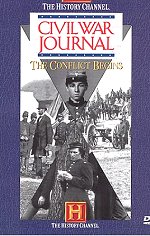 Civil War Journal - The Conflict Begins These four programs from the History Channel series Civil War Journal cover critical aspects of the early days of the war. |
 Civil War Journal Collector's Edition 4-DVD Set Made exclusively for Books Are Fun. Discs include: · Stonewall Jackson · Sherman and the March to the Sea · West Point Classmates-Civil War Enemies · Robert E. Lee · Battle of 1st Bull Run · The 54th Massachusetts · John Brown s War · Destiny at Fort Sumter |
 Gettysburg / Gods and Generals The tide of the war changes during three fierce days of combat at Gettysburg [Disc 1] the gripping saga of the tactics command errors and sacrifices behind the bloodiest battle ever fought on U.S. soil. Gods and Generals [Disc 2] reveals the spirited allegiances and fierce combat of earlier Civil War struggles |
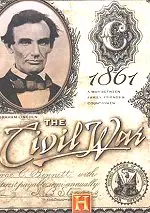 History Channel Presents The Civil War From Harper's Ferry, Fort Sumter, and First Bull Run to Shiloh, Antietam, and Gettysburg. The most legendary Civil War battles in brilliant detail. A selection of the soldiers and legendary leaders. |
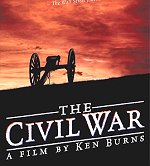 The Civil War - A Film by Ken Burns Here is the saga of celebrated generals and ordinary soldiers, a heroic and transcendent president and a country that had to divide itself in two in order to become one |
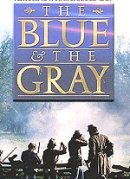 The Blue and the Gray The Complete Miniseries The Civil War proved a backdrop for this 1982 miniseries. Complete and uncut three disc set. Two families divided by the War Between the States. A Southerner caught when he becomes a war correspondent for the Northern newspaper. He finds himself where history's in the making from the Battle of Bull Run to Abraham Lincoln's assassination |
 Blue Vs. Gray - Killing Fields Relive the most vicious fighting of the Civil War, in which General Ulysses S. Grant forcibly reversed the tide of the conflict by paying with the blood of thousands. It was a desperate time for the Union |
