The Longest Raid of the Civil War: Little-Known & Untold Stories of Morgan's Raid into Kentucky, Indiana & Ohio
Kentucky, a slave state, did not secede. Many were pro Confederate however. Jefferson Davis was from Kentucky, Lincoln was also born there.

Middle Creek
Civil War in Kentucky

American Civil War
January 10, 1862


War in Kentucky: From Shiloh to Perryville
Union gains in the Mississippi Valley and in Tennessee and Kentucky had brought the Confederacy to a point of crisis.

More than a month after Confederate Col. John S. Williams left Kentucky, following the fight at Ivy Mountain, Brigadier General Humphrey Marshall led another force into southeast Kentucky to continue recruiting activities. From his headquarters in Paintsville, on the Big Sandy River, northwest of Prestonsburg, Marshall recruited volunteers and had a force of more than 2,000 men by early January, but could only partially equip them.

Union Brigadier General Don Carlos Buell directed Col. James Garfield to force Marshall to retreat back into Virginia. Leaving Louisa, Garfield took command of the 18th Brigade and began his march south on Paintsville. He compelled the Confederates to abandon Paintsville and retreat to the vicinity of Prestonsburg. Garfield slowly headed south, but swampy areas and numerous streams slowed his movements, and he arrived in the vicinity of Marshall on the 9th.

Heading out at 4:00 am on January 10, Garfield marched a mile south to the mouth of Middle Creek, fought off some Rebel cavalry and turned west to attack Marshall. Marshall had put his men in line of battle west and south of the creek near its forks. Garfield attacked shortly after noon, and the fighting continued for most of the afternoon until Union reinforcements arrived in time to dissuade the Confederates from assailing the Federal left. Instead, the Rebels retired south and were ordered back to Virginia on the 24th.

Garfield's force moved to Prestonsburg after the fight and then retired to Paintsville. Union forces had halted the Confederate 1861 offensive in Kentucky, and Middle Creek demonstrated that their strength had not diminished. This victory, along with Mill Springs a little more than a week later, cemented Union control of eastern Kentucky until Confederate General Braxton Bragg launched his offensive in the summer and fall.

Following these two January victories in Kentucky, the Federals carried the war into Tennessee in February.

Result(s): Union victory (indecisive)

Location: Floyd County

Campaign: Offensive in Eastern Kentucky (1862)

Date(s): January 10, 1862

Principal Commanders: Col. James Garfield [US]; Brigadier General Humphrey Marshall [CS]

Forces Engaged: 18th Brigade [US]; brigade [CS]

Estimated Casualties: 92 total (US 27; CS 65)


Kentucky Cavaliers in Dixie: Reminiscences of a Confederate Cavalryman
Mosgrove was born in Kentucky, in 1844, and enlisted in the Fourth Kentucky Cavalry Regiment on September 10, 1862. His eyewitness account illuminates the western theater of the Civil War in Kentucky, east Tennessee, and southwest Virginia

Camping Supplies

Cast Iron Waffle Iron
12 Inch Cast Iron Skillet
Full size military Camp Cot
Eddie Bauer large tents
Hiking Boots
Jan Sport Back Packs
High Sierra Camp Equipment
Mosquito Netting
Fire Starters and Lighters
Camp Stoves
Portable Toilets
Medical Bag First Aid Supplies
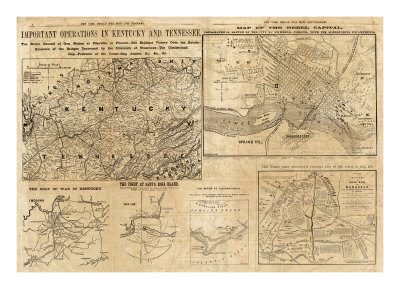
Kentucky Civil War Battle Map
State Battle Maps
Confederate Commanders
Union Generals
General Ulysses S. Grant
Battle of Gettysburg
Women Civil War Soldiers
History of Colored Troops
Documents of the Civil War
Ships and Naval Battles
Civil War Store
Civil War Firearms
Standard Catalog of Civil War Firearms
Over 700 photographs and a rarity scale for each gun, this comprehensive guide to the thousands of weapons used by Billy Yank and Johnny Reb will be indispensable for historians and collectors.
American Civil War Book Titles

CHICAGO'S BATTERY BOYS
The Chicago Mercantile Battery in the Civil War's Western Theater

Organized in 1862 as part of John McClernand's 13th Corps, the battery participated in the arduous Vicksburg campaign. The artillerists performed well everywhere, Chickasaw Bluffs, Port Gibson, Champion Hill, Big Black River, and the siege of Vicksburg

The Tale of the Devil: The Biography of Devil Anse Hatfield
The story of Hatfield patriarch Devil Anse Hatfield, beginning with his childhood in frontier Appalachia; it also covers his Civil War days as a noted Confederate soldier.

The Last Confederate General: John C. Vaughn and His East Tennessee Cavalry
The first man to raise an infantry regiment in the state, and one of the very last Confederate generals to surrender.History has not been kind to Vaughn, who finally emerges from the shadows in this absorbing reassessment of his life and military career

Lee's Cavalrymen: A History of the Mounted Forces of the Army of Northern Virginia, 1861-1865
The cavalry of the Army of Northern Virginia its leadership, the military life of its officers and men as revealed in their diaries and letters, the development of its tactics as the war evolved, and the influence of government policies on its operational abilities. All the major players and battles are involved

The Confederate Army 1861-65
Missouri, Kentucky & Maryland

Each state's militia and the volunteer regiments that were pressed into Confederate service in the initial stages of the war. Early war military units, their uniforms and accoutrements. How the transition occurred from locally supplied clothing and equipment to state-issued regulation Confederate uniforms

Three Years With Quantrill: A True Story Told by His Scout John McCorkle
Quantrill is often maligned as a psychopathic killer and a despot. McCorkle refutes this common claim by the writers of the winner's history, shows that Quantrill was a compassionate and honorable man. He shows a side to the War of Northern Aggression that is rarely told

Gray Ghosts of the Confederacy: Guerrilla Warfare in the West, 1861-1865
The establishment of a police state in Missouri and the subsequent backlash and ensuing war of sabotage by local guerrillas. Missouri and Kansas had shared much animosity in the years leading up to the Civil War

Mosby's Rangers
From 1863 to the end, Mosby's raiders were a constant headache for the North. More than 1,000 men served under Mosby, they usually acted in small detachments of several dozen, sacking supply depots, attacking railroads, and harassing federal troops. They seemed to move behind enemy lines almost at will.

Civil War History Documentary DVD Movie Titles

Civil War Combat: America's Bloodiest Battles
The violent mayhem of the hornet's nest at Shiloh, the valiant charge on the sunken road at Antietam, the carnage in the wheat field at Gettysburg, and the brutal fighting at Cold Harbor

Civil War Journal - The Conflict Begins
These four programs from the History Channel series Civil War Journal cover critical aspects of the early days of the war.

History Channel Presents The Civil War
From Harper's Ferry, Fort Sumter, and First Bull Run to Shiloh, Antietam, and Gettysburg. The most legendary Civil War battles in brilliant detail. A selection of the soldiers and legendary leaders.

Gettysburg / Gods and Generals
The tide of the war changes during three fierce days of combat at Gettysburg [Disc 1] the gripping saga of the tactics command errors and sacrifices behind the bloodiest battle ever fought on U.S. soil. Gods and Generals [Disc 2] reveals the spirited allegiances and fierce combat of earlier Civil War struggles

Civil War: A Concise History
The best collection of Civil War visuals ever assembled in one 75-minute program. A breathtaking and first-hand account of the war. Great DVD Bonuses

The Civil War - A Film by Ken Burns
Here is the saga of celebrated generals and ordinary soldiers, a heroic and transcendent president and a country that had to divide itself in two in order to become one

The Blue and the Gray
The Complete Miniseries

The Civil War proved a backdrop for this 1982 miniseries. Complete and uncut three disc set. Two families divided by the War Between the States. A Southerner caught when he becomes a war correspondent for the Northern newspaper. He finds himself  where history's in the making from the Battle of Bull Run to Abraham Lincoln's assassination

Blue Vs. Gray - Killing Fields
Relive the most vicious fighting of the Civil War, in which General Ulysses S. Grant forcibly reversed the tide of the conflict by paying with the blood of thousands. It was a desperate time for the Union

Sources:
U.S. National Park Service
U.S. Library of Congress.


Search
AmericanCivilWar.com
 
Enter the keywords you are looking for and the site will be searched and all occurrences of your request will be displayed. You can also enter a date format, April 19,1862 or September 1864.
Battle of Shiloh
Civil War Map
First Manassas
Civil War Pictures
Civil War Cooking
Gettysburg
Civil War Ships