|
|
|
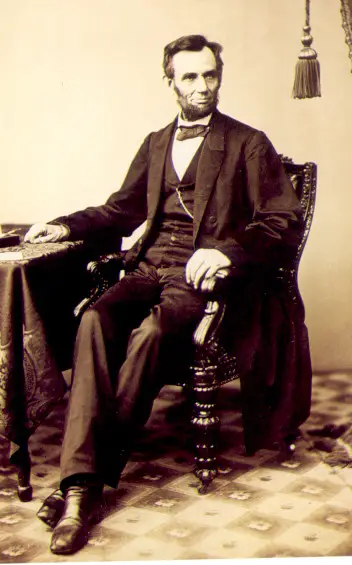
Abraham Lincoln
|
 |
|
Fellow-Countrymen: At this second appearing to take the oath of the Presidential office there is less occasion for an extended address than there was at the first. Then a statement somewhat in detail of a course to be pursued seemed fitting and proper. Now, at the expiration of four years, during which public declarations have been constantly called forth on every point and phase of the great contest which still absorbs the attention and engrosses the energies of the nation, little that is new could be presented. The progress of our arms, upon which all else chiefly depends, is as well known to the public as to myself, and it is, I trust, reasonably satisfactory and encouraging to all. With high hope for the future, no prediction in regard to it is ventured. On the occasion corresponding to this four years ago all thoughts were anxiously directed to an impending civil war. All dreaded it, all sought to avert it. While the inaugural address was being delivered from this place, devoted altogether to saving the Union without war, urgent agents were in the city seeking to destroy it without war--seeking to dissolve the Union and divide effects by negotiation. Both parties deprecated war, but one of them would make war rather than let the nation survive, and the other would accept war rather than let it perish, and the war came. One-eighth of the whole population were colored slaves, not distributed generally over the Union, but localized in the southern part of it. These slaves constituted a peculiar and powerful interest. All knew that this interest was somehow the cause of the war. To strengthen, perpetuate, and extend this interest was the object for which the insurgents would rend the Union even by war, while the Government claimed no right to do more than to restrict the territorial enlargement of it. Neither party expected for the war the magnitude or the duration which it has already attained. Neither anticipated that the cause of the conflict might cease with or even before the conflict itself should cease. Each looked for an easier triumph, and a result less fundamental and astounding. Both read the same Bible and pray to the same God, and each invokes His aid against the other. It may seem strange that any men should dare to ask a just God's assistance in wringing their bread from the sweat of other men's faces, but let us judge not, that we be not judged. The prayers of both could not be answered. That of neither has been answered fully. The Almighty has His own purposes. "Woe unto the world because of offenses; for it must needs be that offenses come, but woe to that man by whom the offense cometh." If we shall suppose that American slavery is one of those offenses which, in the providence of God, must needs come, but which, having continued through His appointed time, He now wills to remove, and that He gives to both North and South this terrible war as the woe due to those by whom the offense came, shall we discern therein any departure from those divine attributes which the believers in a living God always ascribe to Him? Fondly do we hope, fervently do we pray, that this mighty scourge of war may speedily pass away. Yet, if God wills that it continue until all the wealth piled by the bondsman's two hundred and fifty years of unrequited toil shall be sunk, and until every drop of blood drawn with the lash shall be paid by another drawn with the sword, as was said three thousand years ago, so still it must be said "the judgments of the Lord are true and righteous altogether." With malice toward none, with charity for all, with firmness in the right as God gives us to see the right, let us strive on to finish the work we are in, to bind up the nation's wounds, to care for him who shall have borne the battle and for his widow and his orphan, to do all which may achieve and cherish a just and lasting peace among ourselves and with all nations.
|
Sources:
Library of Congress
| Search AmericanCivilWar.com |
| Enter the keywords you are looking for and the site will be searched and all occurances of your request will be displayed. You can also enter a date format, April 19,1862 or September 1864. |
American Civil War Exhibits
Civil War Timeline
Documents of the Civil War
Kindle Available Team of Rivals: The Political Genius of Abraham Lincoln A multiple biography of the entire team of personal and political competitors that Lincoln put together to lead the country. Five of the key players, four of whom contended for the 1860 Republican presidential nomination and all of whom later worked together in Lincoln's cabinet. |
 Lincoln's Melancholy: How Depression Challenged a President and Fueled His Greatness The deep melancholy that pervaded Abraham Lincoln's life and its influence on his mature character. Mired in personal suffering as a young man, Lincoln forged a hard path toward mental health. His coping strategies and depressive insight ultimately helped the sixteenth president |
Kindle Available Lincoln and His World: The Early Years Birth to Illinois Legislature The story of this monumental American and bring a fascinating era of American history to life. The book covers Lincoln's birth through his first election to the Illinois legislature in 1834 |
 Lincoln and the Indians Civil War Policy and Politics Overview of the system of Indian administration as it had developed by 1860. Dominated by the political spoils system and by corruption of the Indian agents. As a master of the art of pragmatic politics, Lincoln used the system as he needed to do to hold the Union together-resulting in tragedy for our country's Indian wards |
Kindle Available The Gettysburg Gospel: The Lincoln Speech That Nobody Knows Reconstructs what really happened in Gettysburg, Pennsylvania, on November 19, 1863. |
 Forced into Glory Abraham Lincoln's White Dream This dissenting view of Lincoln's greatness surveys the president's policies, speeches, and private utterances and concludes that he had little real interest in abolition. Pointing to Lincoln's support for the fugitive slave laws, his friendship with slave-owning senator Henry Clay, and conversations in which he entertained the idea of deporting slaves |
 Lincoln and the Decision for War The Northern Response to Secession Democratic leader Stephen Douglas to Republican party leader William Seward. More than just a politcal history, letters and quotes from common townspeople provide a complete view of the perceptions of the time |
 Lincoln and Freedom: Slavery, Emancipation, and the Thirteenth Amendment The history of slavery in North America, the Dred Scott decision, the evolution of Lincoln's view of presidential powers, the influence of religion on Lincoln, and the effects of the Emancipation Proclamation |

