Who Wrote The Lost Order?
|
|
|
|
|
����������� The historical record, as examined here, indisputedly shows
there are important facts which must be considered in weighing the credibility
of General Lee being the person responsible for the writing of the Lost Order.
First, there is the glaring fact that the Lost Order was not written by one of Lee’s staff officers. The record shows that,
during the Sharpsburg Campaign, all of them were enlisted by Lee, at one point
or another, to write orders and letters at his direction: Chilton wrote Lee’s
letter to
From Lee�s 1868 letter to D.H. Hill:
From the Lost Order:
Another example from the Lost Order:
From a letter from Lee to
From Lee�s 1868 letter to D.H. Hill:
From the Lost Order:
Another example from the Lost Order:
Another example from the Lost Order:
From Lee�s letter to D.H. Hill:
From the Lost Order:
From the Lost Order:
From Lee�s letter to D.H. Hill:
From Lee�s letter to D.H. Hill:
���������������������������������������������������������������������������������������������������������������������� From the Lost Order:
From the Lost Order:
From the Lost Order:
From Lee�s letter to D.H. Hill:
From the Lost Order:
From the Lost Order:
From Lee�s letter to D.H. Hill:
From the Lost Order:
From the Lost Order:
From the Lost Order:
From Lee�s letter to Hill:
From Lee�s letter to Hill:
From Lee�s letter to Hill:
The letter �F�
From Lee�s letter to Hill:
From Lee�s letter toHill:
From the Lost Order:
From the Lost Order:
From the Lost Order:
This is a close call. Several factors must be considered in rendering a verdict. First, the resolution of the images compromise the analysis to some extent, because the original documents are over 150 years old and precise detail of the ends of letters can be better seen by examing the original documents. Second, the person writing the Lost Order was using pencil while General Lee was using a pen in writing to Hill. Third, General Lee’s writing hand might have been injured to some extent when the Lost Order was written, while, in writing to Hill, his hand was not injured. Fourth, the handwriting examples are separated by almost six years of time.
The fact that the question of whether the Lost Order was written in General Lee’s handwriting, is a close call in itself points to Lee as the writer; if what the Library of Congress holds, is the actual document McClellan received, and not a copy, then, of all those who customarily would write orders at Lee’s headquarters, the writing comes closest to being Lee’s. And it makes perfect sense, under the circumstances, that Lee would be the writer.
McClellan died in 1885. His wife, Ellen, was the Executrix
of his estate. Ellen left the
| |
 A copy of the letter Mac's son, George McClellan, Jr., wrote the Library of Congress in 1911, sending along the trunks of his father's papers. 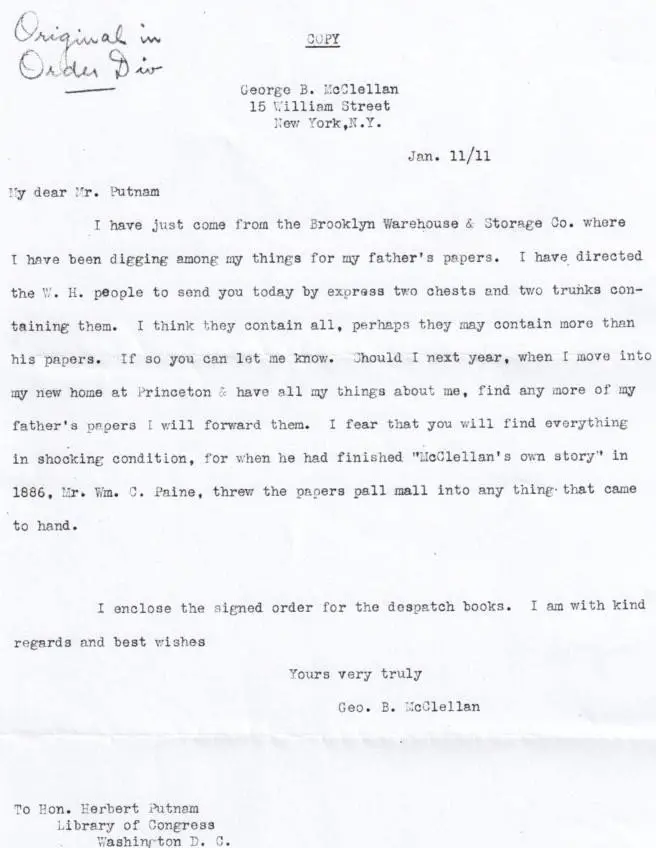
|
|
Prime’s statement that the envelope contains “the original
order found and on which McClellan was able to plan his movements to
When the issue of whether Lee wrote the Lost Order is
considered in light of the totality of the circumstances shown by the evidence,
it seems reasonable to conclude he probably was the writer. Still, there is the
documented fact that Lee did suffer some kind of injury to his hand or hands on
September 1 which may have involved a fractured finger. There exists a letter
written for Lee from
It is possible that Lee had someone close to him write the Lost Order, perhaps his son, Custis, whose whereabouts at the time are uncertain, or his son, Rooney, who was Colonel of the 9th Virginia Cavalry Regiment, attached to Fitz Hugh Lee’s brigade.
Rooney’s writing follows: |
|
 |
|
 |
|
Exemplars of Custis Lee’s handwriting is the subject of a search, since the Virginia Historical Society does not wish to allow the copying of any page of Custis’s 300 page manuscript, written in the war years.
Whatever the results of the search, the advances sure to come in the field of imaging, the writer of the Lost Order will eventually be identified.
JOE RYAN, Palos Verdes, California |


Joseph Ryan Lee's Ruse of War: Special Order 191
|
||||||||