CSS Virginia vs USS Monitor
Civil War Naval Battle
March 9, 1862

At dawn on 9 March 1862, CSS Virginia prepared for renewed combat. The previous day, she had utterly defeated two big Federal warships, Congress and Cumberland , destroying both and killing more than 240 of their crewmen. Today, she expected to inflict a similar fate on the grounded steam frigate Minnesota and other enemy ships, probably freeing the lower Chesapeake Bay region of Union seapower and the land forces it supported. Virginia would thus contribute importantly to the Confederacy's military, and perhaps diplomatic, fortunes.

However, as they surveyed the opposite side of Hampton Roads, where the Minnesota and other potential victims awaited their fate, the Confederates realized that things were not going to be so simple. There, looking small and low near the lofty frigate, was a vessel that could only be USS Monitor , the Union Navy's own ironclad, which had arrived the previous evening after a perilous voyage from New York. Though her crew was exhausted and their ship untested, the Monitor was also preparing for action.

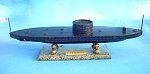
Undeterred, Virginia steamed out into Hampton Roads. Monitor positioned herself to protect the immobile Minnesota , and a general battle began. Both ships hammered away at each other with heavy cannon, and tried to run down and hopefully disable the other, but their iron-armored sides prevented vital damage. Virginia 's smokestack was shot away, further reducing her already modest mobility, and Monitor 's technological teething troubles hindered the effectiveness of her two eleven-inch guns, the Navy's most powerful weapons. Ammunition supply problems required her to temporarily pull away into shallower water, where the deep-drafted Virginia could not follow, but she always covered the Minnesota .

Soon after noon, Virginia gunners concentrated their fire on Monitor 's pilothouse, a small iron blockhouse near her bow. A shell hit there blinded Lieutenant John L. Worden , the Union ship's Commanding Officer, forcing another withdrawal until he could be relieved at the conn. By the time she was ready to return to the fight, Virginia had turned away toward Norfolk.
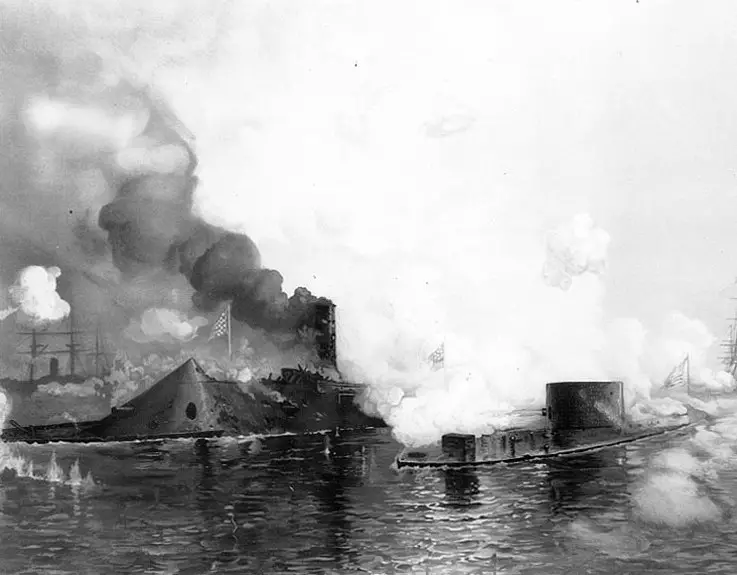
The first battle between ironclad warships had ended in stalemate, a situation that lasted until Virginia 's self-destruction two months later. However, the outcome of combat between armored equals, compared with the previous day's terrible mis-match, symbolized the triumph of industrial age warfare. The value of existing ships of the line and frigates was heavily discounted in popular and professional opinion. Ironclad construction programs, already underway in America and Europe, accelerated. The resulting armored warship competition would continue into the 1940s, some eight decades in the future.


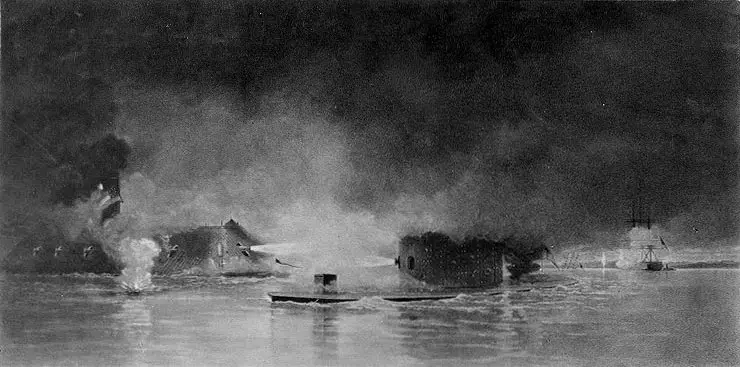
Lithograph by Closson Blake, after a painting by W.F. Halsall, depicting the two ironclads engaging at close range.
Collection of President Franklin D. Roosevelt.

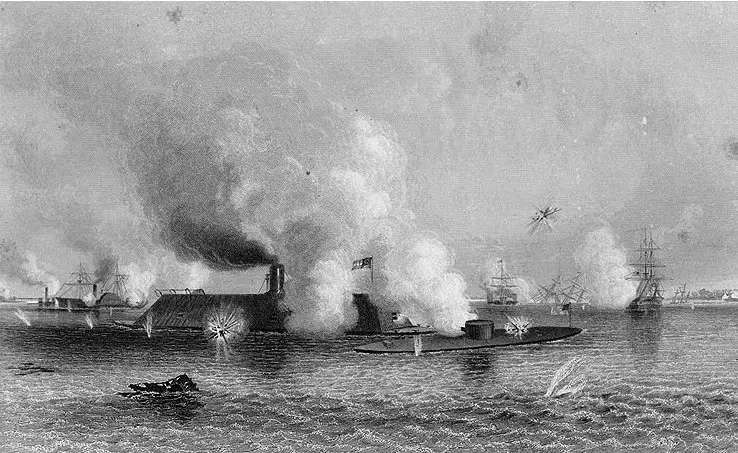
Contemporary print by C. Parsons, New York, after a drawing by J. Davies

Halftone reproduction of an artwork, copyrighted by G.S. Richardson, 1906

Lithograph published by Henry Bill, 1862
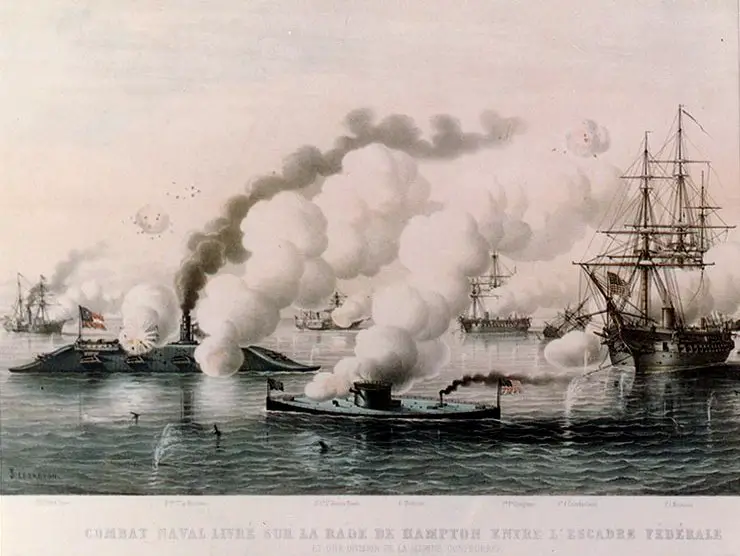
Other ships shown are USS Cumberland (sinking, at left), CSS Jamestown and Yorktown (center distance), USS Congress (right center, behind Virginia ) and USS Minnesota (right).
This artwork is rather inaccurate in historical detail and orientation, showing the other ships generally much closer to the main action than was actually the case and including Cumberland and Congress , both of which had been sunk on the previous day.

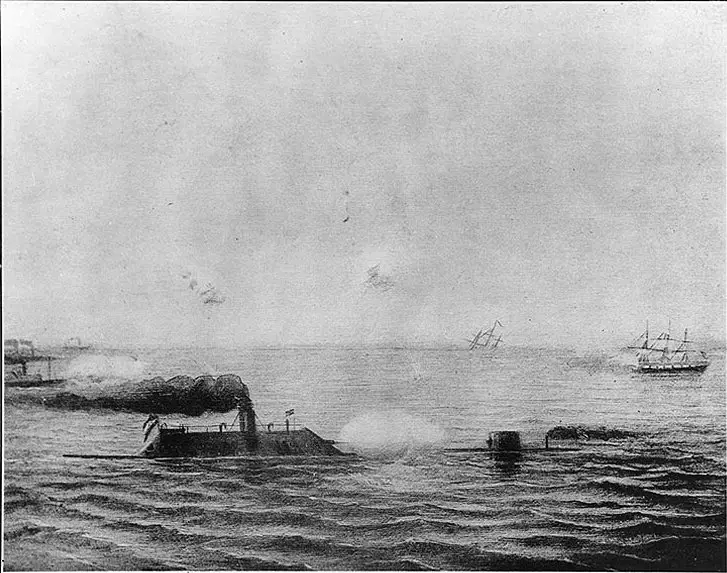
Colored lithograph by LeBreton, after a French officer's sketch, published in Paris, circa 1862

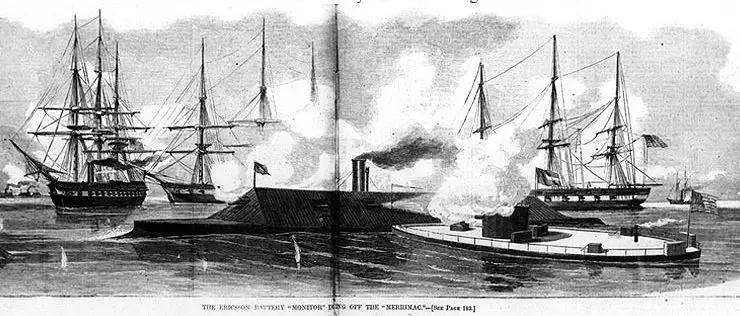
Line engraving published in "Harper's Weekly", January-June 1862
The scene is rather inaccurate in scale and detail, most significantly showing other Federal warships much closer to the action than was actually the case.

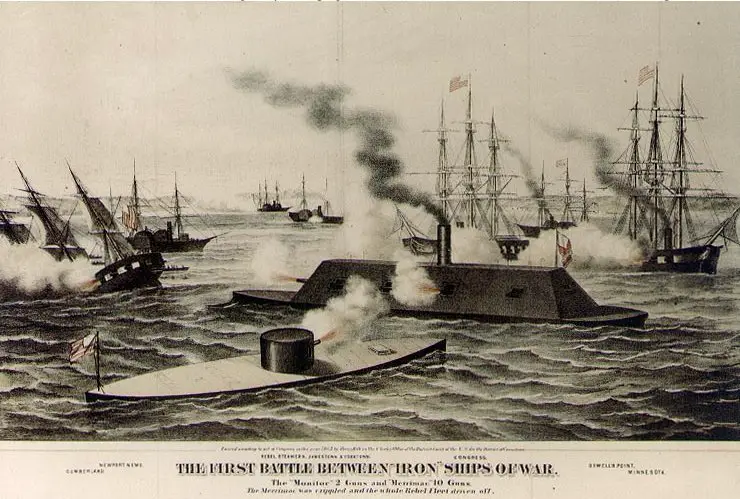
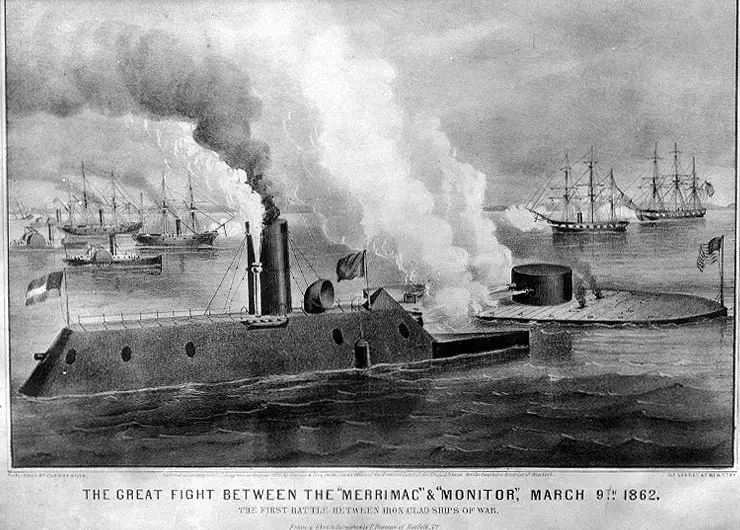
Lithograph by Currier & Ives, New York, 1862, "From a sketch furnished by F. Newman of Norfolk, Va."
note the beginning of the use of the name USS Merrimac for the converted USS Merrimack


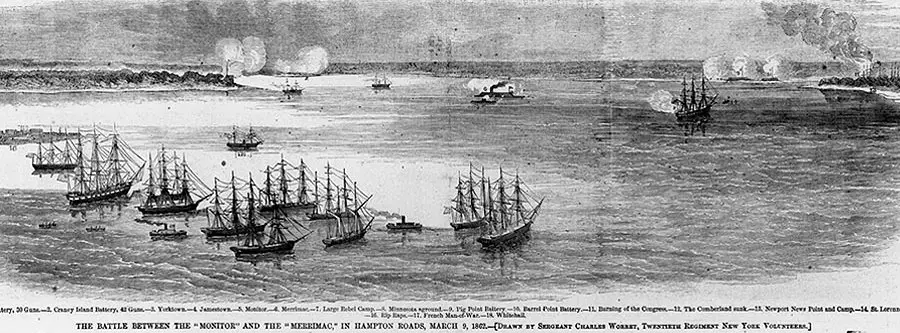
Line engraving published in "Harper's Weekly", January-June 1862, based on a drawing by Sergeant Charles Worret, Twentieth Regiment New York Volunteers. The view looks approximately south, from over Fortress Monroe, and provides a panoramic view of the action, with many elements keyed to text below the picture.
Numbered features, as cited below the view, include: (Note: numbers 1-13 run across the upper part of the view, from left center to right)
1. Sewell's Point Battery, 30 Guns;
2. Craney Island Battery, 42 Guns;
3. CSS Yorktown ;
4. CSS Jamestown ;
5. USS Monitor ;
6. CSS Virginia ('Merrimac');
7. Large Rebel Camp;
8. USS Minnesota aground;
9. Pig Point Battery;
10. Barrel Point Battery;
11. Burning of the Congress ;
12. The Cumberland sunk;
13. Newport News Point and Camp;
14. St. Lorenze ... (small vessel near Minnesota );
15. Hampton
16. Rip Raps (at far left);
17. French Man-of-War (left center);
18. Whitehall.
Ships in the left foreground include USS Roanoke with Union transports and storeships.
Books
Civil War
Womens Subjects
Young Readers
Gettysburg
Native Americans
Military History


Confederate Store
Civil War DVDs
Civil War VHS
Civil War Games
Civil War Music
Civil War Posters

Military Toys
Military Video Games
Military History DVDs
Military Magazines
US Military Gear

Battle at Hampton Roads Virginia
Civil War Ships and Naval Battles
American Civil War Exhibits
United States Navy DVDs
Civil War Submarines
American Civil War Exhibits
Recipes and Cookbooks
Civil War Summary

DVD DVD Book Book

Quest for the Monitor
The first group of non-governmental divers to dive the Monitor. All diving operations were conducted under the close supervision of NOAA.This was beautifully photographed by veteran lensman Ric O'Donnell and narrated and written by Jackie Stone. The video shows a lot of action both on the deck of the dive boat as well as wonderfully clear underwater views of the Monitor

Raise the Alabama
Known as "the ghost ship." During the Civil War, the CSS Alabama sailed over 75,000 miles and captured more than 60 Union vessels. But her career came to an end in June of 1864 when she was sunk by the USS Kearsarge off the coast of Northern France, where the Alabama had gone for repairs.RAISE THE ALABAMA! descends into the murky depths of the English Channel with the marine archeology team led by the renowned Gordon Watts. 200 feet beneath these foreign waters, the legendary Confederate ship is surrendering her secrets, despite weather conditions that make it safe to dive only a few days a year. The program also documents the Alabama's extraordinary career, from her construction in Liverpool to the surprise attacks that made her the scourge of Union shipping and the valiant, 90-minute battle with the Kearsarge

War, Technology, and Experience aboard the USS Monitor
David Mindell has combined a sensitive and incisive reading of the documentary evidence with insightful historical analysis to illuminate not only his central theme, the experience of battle in an emerging machine age, but also the process of invention, negotiation, and politics that brought the Monitor into existence and the quite different process of narration, memory, and imagination that invested the ship and its exploits so heavily with symbolic meaning.

Life in Mr. Lincoln's Navy
Ringle is among the first to examine the many aspects of sailors' lives during the American Civil War. He examines topics such as the recruiting efforts of the U.S. Navy, compensation and promotion, training, entertainment, and disease to name but a few. The extensive research and sheer fact that this is one of the first books to examine this aspect of CW naval history makes it a must for any American naval library

Brain Teasers and Thinking Games at WildGames Puzzles!
Lots of fun with sports at WildGames Sports!
Adventure Action and Strategy Games at WildGames Action!
Volcano Pictures and Glossary


American Military Gear Recruiter and History
United States Marines gear history and support of Semper Fi Fund


The Complete DVD History of U.S. Wars (1700-2004)
War has always been part of the American experience. From the time the first colonists set foot upon North America's shores, they were in conflict with the Native inhabitants. One hundred years later the colonies suddenly found themselves an extension of the conflicts in Europe. Less than a century later, the Revolutionary War freed the fledgling United States from its British overlords and European entanglements. Born and nurtured in war, America grew in strength and power until at the beginning of the 21st century it was the foremost military power in the world.