Pauline Cushman 1833–1893
Union Spy


In 1862, Pauline Cushman was a struggling actress employed in a Louisville playhouse. In a play that required her character to give a toast, she was dared on one occasion to toast Jefferson Davis. She agreed, but gained the permission of the federal provost marshal first.

Perceived now as a self-proclaimed Southern sympathizer, Cushman was expelled from the theater. In 1863, a new opportunity presented itself, the chance to spy for the Union. In lace and petticoats, she became a camp follower of the Confederate army in Kentucky and Tennessee. Her allure and beauty aided her in obtaining information that would be of value to the federal army. Yet the frustrated actress soon proved to be wanting in spying as well.

She aroused suspicions and was finally caught with secret papers. General Bragg had her tried, and a military court sentenced her to hang, whereupon her health broke and her sentence was delayed. Yet military operations intervened. Bragg moved his army and left Cushman behind.

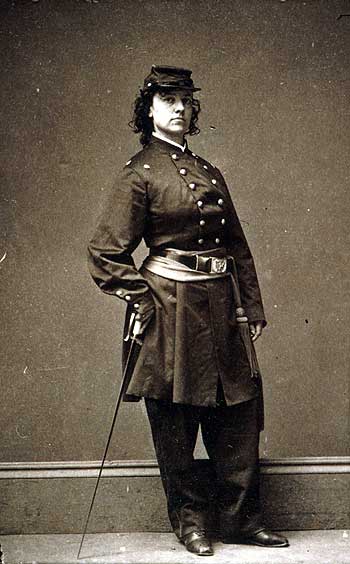
Rescued by Yankees at Shelbyville, Tennessee, she traveled north to much acclaim. President Lincoln made her an honorary major, and wearing her new uniform, she lectured about her clandestine adventures behind rebel lines.

After the war, Cushman's fame mostly ebbed. She tried acting again and married for the second and third times. Her last marriage ended in separation. For an illness, she began taking opium and died of an intentional overdose at sixty. Veterans of the Grand Army of the Republic paid tribute by burying her with military honors in their cemetery in San Francisco.


Civil War Women
Women Civil War Soldiers
Womens Sufferage
Civil War Music History
Colored Troop Pictures
Civil War Exhibits
Civil War Timeline
State Battle Maps
Civil War Store

American Civil War Book Titles

Doctors in Blue: The Medical History of the Union Army in the Civil War
An excellent treatment of a rather specialized subject

A Very Violent Rebel: The Civil War Diary of Ellen Renshaw House
The Siege of Knoxville (November 1863) is covered and Sutherland's footnotes make for good history

Memoirs of a Soldier, Nurse and Spy: A Woman's Adventures in the Union Army
On April 25, 1861, Sarah Emma Edmonds alias Frank Thompson became a male nurse in Company F, of the 2nd Michigan Volunteer Infantry Regiment. This is 'his' story

The Woman in Battle: The Civil War Narrative of Loreta Janeta Velazquez, Cuban Woman and Confederate Soldier
A Cuban woman fought in the Civil War for the Confederacy as the cross-dressing Harry T. Buford. As Buford, she organized an Arkansas regiment; participated in the historic battles of Bull Run, Balls Bluff, Fort Donelson, and Shiloh

A Woman of Honor:
Dr. Walker and the Civil War

A picture of Mary Walker that allows us to see the furrows in her brow as she continued to stubbornly stick to her values. This book is eye-opening and brings to the forefront many women's rights issues that we may not even be aware of.

Hit: Essays on Women's Rights
by Mary Edwards, M.D. Walker

The only woman to receive the Congressional Medal of Honor for her service during the Civil War, Dr. Mary E. Walker (1832-1919) was a surgeon, a public lecturer, and an outspoken champion of women's rights. One of the first women in the country to be awarded a medical degree, she served as an assistant surgeon for the Fifty-second Ohio Infantry

Mothers of Invention: Women of the Slaveholding South in the American Civil War
When Confederate men marched off to battle, southern women struggled with the new responsibilities of directing farms and plantations, providing for families, and supervising increasingly restive slaves

She Went to the Field:
Women Soldiers of the Civil War

Several substantiated cases of female soldiers during the American Civil War, including Sarah Rosetta Wakeman (aka Private Wakeman, Union); Sarah Emma Edmonds (aka Private Thompson, Union); Loreta Janeta Velazquez (aka Lieutenant Buford, Confederate); and Jennie Hodgers (aka Private Cashier, Union).

Harriet Beecher Stowe : Three Novels : Uncle Tom's Cabin Or, Life Among the Lowly; The Minister's Wooing; Oldtown Folks
Uncle Tom's Cabin is probably the most influential work of fiction in American history. This Christian epic turned millions of Americans against slavery, bringing the "peculiar institution" immeasurably closer to its destruction. In The Minister's Wooing and Oldtown Folks, Stowe examines the interplay of religion, domesticity, and women's roles and choices in the shaping of American culture.

The American Woman's Home by Catharine E. Beecher and Harriet Beecher Stowe
Originally published in 1869, was one of the late nineteenth century's most important handbooks of domestic advice. This book represents their attempt to direct women's acquisition and use of a dizzying variety of new household consumer goods available in the post-Civil War economic boom

The Stowe Debate: Rhetorical Strategies in Uncle Tom's Cabin

The Cambridge Companion to Harriet Beecher Stowe
Perspectives on the frequently read Uncle Tom's Cabin as well as on topics of perennial interest, such as Harriet Beecher Stowe's representation of race, her attitude to reform, and her relationship to the American novel

Civil War History Documentary DVD Movie Titles

The Civil War - A Film by Ken Burns
Here is the saga of celebrated generals and ordinary soldiers, a heroic and transcendent president and a country that had to divide itself in two in order to become one

Uncle Toms Cabin
DVD also features a detailed and informative essay by historian David Pierce, an extensive collection of stills, promotional materials, and music cue sheets, and details of cuts made to the film, including two deleted scenes that are among the best moments the film has to offer

Women And The Civil War
The many contributions of women in both the North and South are presented in this program describing their roles on and near the momentous battles of the American Civil War

American Experience - Abraham and Mary Lincoln: A House Divided
Abraham Lincoln's legacy as the Great Emancipator reshaped the nation while his tragic death left Mary reclusive and forgotten.

The Last Confederate: The Story of Robert Adams
Great historically correct movie of a noble confederate and his undying love of a Yankee girl.

American Experience: The Massachusetts 54th Colored Infantry
After Lincoln signed the Emancipation Proclamation, the governor of Massachusetts was authorized to raise the first northern black regiment,  the Massachusetts 54th colored infantry.

Gettysburg / Gods and Generals
The tide of the war changes during three fierce days of combat at Gettysburg [Disc 1] the gripping saga of the tactics command errors and sacrifices behind the bloodiest battle ever fought on U.S. soil. Gods and Generals [Disc 2] reveals the spirited allegiances and fierce combat of earlier Civil War struggles

Horses of Gettysburg
Civil War Minutes

Filmed in high definition with charging horses, battlefield panoramas and no "talking heads," this cinematic documentary tells the story of the estimated 72,000 horses and mules that fought at the Battle of Gettysburg and uncovers the strategies employed to ensure that the millions of animals in service with the North and South remained healthy and well-trained for action.

Sources:
U.S. Library of Congress
U.S. National Park Service
Smithsonian Institution