Lincoln and Freedom: Slavery, Emancipation, and the Thirteenth Amendment The history of slavery in North America, the Dred Scott decision, the evolution of Lincoln's view of presidential powers, the influence of religion on Lincoln, and the effects of the Emancipation Proclamation |
President Abraham Lincoln issued the
|
|
|
|
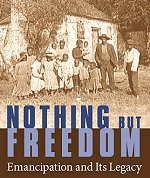
President Abraham Lincoln issued the Emancipation Proclamation on January 1, 1863, as the nation approached its third year of bloody civil war. The proclamation declared "that all persons held as slaves" within the rebellious states "are, and henceforward shall be free." Despite this expansive wording, the Emancipation Proclamation was limited in many ways. It applied only to states that had seceded from the Union, leaving slavery untouched in the loyal border states. It also expressly exempted parts of the Confederacy that had already come under Northern control. Most important, the freedom it promised depended upon Union military victory. Although the Emancipation Proclamation did not immediately free a single slave, it fundamentally transformed the character of the war. After January 1, 1863, every advance of federal troops expanded the domain of freedom. Moreover, the Proclamation announced the acceptance of black men into the Union Army and Navy, enabling the liberated to become liberators. By the end of the war, almost 200,000 black soldiers and sailors had fought for the Union and freedom. From the first days of the Civil War, slaves had acted to secure their own liberty. The Emancipation Proclamation confirmed their insistence that the war for the Union must become a war for freedom. It added moral force to the Union cause and strengthened the Union both militarily and politically. As a milestone along the road to slavery's final destruction, the Emancipation Proclamation has assumed a place among the great documents of human freedom. The original of the Emancipation Proclamation of January 1, 1863, is in the National Archives in Washington, DC. With the text covering five pages the document was originally tied with narrow red and blue ribbons, which were attached to the signature page by a wafered impression of the seal of the United States. Most of the ribbon remains; parts of the seal are still decipherable, but other parts have worn off. The document was bound with other proclamations in a large volume preserved for many years by the Department of State. When it was prepared for binding, it was reinforced with strips along the center folds and then mounted on a still larger sheet of heavy paper. Written in red ink on the upper right-hand corner of this large sheet is the number of the Proclamation, 95, given to it by the Department of State long after it was signed. With other records, the volume containing the Emancipation Proclamation was transferred in 1936 from the Department of State to the National Archives of the United States. |
 Reconstruction after the Civil War Chicago History of US Civilization Praised for cutting through the controversial scholarship and popular myths of the time to provide an accurate account of the role of former slaves during this period in American history |
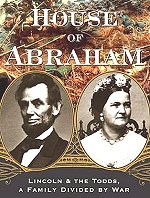 House of Abraham: Lincoln and the Todds, A Family Divided by War Mary Todd Lincoln one of fourteen siblings who were split between the Confederacy and the Union. Three of her brothers fought, and two died, for the South. Several Todds bedeviled Lincolns administration with their scandalous behavior |
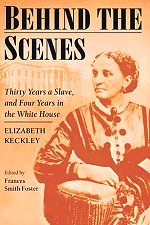 Behind the Scenes: Thirty Years a Slave, and Four Years in the White House This is a memior written by a woman who started life as a slave, then managed to buy her freedom, and later set up a successful living as a seamstress, eventually going to work for Mary Todd Lincoln in the White House |
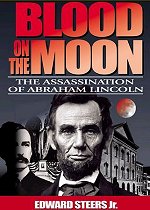 Blood on the Moon: The Assassination of Abraham Lincoln The definative book on the Lincoln Assassination, and the escape of John Wilkes Booth. not only does the author give a clear and concise accounting, he takes us out of the vacuum and explains the minute details of the very knotted relationships between the conspirators, and the links of the Confederate underground to Canada and back. |
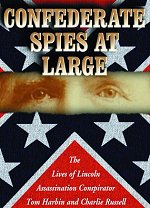 Confederate Spies at Large: The Lives of Lincoln Assassination Conspirator Tom Harbin And Charlie Russell The most wanted of all Confederate agents, was also one of the leaders in the plot to kill Abraham Lincoln |
Kindle Available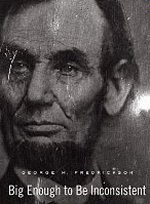 Big Enough to Be Inconsistent: Abraham Lincoln Confronts Slavery and Race “Cruel, merciful; peace-loving, a fighter; despising Negroes and letting them fight and vote; protecting slavery and freeing slaves.” Abraham Lincoln was, W. E. B. Du Bois declared, “big enough to be inconsistent.” |
Kindle Available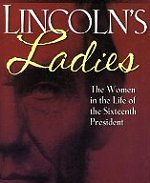 Lincoln's Ladies: The Women in the Life of the Sixteenth President The tumultuous experiences Abraham Lincoln had with women have long been chronicled. Lincoln's Ladies attempts to answer the questions of how he was affected by the women in his life and how he affected them. Abandoned through death by his mother, his sister, and his sweetheart, Ann Rutledge, Lincoln found it difficult to relate to women and developed an emotional barrier that often antagonized them. |
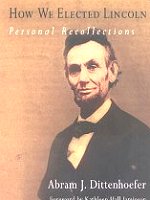 How We Elected Lincoln Personal Recollections Abram J. Dittenhoefer was a young South Carolinian who embraced abolition and moved to New York in order to work for the newly formed Republican party and its antislavery platform. Even though he was in his early twenties, he quickly established himself as a savvy and creative campaigner |
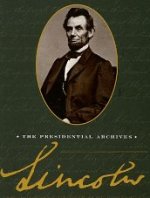 Lincoln: The Presidential Archives There is no better treatment for the life of the great President Abraham Lincoln than this interactive, "museum-in-a-book," which includes accessible text, photography, and removable documents that, combined, provide an educational and entertaining reading experience for the whole family. |
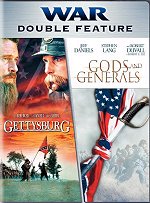 Gettysburg / Gods and Generals The tide of the war changes during three fierce days of combat at Gettysburg [Disc 1] the gripping saga of the tactics command errors and sacrifices behind the bloodiest battle ever fought on U.S. soil. Gods and Generals [Disc 2] reveals the spirited allegiances and fierce combat of earlier Civil War struggles |
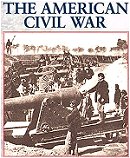 Brother Against Brother The American Civil War Fort Sumter, to the Confederate surrender at Appomattox, Features battle reconstructions and depictions of army life, eyewitness accounts, period photographs and engravings, plus commentary and analyses. |
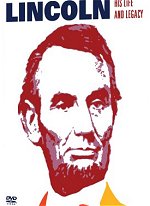 Abraham Lincoln: His Life & Legacy Comprehensive four-DVD set presents a complex portrait of a man who many consider to be our greatest commander-in-chief, but who considered himself "the loneliest man in the world." Bringing to life the tumultuous times in which Lincoln led his country, some of his finest Civil War moments, and his final hours |
 Unsolved History ~ Plots to Kill Lincoln Discovery Channel Before John Wilkes Booth fired that fatal shot in the balcony of Ford's Theater, President Lincoln was the target of at least five other assassination conspiracies. |
 Halls of Honor The U.S. Navy Museum takes you on an informed and entertaining romp through one of North America s oldest and finest military museums. The museum has been in continuous operation at the Washington Navy Yard since the American Civil War |
 Raise The Alabama She was known as "the ghost ship." During the Civil War, the CSS Alabama sailed over 75,000 miles and captured more than 60 Union vessels. But her career came to an end in June of 1864 when she was sunk by the USS Kearsarge off the coast of Northern France |
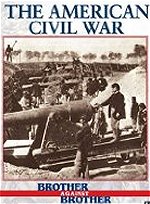 Brother Against Brother The American Civil War It was the most tragic episode in American history. During four years of bitter and bloody fighting between the states, more than 600,000 troops from the Union and Confederate sides lost their lives. The bloody events at places such as Antietam, Gettysburg, Shiloh, Cold Harbor, Vicksburg and Fredericksburg are still burned deep into the American psyche, never to be forgotten |
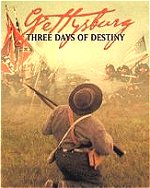 Gettysburg: Three Days of Destiny Presented by the Gettysburg Anniversary Committee and filmed at the massive 140th Gettysburg Battle Reenactment. The dramatic story unfolds through both Union and Confederate commanders dispatches, diaries and after-battle reports, with some of the biggest and most exciting Civil War battle sequences ever filmed |
 Wargame Construction Age of Rifles 1846 - 1905 Game lets you design and play turn-based strategic battles. You can create scenarios betwen years 1846 and 1905. You have complete control over all the units, and can customize their firepower, movement points, strength, aggressiveness, etc. Supports 1 or 2 players |
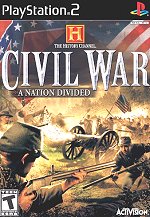 History Channel Civil War A Nation Divided Rally the troops and organize a counterattack -- Your strategic decision and talent as a commander will decide if the Union is preserved or if Dixie wins its independence |
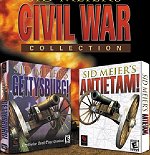 Sid Meier's Civil War Collection Take command of either Confederate or Union troops and command them to attack from the trees, rally around the general, or do any number of other realistic military actions. The AI reacts to your commands as if it was a real Civil War general, and offers infinite replayability. The random-scenario generator provides endless variations on the battles |
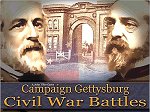 Campaign Gettysburg: Civil War Battles Campaign Gettysburg is simply the best of all the HPS Civil War games. While all of those are very good in their own right they simply do not compete with the level of detail presented here. Hundreds of scenarios and multiple OOBs are only the start, the best thing is the campaign game |
Source:
U.S. National Archives
|
Books Civil War Womens Subjects Young Readers Military History DVDs Confederate Store Civil War Games Music CDs Reenactors |
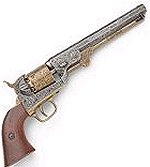 Civil War Model 1851 Naval Pistol with Engraved Silver Tone / Gold Tone Finish and Wooden Grips - Replica of Revolver Used by Both USA / Union and CSA / Confederate Forces |
12 Inch Action Figures 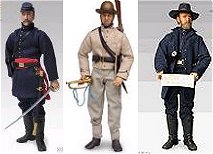 |
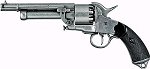 Civil War Confederate Revolver |
|