Union General Nelson Miles
|
|
|
|
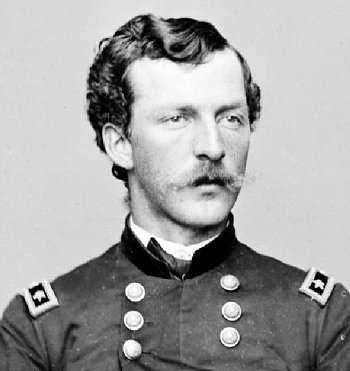
| Nelson Appleton Miles was born on the family farm near Westminster, Massachusetts, on 8 August 1839; attended local schools and received rudimentary military instruction from a former French officer; recruited a company of volunteers and received a commission as captain. September 1861; served on General Oliver O. Howard's staff and was wounded at the battle of Fair Oaks; was promoted to lieutenant colonel, 61st New York Volunteer Infantry, for gallantry in action, May 1862; replaced September 1862; was again wounded in the battle of Fredericksburg, 1862; was again wounded at the battle of Chancellorsville, 1863, where his gallant conduct later was recognized with the brevet of brigadier general (1867) and the Medal of Honor (1892); received the thanks of Congress for his conduct in the battles of the Wilderness and Spotsylvania. Suffered slight wounds at the battle of Petersburg, and was appointed brigadier general of volunteers, May 1864; received his promotion to major general of volunteers, October 1865; commanded the District of Fort Monroe with supervision over Confederate President Jefferson Davis confined there; was appointed colonel in the regular establishment. July 1866; commanded the District of North Carolina during Reconstruction, 1866-1867; married General Sherman's niece, Mary Hoyt Sherman, 1868; served in the frontier Indian wars, participating importantly in operations against Central Plains tribes, 1869-1874, and Northern Plains tribes. 1874-1880; commanded the Department of the Columbia, 1880-1884; commanded the Department of the Missouri, 1885-1886; commanded the Department of Arizona, 1886-1887, bringing the Apache Wars to a close; commanded the Division of the Pacific, 1888-1889; commanded the Division of the Missouri, 1889-1894, with overall responsibility for operations at Wounded Knee and in the Pullman Strike; was commanding general of the United States Army. 5 October 1895-8 August 1903; represented the United States at the Queen Victoria Jubilee Celebration, was an observer of Turco-Grecian War operations, and attended the maneuvers of the Russian, German, and French armies, 1897, observed operations in Cuba and conducted the campaign in Puerto Rico in the War with Spain, 1898; was advanced to three-star rank under the provisions of a 6 June 1900 act that specified the senior major general of the line commanding the Army shall have the rank, pay and allowances of a lieutenant general; was promoted to permanent lieutenant general. February 1901; visited the Philippines, the Far East, and Europe, 1902; retired from active service, August 1903; was the author of three books published in 1896, 1897, and 1911; died in Washington, D.C., on 15 May 1925. |
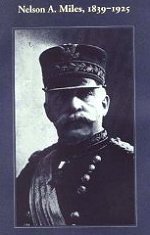 A Hero to His Fighting Men: Nelson A. Miles, 1839-1925 Without the benefit of a college education, Miles attained the rank of major general of volunteers two months after his twenty-sixth birthday. At the close of the Civil War, he was Jefferson Davis's military jailer, then served with the Freedmen's Bureau in North Carolina. |
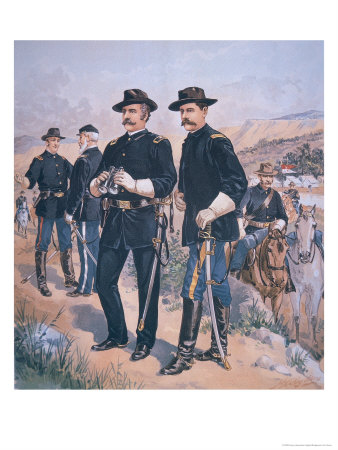
Brigadier-General Nelson A. Miles 18 in. x 24 in. Buy at AllPosters.com Framed Mounted |
Kindle Available Civil War Curiosities: Strange Stories, Oddities, Events, and Coincidences |
 The Battle of the Wilderness May 5-6, 1864 Fought in a tangled forest fringing the south bank of the Rapidan River, the Battle of the Wilderness marked the initial engagement in the climactic months of the Civil War in Virginia, and the first encounter between Ulysses S. Grant and Robert E. Lee |
 The Civil War Day By Day An Almanac, 1861-1865 The most exhaustively detailed and fascinating book on the American Civil War of its kind. Not only does it provide a day-by-day look at the major events of the war, but lists so many of the small skirmishes and actions as well. Accurate and enjoyable |
Kindle Available Civil War Medicine The staggering challenge of treating wounds and disease on both sides of the conflict. Written for general readers and scholars alike, this first-of-its kind encyclopedia will help all Civil War enthusiasts to better understand this amazing medical saga. Clearly organized, authoritative, and readable |
|
 Sabine Pass The Confederacy's Thermopylae Sabine Pass was the site of one of the most decisive Civil War battles |
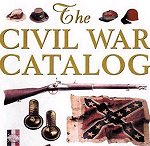 The Civil War Catalog More than 200 illustrations and restored photographs, all the weapons, uniforms, and implements of battle. Packed with color photos of insignia, medals, kits, paper ephemera, rare uniforms, and personal equipment for all enlisted ranks. |
Kindle Available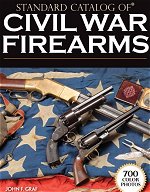 Standard Catalog of Civil War Firearms Over 700 photographs and a rarity scale for each gun, this comprehensive guide to the thousands of weapons used by Billy Yank and Johnny Reb will be indispensable for historians and collectors. |
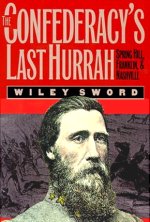 The Confederacy's Last Hurrah: Spring Hill, Franklin, and Nashville John Bell Hood rallied his demoralized troops and marched them off the Tennessee, desperately hoping to draw Sherman after him and forestall the Confederacy's defeat |
Sources:
Library of Congress
West Point
Federal Citizens
| Search AmericanCivilWar.com |
| Enter the keywords you are looking for and the site will be searched and all occurrences of your request will be displayed. You can also enter a date format, April 19,1862 or September 1864. |

 his seriously wounded commander at the battle of Antietam and was promoted to colonel.